

More by J.R.R. Tolkien

Smaug certainly looked fast asleep, when Bilbo peeped once more from the entrance. He was just about to step out onto the floor when he caught a sudden thin ray of red from under the drooping lid of Smaug's left eye. He was only pretending to be sleep! He was watching the tunnel entrance!
Whisked from his comfortable hobbit-hole by Gandalf the wizard and a band of dwarves, Bilbo Baggins finds himself caught up in a plot to raid the treasure hoard of Smaug the Magnificent, a large and very dangerous dragon.

J.R.R. Tolkien's
On Fairy-stories
is his most-studied and most-quoted essay, an exemplary personal statement of his own views on the role of imagination in literature, and an intellectual tour de force vital for understanding Tolkien's achievement in writing
The Lord of the Rings
.
Contained within is an introduction to Tolkien's original 1939 lecture and the history of the writing of On Fairy-stories, with previously unseen material. Here, at last, Flieger and Anderson reveal the extraordinary genesis of this seminal work and discuss how the conclusions that Tolkien reached during the composition of the essay would shape his writing for the rest of his life.
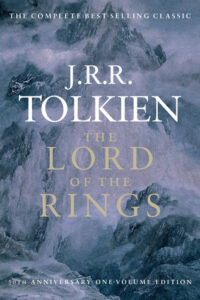
One Ring to rule them all, One Ring to find them, One Ring to bring them all and in the darkness bind them
In ancient times the Rings of Power were crafted by the Elven-smiths, and Sauron, the Dark Lord, forged the One Ring, filling it with his own power so that he could rule all others. But the One Ring was taken from him, and though he sought it throughout Middle-earth, it remained lost to him. After many ages it fell by chance into the hands of the hobbit Bilbo Baggins.
From Sauron's fastness in the Dark Tower of Mordor, his power spread far and wide. Sauron gathered all the Great Rings to him, but always he searched for the One Ring that would complete his dominion.
When Bilbo reached his eleventy-first birthday he disappeared, bequeathing to his young cousin Frodo the Ruling Ring and a perilous quest: to journey across Middle-earth, deep into the shadow of the Dark Lord, and destroy the Ring by casting it into the Cracks of Doom.
The Lord of the Rings tells of the great quest undertaken by Frodo and the Fellowship of the Ring: Gandalf the Wizard; the hobbits Merry, Pippin, and Sam; Gimli the Dwarf; Legolas the Elf; Boromir of Gondor; and a tall, mysterious stranger called Strider.

The Silmarillion is an account of the Elder Days, of the First Age of Tolkien’s world. It is the ancient drama to which the characters in The Lord of the Rings look back, and in whose events some of them such as Elrond and Galadriel took part. The tales of The Silmarillion are set in an age when Morgoth, the first Dark Lord, dwelt in Middle-Earth, and the High Elves made war upon him for the recovery of the Silmarils, the jewels containing the pure light of Valinor.
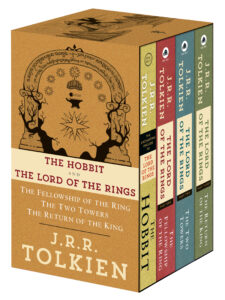
These magical adaptations became instant classics when they were first broadcast on BBC Radio 4, and continue to delight today. Tolkien's epic tale of Middle-earth has all the classic ingredients of fantasy and adventure: dwarves, elves, goblins and trolls, a terrifying dragon, a great wizard, a fearsome evil, a perilous quest and a dramatic climax. With an all-star cast including Ian Holm, Michael Hordern, Robert Stephens, John le Mesurier and Bill Nighy, these enchanting dramatisations are a must for all Tolkien fans. 'For those who find the books too long-winded and the films too noisy, this is the perfect way to assimilate the myth and magic of Middle-earth' - Guardian.
19 CDs. 17 hrs 30 mins.
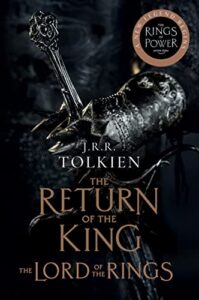
In the third volume of The Lord of the Rings trilogy the good and evil forces join battle, and we see that the triumph of good is not absolute. The Third Age of Middle-earth ends, and the age of the dominion of Men begins.
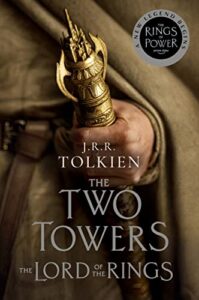
Alternate Cover Edition ISBN 0345296060 (ISBN13: 9780345296061)
One Ring to rule them all, One Ring to find them, One Ring to bring them all and in the darkness bind them
Frodo and his Companions of the Ring have been beset by danger during their quest to prevent the Ruling Ring from falling into the hands of the Dark Lord by destroying it in the Cracks of Doom. They have lost the wizard, Gandalf, in a battle in the Mines of Moria. And Boromir, seduced by the power of the Ring, tried to seize it by force. While Frodo and Sam made their escape, the rest of the company was attacked by Orcs. Now they continue the journey alone down the great River Anduin—alone, that is, save for the mysterious creeping figure that follows wherever they go.
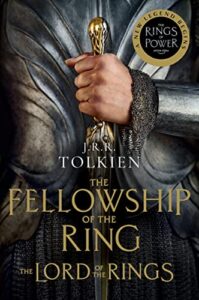
Alternate Cover Edition ISBN 0618260269 (copyright page ISBN is 0618346252 - different from back cover)
One Ring to rule them all, One Ring to find them, One Ring to bring them all and in the darkeness bind them
In ancient times the Rings of Power were crafted by the Elven-smiths, and Sauron, The Dark Lord, forged the One Ring, filling it with his own power so that he could rule all others. But the One Ring was taken from him, and though he sought it throughout Middle-earth, it remained lost to him. After many ages it fell into the hands of Bilbo Baggins, as told in The Hobbit.
In a sleepy village in the Shire, young Frodo Baggins finds himself faced with an immense task, as his elderly cousin Bilbo entrusts the Ring to his care. Frodo must leave his home and make a perilous journey across Middle-earth to the Cracks of Doom, there to destroy the Ring and foil the Dark Lord in his evil purpose.
--back cover
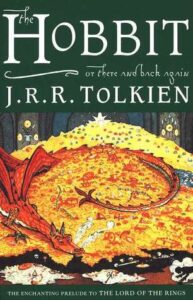
In a hole in the ground there lived a hobbit. Not a nasty, dirty, wet hole, filled with the ends of worms and an oozy smell, nor yet a dry, bare, sandy hole with nothing in it to sit down on or to eat: it was a hobbit-hole, and that means comfort.
Written for J.R.R. Tolkien’s own children, The Hobbit met with instant critical acclaim when it was first published in 1937. Now recognized as a timeless classic, this introduction to the hobbit Bilbo Baggins, the wizard Gandalf, Gollum, and the spectacular world of Middle-earth recounts of the adventures of a reluctant hero, a powerful and dangerous ring, and the cruel dragon Smaug the Magnificent. The text in this 372-page paperback edition is based on that first published in Great Britain by Collins Modern Classics (1998), and includes a note on the text by Douglas A. Anderson (2001).