

More by Orson Scott Card

Orson Scott Card offers a Christmas gift to his millions of fans with A War of Gifts, a short novel set during Ender Wiggin's first years at the Battle School where it is forbidden to celebrate religious holidays. The children come from many nations, many religions; while they are being trained for war, religious conflict between them is not on the curriculum. But Dink Meeker, one of the older students, doesn't see it that way. He thinks that giving gifts isn't exactly a religious observation, and on Sinterklaas Day he tucks a present into another student's shoe.This small act of rebellion sets off a battle royal between the students and the staff, but some surprising alliances form when Ender comes up against a new student, Zeck Morgan. The War over Santa Claus will force everyone to make a choice.
Come here to the magical America that might have been
In this sequel to Seventh Son, Alvin Maker is awakening to many mysteries: his own strange powers, the magic of the land, and the special virtues of its chosen people, the Native Americans.
Alvin has discovered his own unique talent for making things whole again. Now he summons all his powers to prevent a tragic war between Native Americans and the white settlers of North America.

"The Polish Boy" is John Paul Wiggin, the future father of Ender. In the years between the first two Bugger Wars, the Hegemony is desperate to recruit brilliant military commanders to repel the alien invasion. They may have found their man--or boy--in John Paul Wiggin....
In "Teacher's Pest"-a novella written especially for this collection--a brilliant but arrogant John Paul Wiggin, now a university student, matches wits with an equally brilliant graduate student.
"The Investment Counselor" is set after the end of the Bugger Wars. Banished from Earth and slandered as a mass murderer, twenty-year-old Andrew Wiggin wanders incognito from planet to planet as a fugitive--until a blackmailing tax inspector compromises his identity and threatens to expose Ender the Xeoncide.
Also reprinted here is the original award-winning novella, "Ender's Game," which first appeared in 1977.

After twenty-three years, Orson Scott Card returns to his acclaimed best-selling series with the first true, direct sequel to the classic Ender's Game.
In Ender’s Game, the world’s most gifted children were taken from their families and sent to an elite training school. At Battle School, they learned combat, strategy, and secret intelligence to fight a dangerous war on behalf of those left on Earth. But they also learned some important and less definable lessons about life.
After the life-changing events of those years, these children—now teenagers—must leave the school and readapt to life in the outside world.
Having not seen their families or interacted with other people for years—where do they go now? What can they do?
Ender fought for humanity, but he is now reviled as a ruthless assassin. No longer allowed to live on Earth, he enters into exile. With his sister Valentine, he chooses to leave the only home he’s ever known to begin a relativistic—and revelatory—journey beyond the stars.
What happened during the years between Ender’s Game and Speaker for the Dead? What did Ender go through from the ages of 12 through 35? The story of those years has never been told. Taking place 3000 years before Ender finally receives his chance at redemption in Speaker for the Dead, this is the long-lost story of Ender.
For twenty-three years, millions of readers have wondered and now they will receive the answers. Ender in Exile is Orson Scott Card’s moving return to all the action and the adventure, the profound exploration of war and society, and the characters one never forgot.
On one of these ships, there is a baby that just may share the same special gifts as Ender’s old friend Bean…
High above the planet Harmony. the Oversoul watches Its task. programmed so many millennia ago. is to guard the human settlement on this planet-. -to protect this fragile remnant of Earth from all threats. To protect them. most of all. from themselves. The Oversoul has done its job well. There is no war on Harmony. There are no weapons of mass destruction. There is no technology that could lead to weapons of war. By control of the data banks. and subtle interference in the very thoughts of the people. the artificial intelligence has fulfilled its mission. But now there is a problem. In orbit. the Oversoul realizes that it has lost access to some of its memory banks. and some of its power systems are failing. And on the planet. men are beginning to think about power. wealth. and conquest.
In an alternate version of frontier America, young Alvin is the seventh son of a seventh son, and such a birth is powerful magic. Yet even in the loving safety of his home, dark forces reach out to destroy him.
A powerful secret. A dangerous path.
Rigg is well trained at keeping secrets. Only his father knows the truth about Rigg's strange talent for seeing the paths of people's pasts. But when his father dies, Rigg is stunned to learn just how many secrets Father had kept from him--secrets about Rigg's own past, his identity, and his destiny. And when Rigg discovers that he has the power not only to see the past, but also to change it, his future suddenly becomes anything but certain.
Rigg’s birthright sets him on a path that leaves him caught between two factions, one that wants him crowned and one that wants him dead. He will be forced to question everything he thinks he knows, choose who to trust, and push the limits of his talent…or forfeit control of his destiny.
Gathering every story about Jason Worthing, this volume includes "The Worthing Chronicle," as well as all of the other stories set on Capitol and later on Jason's colonized planet.
It was a miracle of science that permitted human beings to live, if not forever, then for a long, long time. Some people, anyway. The rich, the powerful--they lived their lives at the rate of one year every ten. Somec created two societies: that of people who lived out their normal span and died, and those who slept away the decades, skipping over the intervening years and events. It allowed great plans to be put in motion. It allowed interstellar Empires to be built.
It came near to destroying humanity.
After a long, long time of decadence and stagnation, a few seed ships were sent out to save our species. They carried human embryos and supplies, and teaching robots, and one man. The Worthing Saga is the story of one of these men, Jason Worthing, and the world he found for the seed he carried.
Orson Scott Card is "a master of the art of storytelling" (Booklist), and The Worthing Saga is a story that only he could have written.

Children of the Mind (1996) is the fourth novel of Orson Scott Card's popular Ender's Game series of science fiction novels that focus on the character Ender Wiggin. This book was originally the second half of Xenocide, before it was split into two novels.
At the start of Children of the Mind, Jane, the evolved computer intelligence, is using her newly discovered abilities to take the races of buggers, humans and pequeninos outside the universe and back instantaneously. She uses these powers to move them to distant habitable planets for colonization. She is losing her memory and concentration as the vast computer network connected to the ansible is being shut down. If she is to survive, she must find a way to transfer her aiúa (or soul) to a human body.
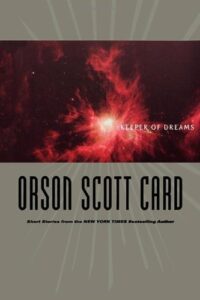
This huge collection of short stories by one of science fiction's most beloved and popular writers is sure to please his millions of fans. Keeper of Dreams contains 22 stories written since 1990.
From the opening science fiction tale, "The Elephants of Poznan," we see the hand of a master at work making a familiar idea new, strange, and wonderful. "Angles" takes a sideways look at alternate universes. "Geriatric Ward" is published here for the first time; it was originally written for the legendary Last Dangerous Visions.
Keeper of Dreams contains science fiction, fantasy, and several of Card's mainstream fiction works. Included are two tales from the Alvin Maker universe, "Grinning Man" and "The Yazoo Queen."
In addition to the stories, this book features new introductions by Orson Scott Card for each story, with commentary on his life and work. With the earlier Maps in a Mirror, this collection is a definitive retrospective of the short fiction career of the writer that the Houston Post called "the best writer science fiction has to offer."
• Preface (Keeper of Dreams) • essay by Orson Scott Card
• The Elephants of Poznan • (2000)
• Atlantis • (1992)
• Geriatric Ward
• Heal Thyself • (1999)
• Space Boy • juvenile • (2006)
• Angles • (2002)
• Vessel • (1999)
• Dust • (2002)
• Homeless in Hell • (2002)
• In the Dragon's House • (2003)
• Inventing Lovers on the Phone • (2003)
• Waterbaby • (2000)
• Keeper of Lost Dreams • (2004)
• Missed
• 50 WPM • (2002)
• Feed the Baby of Love • (1991)
• Grinning Man • [The Alvin Maker Saga] • (1998)
• The Yazoo Queen • [The Alvin Maker Saga] • (2003)
• Notes on the Mormon Stories • essay by Orson Scott Card
• Christmas at Helaman's House
• Neighbors
• God Plays Fair Once Too Often
• Worthy to Be One of Us

Maps in a Mirror brings together nearly all of Orson Scott Card's short fiction written between 1977 and 1990. For those readers who have followed this remarkable talent since the beginning, here are all those amazing stories gathered together in one place, with some extra surprises as well. For the many who are newly come to Card, here is chance to experience the wonder of a writer so versatile that he can handle everything from traditional narrative poetry to modern experimental fiction with equal ease and grace. The brilliant story-telling of the Alvin Maker books is no accident; the breathless excitement evoked by the Ender books is not a once-in-a-lifetime experience. In this enormous volume are forty-six stories, plus ten long, intensely personal essays, unique to this volume. In them the author reveals some of his reasons and motivations for writing, with a good deal of autobiography into the bargain.
Contents:
Introduction (Book 1: The Hanged Man, Tales of Dread) • essay by Orson Scott Card
Eumenides in the Fourth Floor Lavatory (1979) / novelette by Orson Scott Card
Quietus (1979) / short story by Orson Scott Card
Deep Breathing Exercises (1979) / short story by Orson Scott Card
Fat Farm (1980) / short story by Orson Scott Card
Closing the Timelid (1979) / short story by Orson Scott Card
Freeway Games (1979) / short story by Orson Scott Card
A Sepulchre of Songs (1981) / novelette by Orson Scott Card
Prior Restraint (1986) / short story by Orson Scott Card
The Changed Man and the King of Words (1982) / novelette by Orson Scott Card
Memories of My Head (1990) / short story by Orson Scott Card
Lost Boys (1989) / short story by Orson Scott Card
Afterword (Book 1: The Hanged Man, Tales of Dread) • essay by Orson Scott Card
Introduction (Book 2: Flux, Tales of Human Futures) • essay by Orson Scott Card
A Thousand Deaths [Tales of Capitol] (1978) / novelette by Orson Scott Card
Clap Hands and Sing (1982) / short story by Orson Scott Card
Dogwalker (1989) / novelette by Orson Scott Card
But We Try Not to Act Like It (1979) / short story by Orson Scott Card
I Put My Blue Genes On (1978) / short story by Orson Scott Card
In the Doghouse (1978) / short story by Orson Scott Card and Jay A. Parry
The Originist [Foundation] (1989) / novella by Orson Scott Card
Afterword (Book 2: Flux, Tales of Human Futures) • essay by Orson Scott Card
Introduction (Book 3: Maps in a Mirror, Fables and Fantasies) • essay by Orson Scott Card
Unaccompanied Sonata (1979) / short story by Orson Scott Card
A Cross-Country Trip to Kill Richard Nixon (1980) / novelette by Orson Scott Card
The Porcelain Salamander (1981) • short story by Orson Scott Card
Middle Woman (1981) / short story by Orson Scott Card
The Bully and the Beast (1979) / novella by Orson Scott Card
The Princess and the Bear (1980) / novelette by Orson Scott Card
Sandmagic [Mither Mages] (1979) / novelette by Orson Scott Card
The Best Day (1984) / short story by Orson Scott Card
A Plague of Butterflies (1981) / short story by Orson Scott Card
The Monkeys Thought 'Twas All in Fun (1979) / novelette by Orson Scott Card
Afterword (Book 3: Maps in a Mirror, Fables and Fantasies) • essay by Orson Scott Card
Introduction (Book 4: Cruel Miracles, Tales of Death, Hope, and Holiness) • essay by Orson Scott Card
Mortal Gods (1979) / short story by Orson Scott Card
Saving Grace (1987) / short story by Orson Scott Card
Eye for Eye (1987) / novella by Orson Scott Card
St. Amy's Tale (1980) / novelette by Orson Scott Card
Kingsmeat (1978) / short story by Orson Scott Card
Holy (1980) / novelette by Orson Scott Card
Afterword (Book 4: Cruel Miracles, Tales of Death, Hope, and Holiness) • essay by Orson Scott Card
Introduction (Book 5: Lost Songs, The Hidden Stories) • essay by Orson Scott Card
Ender's Game [Ender Wiggin] (1977) / novelette by Orson Scott Card
Mikal's Songbird (1978) / novelette by Orson Scott Card
Prentice Alvin and the No-Good Plow [The Alvin Maker Saga] (1989) • poem by Orson Scott Card
Malpractice (1977) / short story by Orson Scott Card
Follower (1978) / short story by Orson Scott Card
Hitching (1978) / short story by Orson Scott Card
Damn Fine Novel (1989) / short story by Orson Scott Card
Billy's Box (1978) / short story by Orson Scott Card
The Best Family Home Evening Ever (1978) / short story by Orson Scott Card
Bicicleta (1977) / short story by Orson Scott Card
I Think Mom and Dad Are Going Crazy, Jerry (1979) / short story by Orson Scott Card
Gert Fram (1977) / short story by Orson Scott Card
Afterword (Book 5: Lost Songs, The Hidden Stories) • essay by Orson Scott Card
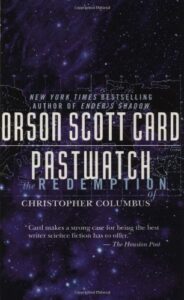
In one of the most powerful and thought-provoking novels of his remarkable career, Orson Scott Card's Pastwatch interweaves a compelling portrait of Christopher Columbus with the story of a future scientist who believes she can alter human history from a tragedy of bloodshed and brutality to a world filled with hope and healing.