


More by Philip K. Dick
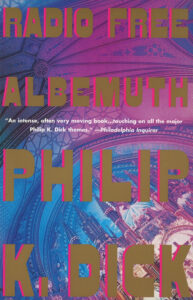
In the late 1960s a paranoid incompetent has schemed his way into the White House and convulsed America in a vicious war against imaginary internal enemies. A struggling science Fiction writer named Philip K. Dick is trying to keep from becoming one of that war's casualties. And Dick's best friend, a record executive named Nicholas Brady, is receiving transmissions from an extraterrestrial entity that may also happen to be God — an entity that apparently wants him to overthrow the President.
In this, his last novel, Philip K. Dick morphed and recombined themes that had informed his fiction from A Scanner Darkly to VALIS and produced a wild, impassioned work that reads like a visionary alternate history of the United States. Agonizingly suspenseful, darkly hilarious, and filled with enough conspiracy theories to thrill the most hardened paranoid, Radio Free Albemuth is proof of Dick's stature as our century's greatest prankster-prophet.

Philip K. Dick was a master of science fiction, but he was also a writer whose work transcended genre to examine the nature of reality and what it means to be human. A writer of great complexity and subtle humor, his work belongs on the shelf of great twentieth-century literature, next to Kafka and Vonnegut. Collected here are twenty-one of Dick's most dazzling and resonant stories, which span his entire career and show a world-class writer working at the peak of his powers.
In "The Days of Perky Pat," people spend their time playing with dolls who manage to live an idyllic life no longer available to the Earth's real inhabitants. "Adjustment Team" looks at the fate of a man who by mistake has stepped out of his own time. In "Autofac," one community must battle benign machines to take back control of their lives. And in "I Hope I Shall Arrive Soon," we follow the story of one man whose very reality may be nothing more than a nightmare. The collection also includes such classic stories as "The Minority Report," the basis for the Steven Spielberg movie, and "We Can Remember It for You Wholesale," the basis for the film Total Recall. Selected Stories of Philip K. Dick is a magnificent distillation of one of American literature's most searching imaginations.
» Introduction by Jonathan Lethem
1. Beyond Lies the Wub (wikipedia)
2. Roog (wikipedia)
3. Paycheck (wikipedia, imdb)
4. Second Variety (wikipedia, imdb)
5. Imposter (wikipedia)
6. The King of the Elves (wikipedia, imdb)
7. Adjustment Team (wikipedia, imdb)
8. Foster, You're Dead! (wikipedia)
9. Upon the Dull Earth (wikipedia)
10. Autofac (wikipedia)
11. The Minority Report (wikipedia, imdb)
12. The Days of Perky Pat (wikipedia)
13. Precious Artifact
14. A Game of Unchance
15. We Can Remember It for You Wholesale (wikipedia, imdb)
16. Faith of Our Fathers (wikipedia)
17. The Electric Ant (wikipedia)
18. A Little Something for Us Tempunauts (wikipedia)
19. The Exit Door Leads In (wikipedia)
20. Rautavaara's Case (wikipedia)
21. I Hope I Shall Arrive Soon (wikipedia)
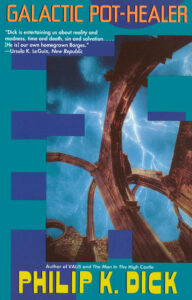
The Glimmung wants Joe Fernwright. Fernwright is a pot-healer — a repairer of ceramics — in a drably utilitarian future where such skills have little value. And the Glimmung? The Glimmung is a being that looks something like a gyroscope, something like a teenaged girl, and something like the contents of an ocean. What's more, it may be divine. And, like certain gods of old Earth, it has a bad temper.
What could an omnipresent and seemingly omnipotent entity want with a humble pot-healer? Or with the dozens of other odd creatures it has lured to Plowman's Planet? And if the Glimmung is a god, are its ends positive or malign? Combining quixotic adventure, spine-chilling horror, and deliriously paranoid theology, Galactic Pot-Healer is a uniquely Dickian voyage to alternate worlds of the imagination.
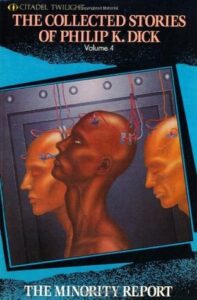
Many thousands of readers consider Philip K. Dick the greatest science fiction mind on any planet. Since his untimely death in 1982, interest in Dick's works has continued to mount and his reputation has been further enhanced by a growing body of critical attention. The Philip K. Dick Award is now given annually to a distinguished work of science fiction, and the Philip K. Dick Society is devoted to the study and promulgation of his works.
This collection includes all of the writer's earliest short and medium-length fiction (including some previously unpublished stories) covering the years 1954-1964.
"A useful acquisition for any serious SF library or collection" -- Kirkus
"The collected stories of Philip K. Dick is awe inspiring". -- The Washington Post
"More than anyone else in the field, Mr. Dick really puts you inside people's minds". -- Wall Street Journal
Volume 4/5. Includes stories from 1954-1964:
- Autofac (1955)
- Service Call (1955)
- Captive Market (1955)
- The Mold of Yancy (1955)
- The Minority Report (1956)
- Recall Mechanism (1959)
- The Unreconstructed M (1957)
- Explorers We (1959)
- War Game (1959)
- If There Were No Benny Cemoli (1963)
- Novelty Act (1964)
- Waterspider (1964)
- What the Dead Men Say (1964)
- Orpheus with Clay Feet (1987)
- The Days of Perky Pat (1963)
- Stand-By (1963)
- What'll We Do with Ragland Park? (1963)
- Oh, to Be a Blobel! (1964)
Other editions of this volume have the same stories, and were published under these titles:
- The Days of Perky Pat,
- The Minority Report,
- The Minority Report and Other Classic Stories.
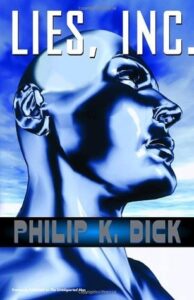
A masterwork by Philip K. Dick, this is the final, expanded version of the novella The Unteleported Man, which Dick worked on shortly before his death. In Lies, Inc., fans of the science fiction legend will immediately recognize his hallmark themes of life in a security state, conspiracy, and the blurring of reality and illusion. This publication marks its first complete appearance in the United States.
In this wry, paranoid vision of the future, overpopulation has turned cities into cramed industrial anthills. For those sick of this dystopian reality, one corporation, Trails of Hoffman, Inc., promises an alternative: Take a teleport to Whale's Mouth, a colonized planet billed as the supreme paradise. The only catch is that you can never comeback. When a neurotic man named Rachmael ben Applebaum discovers that the promotional films of happy crowds cheering their newfound existence on Whale's Mouth are faked, he decides to pilot a scapeship on the eighteen-year journey there to see if anyone wants to return.
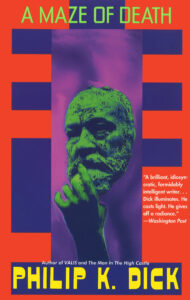
Fourteen strangers come to Delmak-O. Thirteen of them were transferred by the usual authorities. One got there by praying. But once they arrived on that treacherous planet, whose very atmosphere seemed to induce paranoia and psychosis, the newcomers tound that even prayer was useless. For on Delmak-O, God is either absent or intent on destroying His creations. At once a wrenching metaphysical thriller and an ingenious meditation on the nature of divinity, A Maze of Death is Philip K. Dick at his most dizzyingly provocative.
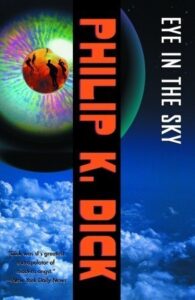
While sightseeing at the Belmont Bevatron, Jack Hamilton, along with seven others, is caught in a lab accident. When he regains consciousness, he is in a fantasy world of Old Testament morality gone awry—a place of instant plagues, immediate damnations, and death to all perceived infidels. Hamilton figures out how he and his compatriots can escape this world and return to their own, but first they must pass through three other vividly fantastical worlds, each more perilous and hilarious than the one before.
Winner of both the Hugo and John W. Campbell awards for best novel, widely regarded as the premiere science fiction writer of his day, and the object of cult-like adoration from his legions of fans, Philip K. Dick has come to be seen in a literary light that defies classification in much the same way as Borges and Calvino. With breathtaking insight, he utilizes vividly unfamiliar worlds to evoke the hauntingly and hilariously familiar in our society and ourselves.
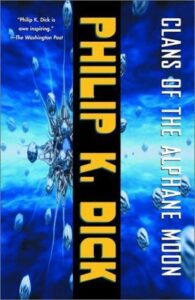
When CIA agent Chuck Rittersdorf and his psychiatrist wife, Mary, file for divorce, they have no idea that in a few weeks they will be shooting it out on Alpha III M2, the distant moon ruled by various psychotics liberated from a mental ward. Nor do they suspect that Chuck's new employer, the famous TV comedian Bunny Hentman, will also be there aiming his own laser gun. How things came to such a darkly hilarious pass is the subject of Clans of the Alphane Moon, an astutely shrewd and acerbic tale that blurs all conventional distinctions between sanity and madness.
"Shell Game" was originally published in 1954 for the first time. Later it was expanded into the "Clans of the Alphane Moon." (1964)

Volume 1/5. Includes stories from 1952-1955:
- Stability
- Roog
- The Little Movement
- Beyond Lies the Wub
- The Gun
- The Skull
- The Defenders
- Mr. Spaceship
- Piper in the Woods
- The Infinites
- The Preserving Machine
- Expendable
- The Variable Man
- The Indefatigable Frog
- The Crystal Crypt
- The Short Happy Life of the Brown Oxford
- The Builder
- Meddler
- Paycheck
- The Great C
- Out in the Garden
- The King of the Elves
- Colony
- Prize Ship
- Nanny
Other editions of this volume have the same list of stories, and were published under these titles:
- The Short Happy Life of the Brown Oxford,
- Paycheck and Other Classic Stories,
- The King of the Elves (+1 extra story).
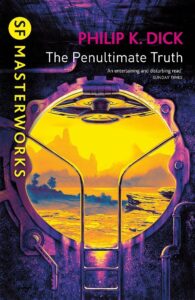
World War III is raging - or so the millions of people crammed in their underground tanks believe. For fifteen years, subterranean humanity has been fed on daily broadcasts of a never-ending nuclear destruction, sustained by a belief in the all powerful Protector. But up on Earth's surface, a different kind of reality reigns. East and West are at peace. Across the planet, an elite corps of expert hoaxers preserve the lie.
Cover Illustration: Chris Moore

Ragle Gumm is an ordinary man leading an ordinary life, except that he makes his living by entering a newspaper contest every day - and winning, every day.
But he gradually begins to suspect that his life - indeed his whole world - is an illusion, constructed around him for the express purpose of keeping him docile and happy. But if that is the case, what is his real world like, and what is he actually doing every day when he thinks he is guessing 'Where Will The Little Green Man Be Next?'

In the world of The Minority Report, Commissioner John Anderton is the one to thank for the lack of crime. He is the originator of the Precrime System, which uses precogs—people with the power to see into the future—to identify criminals before they can do any harm. Unfortunately for Anderton, his precogs perceive him as the next criminal.