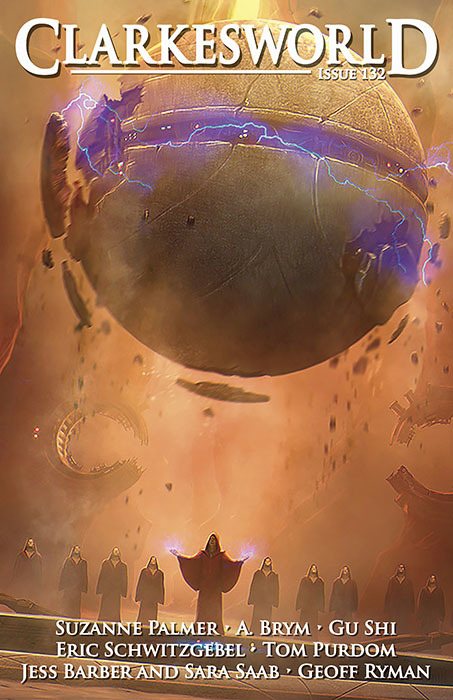
FICTION “Antarctic Birds” by A. Brym “Little /^^^&-” by Eric Schwitzgebel “The Secret Life of Bots” by Suzanne Palmer “Pan-Humanism: Hope and Pragmatics” by Jess Barber and Sara Saab “Möbius Continuum” by Gu Shi, translated by S. Qiouyi Lu “Bonding with Morry” by Tom Purdom “Warmth” by Geoff Ryman
NON-FICTION “Artificial Wombs and Control of Reproductive Technology” by Stephanie M. Bucklin “Occult Agencies and Political Satire: A Conversation with Charles Stross” by Chris Urie “Another Word: The Dream of Writing Full Time” by Kelly Robson “Editor’s Desk: Home for the Month” by Neil Clarke
FICTION Little Animals by Nancy Kress Poubelle by Robert Reed Bots of the Lost Ark by Suzanne Palmer Face Changing by Jiang Bo, translated by Andy Dudak The Shroud for the Mourners by Yukimi Ogawa Our Fate, Told in Photons by K.W. Colyard Embracing the Movement by Cristina Jurado, translated by Sue Burke
NON-FICTION Fungi in Fiction by Carrie Sessarego Undoing Good Women: A Conversation with Cassandra Khaw by Arley Sorg A Wider Range of Freedom: A Conversation with Alyssa Winans by Arley Sorg Editor's Desk: What Do You Want? by Neil Clarke
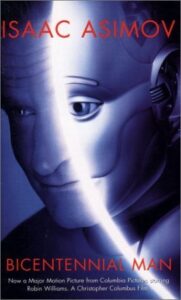
Andrew was one of Earth's first house robot domestic servants—smoothly designed and functional. But when Andrew started to develop special talents which exceeded the confines of his allotted positronic pathways, he abandoned his domestic duties in favour of more intellectual pursuits. As time passed, Andrew acquired knowledge, feelings and ambitions way beyond anything ever experienced by any other mechanical men. And he found himself launched on to a career which would bring him fame fortune — and danger. For a robot who wants to be human must also be prepared to die...
In the Bicentennial Man, Isaac Asimov returns to his first and most enduring love — robotics. The result is a brilliant book of first-class entertainment and mind-spinning ideas which confirm Asimov's supreme status as Grand Master of science fiction.
Content
"Feminine Intuition" (1969) "Waterclap" (1970) "That Thou Art Mindful of Him" (1974) "Stranger in Paradise" (1974) "The Life and Times of Multivac" (1975) "The Winnowing" (1976) "The Bicentennial Man" (1976) "Marching In" (1976) "Old-Fashioned" (1976) "The Tercentenary Incident" (1976) "Birth of a Notion" (1976)
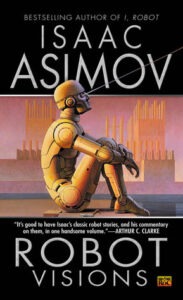
From Isaac Asimov, the Hugo Award-winning Grand Master of Science Fiction whose name is synonymous with the science of robotics, comes five decades of robot visions: thirty-four landmark stories and essays—including three rare tales—gathered together in one volume.
Meet all of Asimov’s most famous creations including: Robbie, the very first robot that his imagination brought to life; Susan Calvin, the original robot psychologist; Stephen Byerley, the humanoid robot; and the famous human/robot detective team of Lije Bailey and R. Daneel Olivaw, who have appeared in such bestselling novels as The Robots of Dawn and Robots and Empire.
Let the master himself guide you through the key moments in the fictional history of robot-human relations—from the most primitive computers and mobile machines to the first robot to become a man. (back cover)
Contents:
Robot Visions • cover and interior artwork by Ralph McQuarrie Introduction: The Robot Chronicles • essay by Isaac Asimov Robot Visions / short story by Isaac Asimov Too Bad! (1989) / short story by Isaac Asimov Robbie (1940) / short story by Isaac Asimov (variant of Strange Playfellow) Reason [Mike Donovan] (1941) / short story by Isaac Asimov Liar! [Susan Calvin] (1941) / short story by Isaac Asimov Runaround [Mike Donovan] (1942) / novelette by Isaac Asimov Evidence [Susan Calvin] (1946) / novelette by Isaac Asimov Little Lost Robot [Susan Calvin] (1947) / novelette by Isaac Asimov The Evitable Conflict [Susan Calvin] (1950) / novelette by Isaac Asimov Feminine Intuition [Susan Calvin] (1969) / novelette by Isaac Asimov The Bicentennial Man (1976) / novelette by Isaac Asimov Someday (1956) / short story by Isaac Asimov Think! (1977) / short story by Isaac Asimov Segregationist (1967) / short story by Isaac Asimov Mirror Image [Elijah Bailey/R. Daneel Olivaw] (1972) / short story by Isaac Asimov Lenny [Susan Calvin] (1958) / short story by Isaac Asimov Galley Slave [Susan Calvin] (1957) / novelette by Isaac Asimov Christmas Without Rodney (1988) / short story by Isaac Asimov Essays by Isaac Asimov: Robots I Have Known (1954); The New Teachers (1976); Whatever You Wish (1977); The Friends We Make (1977); Our Intelligent Tools (1977); The Laws of Robotics (1979); Future Fantastic (1989); The Machine and the Robot (1978); The New Profession (1979); The Robot As Enemy? (1979); Intelligences Together (1979); My Robots (1987); The Laws of Humanics (1987); Cybernetic Organism (1987); The Sense of Humor (1988); Robots in Combination (1988).
The volume features many black-and-white illustrations by Ralph McQuarrie.
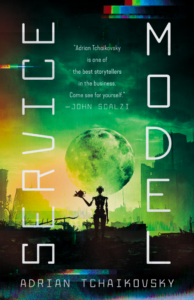
To fix the world they first must break it further.
Humanity is a dying breed, utterly reliant on artificial labor and service. When a domesticated robot gets a nasty little idea downloaded into their core programming, they murder their owner. The robot then discovers they can also do something else they never did before: run away. After fleeing the household, they enter a wider world they never knew existed, where the age-old hierarchy of humans at the top is disintegrating, and a robot ecosystem devoted to human wellbeing is finding a new purpose.
Playing by the book? That’s not how we do it! In his attempt to delay his appearance in Emperor’s court, Crown Prince Georg triggers an alien invasion of his own star system. The whole of the Empire watches the live broadcast with bated breath as his fleet battles the awesome invaders. The Iseyeks - gigantic sentient praying mantises - are suitably impressed too, so they promptly remind the Crown Prince of his allied duties. The Sector Eight Fleet hurries to the Swarm’s aid… but sadly disregards the insects’ hive mentality.
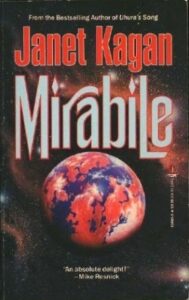
On the distant planet of Mirabile, a settlement of human colonists from Earth is jeopardized by genetic mutants of Earth plants and animals, and it is up to ecological troubleshooter Mama Jason to destroy the menacing mutants. Reprint.
Contents: The Loch Moose Monster (1989) The Return of the Kangaroo Rex (1989) The Flowering Inferno (1990) Getting the Bugs Out (1990) Raising Cane (1991) Frankenswine (1991)
Zander und seine Freunde stellen sich furchtlos der Gefahr, denn ein sicherer Respawn-Punkt verheißt Hoffnung. Nichts und niemand kann ihnen schaden oder sie vernichten. Schließlich ist alles nur ein Spiel – oder?
Ein Spiel, bei dem sich die Protagonisten in einem uralten Hyperraumnetz bewegen und auf die unterschiedlichsten außerirdischen Zivilisationen treffen. Ein Spiel, wie es realistischer nicht sein könnte. Die Erde ist menschenleer. Das Schicksal der Menschheit ist unbekannt.
Unsere Helden sitzen im Darg-Sternensystem fest. Jetzt geht es ums Überleben. Sie müssen den Phantom-Server finden, das Zentrum des interstellaren Netzes, das die uralte Zivilisation der Gründer geschaffen hat. Wenn sie leben wollen, müssen sie das Geheimnis entschlüsseln – oder dabei sterben.
Murderbot—the sardonic, almost-homicidal, media-loving android created by Martha Wells—has proven to be one of the most popular characters in 21 st century science fiction. Everything that makes this protagonist (it would be wrong to call Murderbot a hero) beloved of fans is on display in Compulsory.
While trying to watch episode 44 of The Rise and Fall of Sanctuary Moon, Murderbot is—again, what is it with humans?—distracted by something that is technically outside its purview. A miner is suddenly in danger following a pointless (to Murderbot’s way of thinking) argument, and the choice is to risk discovery and leap into action, which would require hitting the pause button during a very exciting part of SanctuaryMoon, or to follow orders and stay still.
This is a tougher choice than it seems. But then, when has Murderbot ever been faced with an easy choice?
A shorter version of this story originally appeared in Wired magazine.
Welcome Back!
Track your reading progress and sync your library.