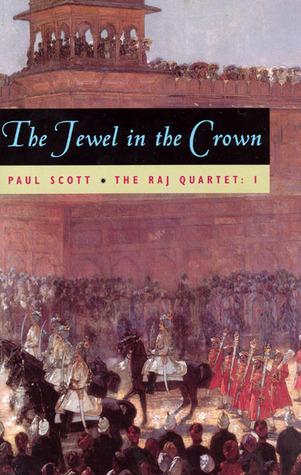
No set of novels so richly recreates the last days of India under British rule–“two nations locked in an imperial embrace”–as Paul Scott’s historical tour de force, “The Raj Quartet.” The Jewel in the Crown opens in 1942 as the British fear both Japanese invasion and Indian demands for independence.
Vikram Seth's novel is, at its core, a love story: Lata and her mother, Mrs. Rupa Mehra, are both trying to find—through love or through exacting maternal appraisal—a suitable boy for Lata to marry. Set in the early 1950s, in an India newly independent and struggling through a time of crisis, A Suitable Boy takes us into the richly imagined world of four large extended families and spins a compulsively readable tale of their lives and loves. A sweeping panoramic portrait of a complex, multiethnic society in flux, A Suitable Boy remains the story of ordinary people caught up in a web of love and ambition, humor and sadness, prejudice and reconciliation, the most delicate social etiquette and the most appalling violence.
A magnificent romantic/historical/adventure novel set in India at the time of mutiny. The Far Pavilions is a story of 19th Century India, when the thin patina of English rule held down dangerously turbulent undercurrents. It is a story about and English man - Ashton Pelham-Martyn - brought up as a Hindu and his passionate, but dangerous love for an Indian princess. It's a story of divided loyalties, of tender camaraderie, of greedy imperialism and of the clash between east and west. To the burning plains and snow-capped mountains of this great, humming continent, M.M. Kaye brings her quite exceptional gift of immediacy and meticulous historical accuracy, plus her insight into the human heart.
Howards End is considered by many to be E. M. Forster’s masterpiece. First published in 1910, this beguiling and completely captivating tale explores social conventions, codes of conduct, and relationships in turn-of-the-century Edwardian England. The story revolves around three families: the Wilcoxes, rich capitalists with a fortune made in the colonies; the half-German Schlegel siblings, whose cultural pursuits have much in common with the Bloomsbury Group—a loose collective of friends and relatives who were united by an abiding belief in the importance of the arts; and the Basts, an impoverished young couple from a lower-class background. A chance encounter, impetuous youth, love, and ambition play into the inheritance of Howards End, the Wilcox’s charming country home.
Howards End was adapted as a film in 1992 by the Merchant-Ivory team, starring Vanessa Redgrave, Emma Thompson, Anthony Hopkins, and Helena Bonham-Carter.
Set after the Second Afghan War which ended in 1881, but before the Third fought in 1919, probably in the period 1893 to 1898. The novel is notable for its detailed portrait of the people, culture, and varied religions of India. The book presents a vivid picture of India, its teeming populations, religions, and superstitions, and the life of the bazaars and the road.
Two men - a boy who grows into early manhood and an old ascetic priest, the lama - are at the center of the novel. A quest faces them both. Born in India, Kim is nevertheless white, a sahib. While he wants to play the Great Game of Imperialism, he is also spiritually bound to the lama. His aim, as he moves chameleon-like through the two cultures, is to reconcile these opposing strands, while the lama searches for redemption from the Wheel of Life.
A celebration of their friendship in a beautiful but often hostile environment, 'Kim' captures the opulence of India's exotic landscape, overlaid by the uneasy presence of the British Raj.
An alternative cover edition for this ISBN can be found here.
Saleem Sinai is born at the stroke of midnight on August 15, 1947, the very moment of India’s independence. Greeted by fireworks displays, cheering crowds, and Prime Minister Nehru himself, Saleem grows up to learn the ominous consequences of this coincidence. His every act is mirrored and magnified in events that sway the course of national affairs; his health and well-being are inextricably bound to those of his nation; his life is inseparable, at times indistinguishable, from the history of his country. Perhaps most remarkable are the telepathic powers linking him with India’s 1,000 other “midnight’s children,” all born in that initial hour and endowed with magical gifts.
This novel is at once a fascinating family saga and an astonishing evocation of a vast land and its people–a brilliant incarnation of the universal human comedy. Twenty-five years after its publication, Midnight’ s Children stands apart as both an epochal work of fiction and a brilliant performance by one of the great literary voices of our time.
"A Tale of Passion," as its subtitle declares, The Good Soldier relates the complex social and sexual relationships between two couples, one English, one American, and the growing awareness by the American narrator John Dowell of the intrigues and passions behind their orderly Edwardian facade. It is the attitude of Dowell, his puzzlement, his uncertainty, and the seemingly haphazard manner of his narration that make the book so powerful and mysterious. Despite its catalogue of death, insanity, and despair, the novel has many comic moments, and has inspired the work of several distinguished writers, including Graham Greene. This is the only annotated edition available.
When Adela Quested and her elderly companion Mrs Moore arrive in the Indian town of Chandrapore, they quickly feel trapped by its insular and prejudiced 'Anglo-Indian' community. Determined to escape the parochial English enclave and explore the 'real India', they seek the guidance of the charming and mercurial Dr Aziz, a cultivated Indian Muslim. But a mysterious incident occurs while they are exploring the Marabar caves with Aziz, and the well-respected doctor soon finds himself at the centre of a scandal that rouses violent passions among both the British and their Indian subjects. A masterful portrait of a society in the grip of imperialism, A Passage to India compellingly depicts the fate of individuals caught between the great political and cultural conflicts of the modern world.
In his introduction, Pankaj Mishra outlines Forster's complex engagement with Indian society and culture. This edition reproduces the Abinger text and notes, and also includes four of Forster's essays on India, a chronology and further reading.
A gripping tale of capitalist exploitation and rebellion, set amid the mist-shrouded mountains of a fictional South American republic, employs flashbacks and glimpses of the future to depict the lure of silver and its effects on men. Conrad's deeply moral consciousness and masterful narrative technique are at their best in this, one of his finest works.
Welcome Back!
Track your reading progress and sync your library.