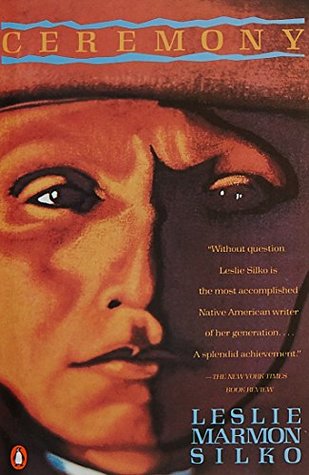
Tayo, a young Native American, has been a prisoner of the Japanese during World War II, and the horrors of captivity have almost eroded his will to survive. His return to the Laguna Pueblo reservation only increases his feeling of estrangement and alienation. While other returning soldiers find easy refuge in alcohol and senseless violence, Tayo searches for another kind of comfort and resolution. Tayo’s quest leads him back to the Indian past and its traditions, to beliefs about witchcraft and evil, and to the ancient stories of his people. The search itself becomes a ritual, a curative ceremony that defeats the most virulent of afflictions—despair.
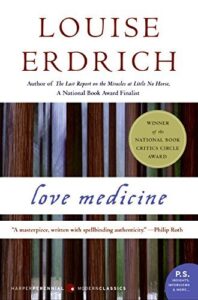
The first book in Louise Erdrich's highly acclaimed "Native American" trilogy that includes "The Beet Queen," "Tracks," and "The Bingo Palace," re-sequenced and expanded to include never-before-published chapters.
Set on and around a North Dakota Ojibwe reservation, Love Medicine is the epic story about the intertwined fates of two families: the Kashpaws and the Lamartines.
With astonishing virtuosity, each chapter draws on a range of voices to limn its tales. Black humor mingles with magic, injustice bleeds into betrayal, and through it all, bonds of love and family marry the elements into a tightly woven whole that pulses with the drama of life.
Filled with humor, magic, injustice and betrayal, Erdrich blends family love and loyalty in a stunning work of dramatic fiction.
Librarian's note: An alternate cover edition can be found here
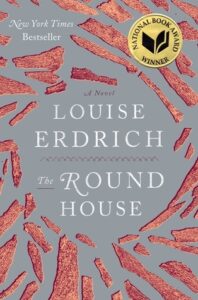
One of the most revered novelists of our time - a brilliant chronicler of Native-American life - Louise Erdrich returns to the territory of her bestselling, Pulitzer Prize finalist The Plague of Doves with The Round House, transporting readers to the Ojibwe reservation in North Dakota. It is an exquisitely told story of a boy on the cusp of manhood who seeks justice and understanding in the wake of a terrible crime that upends and forever transforms his family.
Riveting and suspenseful, arguably the most accessible novel to date from the creator of Love Medicine, The Beet Queen, and The Bingo Palace, Erdrich’s The Round House is a page-turning masterpiece of literary fiction - at once a powerful coming-of-age story, a mystery, and a tender, moving novel of family, history, and culture.
The unsolved murder of a farm family still haunts the white small town of Pluto, North Dakota, generations after the vengeance exacted and the distortions of fact transformed the lives of Ojibwe living on the nearby reservation.
Part Ojibwe, part white, Evelina Harp is an ambitious young girl prone to falling hopelessly in love. Mooshum, Evelina's grandfather, is a repository of family and tribal history with an all-too-intimate knowledge of the violent past. And Judge Antone Bazil Coutts, who bears witness, understands the weight of historical injustice better than anyone. Through the distinct and winning voices of three unforgettable narrators, the collective stories of two interwoven communities ultimately come together to reveal a final wrenching truth.
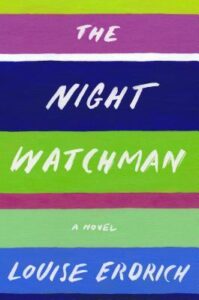
Based on the extraordinary life of National Book Award-winning author Louise Erdrich’s grandfather who worked as a night watchman and carried the fight against Native dispossession from rural North Dakota all the way to Washington, D.C., this powerful novel explores themes of love and death with lightness and gravity and unfolds with the elegant prose, sly humor, and depth of feeling of a master craftsman.
Thomas Wazhashk is the night watchman at the jewel bearing plant, the first factory located near the Turtle Mountain Reservation in rural North Dakota. He is also a Chippewa Council member who is trying to understand the consequences of a new “emancipation” bill on its way to the floor of the United States Congress. It is 1953 and he and the other council members know the bill isn’t about freedom; Congress is fed up with Indians. The bill is a “termination” that threatens the rights of Native Americans to their land and their very identity. How can the government abandon treaties made in good faith with Native Americans “for as long as the grasses shall grow, and the rivers run”?
Since graduating high school, Pixie Paranteau has insisted that everyone call her Patrice. Unlike most of the girls on the reservation, Patrice, the class valedictorian, has no desire to wear herself down with a husband and kids. She makes jewel bearings at the plant, a job that barely pays her enough to support her mother and brother. Patrice’s shameful alcoholic father returns home sporadically to terrorize his wife and children and bully her for money. But Patrice needs every penny to follow her beloved older sister, Vera, who moved to the big city of Minneapolis. Vera may have disappeared; she hasn’t been in touch in months, and is rumored to have had a baby. Determined to find Vera and her child, Patrice makes a fateful trip to Minnesota that introduces her to unexpected forms of exploitation and violence, and endangers her life.
Thomas and Patrice live in this impoverished reservation community along with young Chippewa boxer Wood Mountain and his mother Juggie Blue, her niece and Patrice’s best friend Valentine, and Stack Barnes, the white high school math teacher and boxing coach who is hopelessly in love with Patrice.
In the Night Watchman, Louise Erdrich creates a fictional world populated with memorable characters who are forced to grapple with the worst and best impulses of human nature. Illuminating the loves and lives, the desires and ambitions of these characters with compassion, wit, and intelligence, The Night Watchman is a majestic work of fiction from this revered cultural treasure.
One family’s deepest pain. Another’s darkest secret. Who will they be when the truth comes out?
On a hot day in 1960s Maine, six-year-old Joe watches his little sister Ruthie, sitting on her favourite rock at the edge of the blueberry fields, while their family, Mi’kmaq people from Nova Scotia, pick fruit. That afternoon, Ruthie vanishes without a trace. As the last person to see her, Joe will be forever haunted by grief, guilt, and the agony of imagining how his life could have been.
In an affluent suburb nearby, Norma is growing up as the only child of unhappy parents. She is smart, precocious, and bursting with questions she isn’t allowed to ask – questions about her missing baby photos; questions about her dark skin; questions about the strange, vivid dreams of campfires and warm embraces that return night after night. Norma senses there are things her parents aren’t telling her, but it will take decades to unravel the secrets they have kept buried since she was a little girl.
The Berry Pickers is an exquisitely moving story of unrelenting hope, unwavering love, and the power of family – even in the face of grief and betrayal.
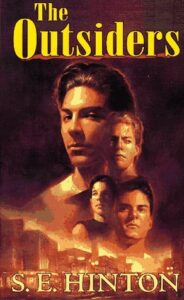
The Outsiders is about two weeks in the life of a 14-year-old boy. The novel tells the story of Ponyboy Curtis and his struggles with right and wrong in a society in which he believes that he is an outsider. According to Ponyboy, there are two kinds of people in the world: greasers and socs. A soc (short for "social") has money, can get away with just about anything, and has an attitude longer than a limousine. A greaser, on the other hand, always lives on the outside and needs to watch his back. Ponyboy is a greaser, and he's always been proud of it, even willing to rumble against a gang of socs for the sake of his fellow greasers--until one terrible night when his friend Johnny kills a soc. The murder gets under Ponyboy's skin, causing his bifurcated world to crumble and teaching him that pain feels the same whether a soc or a greaser.
Librarian note: This record is for one of the three editions published with different covers and with ISBN 0-140-38572-X / 978-0-14-038572-4. The records are for the 1988 cover (this record), the 1995 cover, and the 2008 cover which is also the current in-print cover.
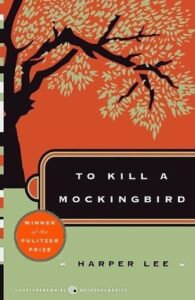
"Shoot all the bluejays you want, if you can hit 'em, but remember it's a sin to kill a mockingbird."
A lawyer's advice to his children as he defends the real mockingbird of Harper Lee's classic novel - a black man charged with the rape of a white girl. Through the young eyes of Scout and Jem Finch, Harper Lee explores with exuberant humour the irrationality of adult attitudes to race and class in the Deep South of the 1930s. The conscience of a town steeped in prejudice, violence and hypocrisy is pricked by the stamina of one man's struggle for justice. But the weight of history will only tolerate so much.
"To Kill A Mockingbird" became both an instant bestseller and a critical success when it was first published in 1960. It went on to win the Pulitzer Prize in 1961 and was later made into an Academy Award-winning film.
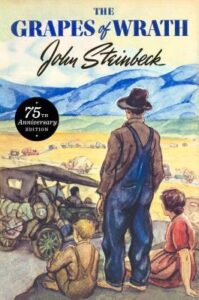
The Pulitzer Prize-winning epic of the Great Depression, a book that galvanized—and sometimes outraged—millions of readers.
First published in 1939, Steinbeck’s Pulitzer Prize-winning epic of the Great Depression chronicles the Dust Bowl migration of the 1930s and tells the story of one Oklahoma farm family, the Joads—driven from their homestead and forced to travel west to the promised land of California. Out of their trials and their repeated collisions against the hard realities of an America divided into Haves and Have-Nots evolves a drama that is intensely human yet majestic in its scale and moral vision, elemental yet plainspoken, tragic but ultimately stirring in its human dignity. A portrait of the conflict between the powerful and the powerless, of one man’s fierce reaction to injustice, and of one woman’s stoical strength, the novel captures the horrors of the Great Depression and probes into the very nature of equality and justice in America. At once a naturalistic epic, captivity narrative, road novel, and transcendental gospel, Steinbeck’s powerful landmark novel is perhaps the most American of American Classics.
Welcome Back!
Track your reading progress and sync your library.