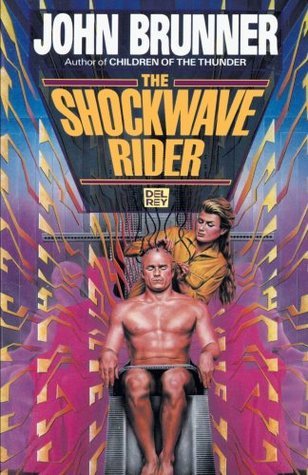
One man has made it his mission to liberate the mental prisoners. to restore their freedom in a world run mad.
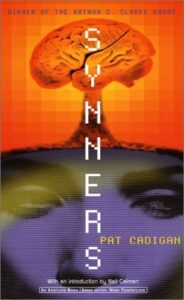
Nickie Halflinger, the only person to escape from Tarnover—where they raise hyper-intelligent children to maintain the political dominance of the USA in the 21st century—is on the run, dodging from loophole to crevice to crack in the computerised data-net that binds the continent like chains. After years of flight and constant changes of identity, at the strange small town called Precipice he discovers he is not alone in his quest. But can his new allies save him when he falls again into the sinister grasp of Tarnover…?
In twenty-first century Tokyo, Rez, one of the world's biggest rock stars, prepares to marry Rei Toe, Japan's biggest media star, who is known as the Idoru and who exists only in virtual reality. Reprint.
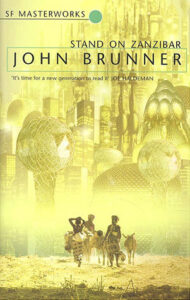
Earth 2381: The hordes of humanity have withdrawn into isolated 1000-story Urbmons, comfortably controlled multicity-buildings which perpetuate an open culture of free sex and unrestricted population growth. Nearly all of Earth's 75 billion live in the hundreds of monolithic structures scattered across the globe, with the exception of the small agricultural communes that supply the Urbmons with food. When a restless Urbmon computer engineer begins to think unblessworthy thoughts of making a trip outside, he risks being labeled a flippo, for whom there is only one punishment.
Norman Niblock House is a rising executive at General Technics, one of a few all-powerful corporations. His work is leading General Technics to the forefront of global domination, both in the marketplace and politically—it's about to take over a country in Africa. Donald Hogan is his roommate, a seemingly sheepish bookworm. But Hogan is a spy, and he's about to discover a breakthrough in genetic engineering that will change the world ... and kill him. These two men's lives weave through one of science fiction's most praised novels. Written in a way that echoes John Dos Passos' U.S.A. Trilogy, Stand on Zanzibar is a cross-section of a world overpopulated by the billions. Where society is squeezed into hive-living madness by god-like mega computers, mass-marketed psychedelic drugs, and mundane uses of genetic engineering. Though written in 1968, it speaks of 2010, and is frighteningly prescient and intensely powerful.
This edition comes with a tipped in collectors' note and an introduction by David Brin.
In Synners, the line between technology and humanity is hopelessly slim. A constant stream of new technology spawns crime before it hits the streets; the human mind and the external landscape have fused to the point where any encounter with "reality" is incidental.
By the end of the 30th century humanity has the capability to travel the universe, to journey beyond earth and beyond the confines of the vulnerable human frame.The descendants of centuries of scientific, cultural and physical development divide into fleshers — true Homo sapiens; Gleisner robots — embodying human minds within machines that interact with the physical world; and polises — supercomputers teeming with intelligent software, containing the direct copies of billions of human personalities now existing only in the virtual reality of the polis.Diaspora is the story of Yatima — a polis being created from random mutations of the Konishi polis base mind seed — and of humankind, Of an astrophysical accident that spurs the thousandfold cloning of the polises. Of the discovery of an alien race and of a kink in time that means humanity — whatever form it takes — will never again be threatened by acts of God.
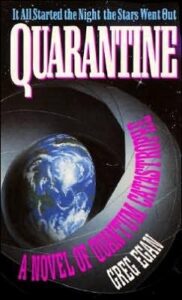
It causes riots and religions. It has people dancing in the streets and leaping off skyscrapers. And it's all because of the impenetrable gray shield that slid into place around the solar system on the night of November 15, 2034.
Some see the bubble as the revenge of an insane God. Some see it as justice. Some even see it as protection. But one thing is for certain -- now there is the universe, and the earth. And never the twain shall meet.
Or so it seems. Until a bio-enhanced PI named Nick Stavrianos takes on a job for an anonymous client: find a girl named Laura who disappeared from a mental institution by the most direct possible method -- walking through the walls.
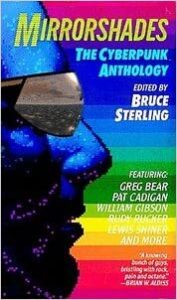
With their hard-edged, street-wise prose, they created frighteningly probable futures of high-tech societies and low-life hustlers. Fans and critics call their world cyberpunk. Here is the definitive "cyberpunk" short fiction collection.
Contents: The Gernsback Continuum (1981) by William Gibson Snake-Eyes (1986) by Tom Maddox Rock On (1984) by Pat Cadigan Tales of Houdini (1981) by Rudy Rucker 400 Boys (1983) by Marc Laidlaw Solstice (1985) by James Patrick Kelly Petra (1982) by Greg Bear Till Human Voices Wake Us (1984) by Lewis Shiner Freezone (1985) by John Shirley Stone Lives (1985) by Paul Di Filippo Red Star, Winter Orbit (1983) by William Gibson and Bruce Sterling Mozart in Mirrorshades (1984) by Bruce Sterling and Lewis Shiner
Robert Gu is a recovering Alzheimer's patient. The world that he remembers was much as we know it today. Now, as he regains his faculties through a cure developed during the years of his near-fatal decline, he discovers that the world has changed and so has his place in it. He was a world-renowned poet. Now he is seventy-five years old, though by a medical miracle he looks much younger, and he’s starting over, for the first time unsure of his poetic gifts. Living with his son’s family, he has no choice but to learn how to cope with a new information age in which the virtual and the real are a seamless continuum, layers of reality built on digital views seen by a single person or millions, depending on your choice. But the consensus reality of the digital world is available only if, like his thirteen-year-old granddaughter Miri, you know how to wear your wireless access—through nodes designed into smart clothes—and to see the digital context—through smart contact lenses.
With knowledge comes risk. When Robert begins to re-train at Fairmont High, learning with other older people what is second nature to Miri and other teens at school, he unwittingly becomes part of a wide-ranging conspiracy to use technology as a tool for world domination.
In a world where every computer chip has Homeland Security built-in, this conspiracy is something that baffles even the most sophisticated security analysts, including Robert’s son and daughter-in law, two top people in the U.S. military. And even Miri, in her attempts to protect her grandfather, may be entangled in the plot.
As Robert becomes more deeply involved in conspiracy, he is shocked to learn of a radical change planned for the UCSD Geisel Library; all the books there, and worldwide, would cease to physically exist. He and his fellow re-trainees feel compelled to join protests against the change. With forces around the world converging on San Diego, both the conspiracy and the protest climax in a spectacular moment as unique and satisfying as it is unexpected.
Welcome Back!
Track your reading progress and sync your library.