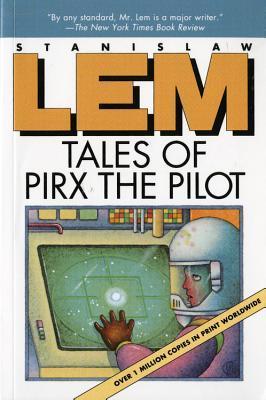
In Pilot Pirx, Lem has created an irresistibly likable character: an astronaut who gives the impression of still navigating by the seat of his pants-a bumbler but an inspired one. By investing Pirx with a range of human foibles, Lem offers a wonderful vision of the audacity, childlike curiosity, and intuition that can give humans the courage to confront outer space. Translated by Louis Iribarne.
A brilliantly funny collection of stories for the next age, from the celebrated author of Solaris. Ranging from the prophetic to the surreal, these stories demonstrate Stanislaw Lem's vast talent and remarkable ability to blend meaning and magic into a wholly entertaining and captivating work.
Ijon Tichy travels undercover to a robot world, joining an organization to clean up world history thru time travel.
Things go crazy immediately. His spaceship runs into gravitational vortices at relativistic speeds, resulting in massive time anomalies. It may be a blessing in disguise. The reason he couldn’t get out of the way was that a meteor had shattered the drive regulator & rudder. He could no longer steer his ship. He had a spare rudder, but couldn’t install it. It was a two-man job & he was alone. So when other versions of him start appearing, all he should need do is team up with one of them, fix the rudder & leave the gravitational vortex field.
After that gets straightened out, he goes undercover. A ship’s computer has mutineed & started its own colony, reproducing itself on a previously uninhabited planet. The insurance company paid the shipowner’s claim, & now believes that the ship, it’s computer & all its progeny belong to them. Tichy disguises himself as a robot & goes to investigate.
On another voyage, he heads to a planet where the government irrigation agency has irrigated beyond all need & refused to give up power. People live in water & are jailed in dry cells if they violate the love of water.
After his modern voyages, he comes back from 2166 to recruit himself as a member of THEOHIPPIP, the Teleotelechronistic-Historical Engineering to Optimize the Hyperputerized Implementation of Paleological Programming & Interplanetary Planning. History is in a mess because of all the time travelers. THEOHIPPIP's mission is: “For World History to be regulated, cleaned up, straightened out, adjusted & perfected, all in accordance with the principles of humanitarianism, rationalism & general esthetics. You can understand, surely, that with such a shambles & slaughterhouse in one’s family tree it’s awkward to go calling on important cosmic civilizations!...If need be, alterations will be made even before the rise of man, so that he arises better.”
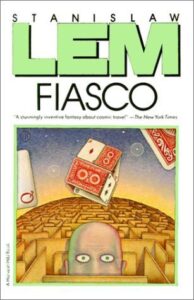
The planet Quinta is pocked by ugly mounds and covered by a spiderweb-like network. It is a kingdom of phantoms and of a beauty afflicted by madness. In stark contrast, the crew of the spaceship Hermes represents a knowledge-seeking Earth. As they approach Quinta, a dark poetry takes over and leads them into a nightmare of misunderstanding. Translated by Michael Kandel.
The novel was published in German translation (translated by H. Schumann) in 1986. The Polish text published in 1987, the English translation (by M. Kandel) the same year.
SETI - Search for Extraterrestrial Intelligence, diese Fahndung nach der Nadel im Heuhaufen, hat diesmal Erfolg: ein Planet im Sternbild Harpyie, die Quinta im dortigen Zetasystem, sendet Signale, und nach jahrhundertelanger Vorbereitung startet die irdische "Hermes" mit einer auserwählten Crew von Spezialisten, unter ihnen der zweite Pilot Marek Tempe, der später die Landung und den ersten Erkundungsgang vornehmen wird. Die Verwirklichung des Projekts bildet den Inhalt dieses Romans.
Als ein Gegenstück zu seinem Jugendroman "Gast im Weltraum", den er in den Jahren 1954/1955 schrieb und der erstmals 1956 bei Volk und Welt in Deutsch erschien (https://www.goodreads.com/book/show/5...), möchte Stanisław Lem seinen neuesten Roman betrachtet wissen, den er im Februar 1985 abschloss.
Keine Negierung von "Gast im Weltraum" soll "Das Fiasko" sein, sondern eher eine Revision eigener, allzu naiver fortschrittsfreudiger Illusionen, die den jungen Lem einst beflügelten und denen er nun den komplizierten, naturwissenschaftlichen, technischen und moralischen Zwängen unterliegenden Prozeß gegenüberstellt, den die Menschen bei ihrem Drang auf der Suche nach außerirdischen Zivilisationen durchlaufen.
The strange and wonderful tale of man’s experiences on Mars, filled with intense images and astonishing visions. Now part of the Voyager Classics collection.
The Martian Chronicles tells the story of humanity’s repeated attempts to colonize the red planet. The first men were few. Most succumbed to a disease they called the Great Loneliness when they saw their home planet dwindle to the size of a fist. They felt they had never been born. Those few that survived found no welcome on Mars. The shape-changing Martians thought they were native lunatics and duly locked them up.
But more rockets arrived from Earth, and more, piercing the hallucinations projected by the Martians. People brought their old prejudices with them – and their desires and fantasies, tainted dreams. These were soon inhabited by the strange native beings, with their caged flowers and birds of flame.
Contents: Rocket Summer Ylla The Summer Night The Earth Men The Taxpayer The Third Expedition -And the Moon Be Still As Bright The Settlers The Green Morning The Locusts Night Meeting The Shore Interim The Musicians Way in the Middle of the Air The Naming of Names Usher II The Old Ones The Martian The Luggage Store The Off Season The Watchers The Silent Towns The Long Years There Will Come Soft Rains The Million Year Picnic
In 1941, Astounding Science Fiction magazine published a short story by a little-known writer named Isaac Asimov. The story was called "Nightfall", and many years later it has long been recognized as a classic, its author a legend. Now, the Grand Master of Science Fiction teams with Robert Silverberg, one of the field's top award-winning authors, to explore and expand an apocalyptic tale that is more spellbinding today than ever before -- Nightfall: The Novel.
Imagine living on a planet with six suns that never experiences darkness. Imagine never having seen the stars. Then, one by one the suns start to set, gradually leading into darkness for the first time ever. Kalgash is a world on the edge of chaos, torn between the madness of religious fanaticism and the unyielding rationalism of scientists. Lurking beneath it all is a collective, instinctual fear of the Darkness. For Kalgash knows only the perpetual light of day; to its inhabitants, a gathering twilight portends unspeakable horror. And only a handful of people on the planet are prepared to face the truth, their six suns are setting all at once for the first time in over two thousand years, signaling the end of civilization as it explodes in the awesome splendor of Nightfall.
Encompassing the psychology of disaster, the tenacity of the human spirit, and, ultimately, the regenerative power of hope, Nightfall is a tale rich in character and suspense that only the unique collaboration of Isaac Asimov and Robert Silverberg could create.
Librarian's Note: Alternate cover edition available here.
Simak's City is a series of connected stories, a series of legends, myths, and campfire stories told by Dogs about the end of human civilization, centering on the Webster family, who, among their other accomplishments, designed the ships that took Men to the stars and gave Dogs the gift of speech and robots to be their hands.
Welcome Back!
Track your reading progress and sync your library.