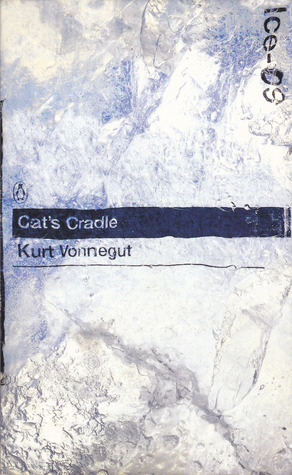
Told with deadpan humour and bitter irony, Kurt Vonnegut’s cult tale of global destruction preys on our deepest fears of witnessing Armageddon and, worse still, surviving it …
Dr Felix Hoenikker, one of the founding ‘fathers’ of the atomic bomb, has left a deadly legacy to the world. For he’s the inventor of ‘ice-nine’, a lethal chemical capable of freezing the entire planet. The search for its whereabouts leads to Hoenikker’s three ecentric children, to a crazed dictator in the Caribbean, to madness. Felix Hoenikker’s Death Wish comes true when his last, fatal gift to humankind brings about the end, that for all of us, is nigh…
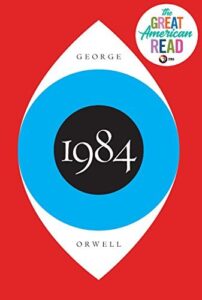
Among the seminal texts of the 20th century, Nineteen Eighty-Four is a rare work that grows more haunting as its futuristic purgatory becomes more real. Published in 1949, the book offers political satirist George Orwell's nightmarish vision of a totalitarian, bureaucratic world and one poor stiff's attempt to find individuality. The brilliance of the novel is Orwell's prescience of modern life—the ubiquity of television, the distortion of the language—and his ability to construct such a thorough version of hell. Required reading for students since it was published, it ranks among the most terrifying novels ever written.
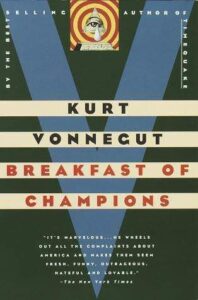
In Breakfast of Champions, one of Kurt Vonnegut’s most beloved characters, the aging writer Kilgore Trout, finds to his horror that a Midwest car dealer is taking his fiction as truth. What follows is murderously funny satire, as Vonnegut looks at war, sex, racism, success, politics, and pollution in America and reminds us how to see the truth.
A vicious fifteen-year-old droog is the central character of this 1963 classic. In Anthony Burgess's nightmare vision of the future, where criminals take over after dark, the story is told by the central character, Alex, who talks in a brutal invented slang that brilliantly renders his and his friends' social pathology. A Clockwork Orange is a frightening fable about good and evil, and the meaning of human freedom. And when the state undertakes to reform Alex to "redeem" him, the novel asks, "At what cost?"
This edition includes the controversial last chapter not published in the first edition and Burgess's introduction "A Clockwork Orange Resucked."
Brave New World is a dystopian social science fiction novel by English author Aldous Huxley. Largely set in a futuristic World State, whose citizens are environmentally engineered into an intelligence-based social hierarchy, the novel anticipates huge scientific advancements in reproductive technology, sleep-learning, psychological manipulation and classical conditioning that are combined to make a dystopian society which is challenged by only a single individual: the story's protagonist.
The astonishing novel Brave New World, originally published in 1932, presents Aldous Huxley's vision of the future--of a world utterly transformed. Through the most efficient scientific and psychological engineering, people are genetically designed to be passive and therefore consistently useful to the ruling class. This powerful work of speculative fiction sheds a blazing critical light on the present and is considered to be Aldous Huxley's most enduring masterpiece.
The non-fiction work Brave New World Revisited, published in 1958, is a fascinating work in which Huxley uses his tremendous knowledge of human relations to compare the modern-day world with his prophetic fantasy envisioned in Brave New World, including the threats to humanity, such as over-population, propaganda, and chemical persuasion.
The Sirens of Titan is an outrageous romp through space, time, and morality. The richest, most depraved man on Earth, Malachi Constant, is offered a chance to take a space journey to distant worlds with a beautiful woman at his side. Of course there's a catch to the invitation—and a prophetic vision about the purpose of human life that only Vonnegut has the courage to tell.
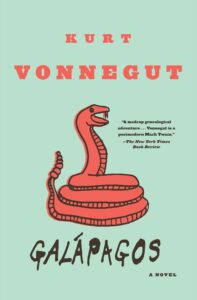
Galápagos takes the reader back one million years, to A.D. 1986. A simple vacation cruise suddenly becomes an evolutionary journey. Thanks to an apocalypse, a small group of survivors stranded on the Galápagos Islands are about to become the progenitors of a brave, new, and totally different human race. In this inimitable novel, America’s master satirist looks at our world and shows us all that is sadly, madly awry—and all that is worth saving.
Slaughterhouse-Five, an American classic, is one of the world’s great antiwar books. Centering on the infamous World War II firebombing of Dresden, the novel is the result of what Kurt Vonnegut described as a twenty-three-year struggle to write a book about what he had witnessed as an American prisoner of war. It combines historical fiction, science fiction, autobiography, and satire in an account of the life of Billy Pilgrim, a barber’s son turned draftee turned optometrist turned alien abductee. As Vonnegut had, Billy experiences the destruction of Dresden as a POW. Unlike Vonnegut, he experiences time travel, or coming “unstuck in time.”
An instant bestseller, Slaughterhouse-Five made Kurt Vonnegut a cult hero in American literature, a reputation that only strengthened over time, despite his being banned and censored by some libraries and schools for content and language. But it was precisely those elements of Vonnegut’s writing—the political edginess, the genre-bending inventiveness, the frank violence, the transgressive wit—that have inspired generations of readers not just to look differently at the world around them but to find the confidence to say something about it.
Fifty years after its initial publication at the height of the Vietnam War, Vonnegut's portrayal of political disillusionment, PTSD, and postwar anxiety feels as relevant, darkly humorous, and profoundly affecting as ever, an enduring beacon through our own era’s uncertainties.
Welcome Back!
Track your reading progress and sync your library.