No food, no water, no government, no obligation, no order.
Discover a chillingly powerful and prescient dystopian vision from one of Europe’s greatest writers.
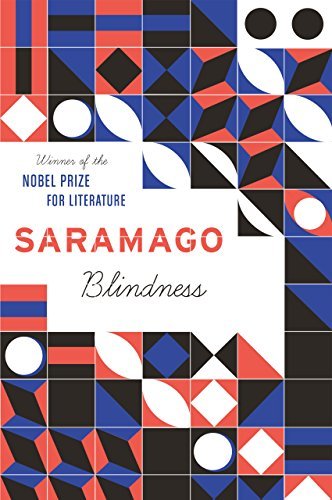
A driver waiting at the traffic lights goes blind. An ophthalmologist tries to diagnose his distinctive white blindness, but is affected before he can read the textbooks. It becomes a contagion, spreading throughout the city. Trying to stem the epidemic, the authorities herd the afflicted into a mental asylum where the wards are terrorised by blind thugs. And when fire destroys the asylum, the inmates burst forth and the last links with a supposedly civilised society are snapped.
This is not anarchy, this is blindness.
‘Saramago repeatedly undertakes to unite the pressing demands of the present with an unfolding vision of the future. This is his most apocalyptic, and most optimistic, version of that project yet’ Independent
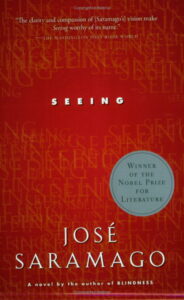
On election day in the capital, it is raining so hard that no one has bothered to go out to vote. The politicians are growing jittery. Should they reschedule the elections for another day? Around three o' clock, the rain finally stops. Promptly at four, voters rush to the polling stations, as if they had been ordered to appear.
But when the ballots are counted, more than 70 percent are blank. The citizens are rebellious. A state of emergency is declared. But are the authorities acting too precipitously? Or even blindly? The word evokes terrible memories of the plague of blindness that hit the city four years before, and of the one woman who kept her sight. Could she be behind the blank ballots? A police superintendent is put on the case.
What begins as a satire on governments and the sometimes dubious efficacy of the democratic system turns into something far more sinister. A singular novel from the author of Blindness.
The author of two critically acclaimed novels, The Russian Debutante’s Handbook and Absurdistan, Gary Shteyngart has risen to the top of the fiction world. Now, in his hilarious and heartfelt new novel, he envisions a deliciously dark tale of America’s dysfunctional coming years—and the timeless and tender feelings that just might bring us back from the brink.
In a very near future—oh, let’s say next Tuesday—a functionally illiterate America is about to collapse. But don’t that tell that to poor Lenny Abramov, the thirty-nine-year-old son of an angry Russian immigrant janitor, proud author of what may well be the world’s last diary, and less-proud owner of a bald spot shaped like the great state of Ohio. Despite his job at an outfit called Post-Human Services, which attempts to provide immortality for its super-rich clientele, death is clearly stalking this cholesterol-rich morsel of a man. And why shouldn’t it? Lenny’s from a different century—he totally loves books (or “printed, bound media artifacts,” as they’re now known), even though most of his peers find them smelly and annoying. But even more than books, Lenny loves Eunice Park, an impossibly cute and impossibly cruel twenty-four-year-old Korean American woman who just graduated from Elderbird College with a major in Images and a minor in Assertiveness.
After meeting Lenny on an extended Roman holiday, blistering Eunice puts that Assertiveness minor to work, teaching our “ancient dork” effective new ways to brush his teeth and making him buy a cottony nonflammable wardrobe. But America proves less flame-resistant than Lenny’s new threads. The country is crushed by a credit crisis, riots break out in New York’s Central Park, the city’s streets are lined with National Guard tanks on every corner, the dollar is so over, and our patient Chinese creditors may just be ready to foreclose on the whole mess. Undeterred, Lenny vows to love both Eunice and his homeland. He’s going to convince his fickle new love that in a time without standards or stability, in a world where single people can determine a dating prospect’s “hotness” and “sustainability” with the click of a button, in a society where the privileged may live forever but the unfortunate will die all too soon, there is still value in being a real human being.
Wildly funny, rich, and humane, Super Sad True Love Story is a knockout novel by a young master, a book in which falling in love just may redeem a planet falling apart.
Cannery Row is a book without much of a plot. Rather, it is an attempt to capture the feeling and people of a place, the cannery district of Monterey, California, which is populated by a mix of those down on their luck and those who choose for other reasons not to live "up the hill" in the more respectable area of town. The flow of the main plot is frequently interrupted by short vignettes that introduce us to various denizens of the Row, most of whom are not directly connected with the central story. These vignettes are often characterized by direct or indirect reference to extreme violence: suicides, corpses, and the cruelty of the natural world.
The "story" of Cannery Row follows the adventures of Mack and the boys, a group of unemployed yet resourceful men who inhabit a converted fish-meal shack on the edge of a vacant lot down on the Row.
Still Life with Woodpecker is a sort of a love story that takes place inside a pack of Camel cigarettes. It reveals the purpose of the moon, explains the difference between criminals andoutlaws, examines the conflict between social activism and romantic individualism, and paints a portrait of contemporary society that includes powerful Arabs, exiled royalty, and pregnant cheerleaders. It also deals withthe problem of redheads. "From the Trade Paperback edition."
Ethan Allen Hawley, the protagonist of Steinbeck’s last novel, works as a clerk in a grocery store that his family once owned. With Ethan no longer a member of Long Island’s aristocratic class, his wife is restless, and his teenage children are hungry for the tantalizing material comforts he cannot provide. Then one day, in a moment of moral crisis, Ethan decides to take a holiday from his own scrupulous standards.
Set in Steinbeck’s contemporary 1960 America, the novel explores the tenuous line between private and public honesty that today ranks it alongside his most acclaimed works of penetrating insight into the American condition. This edition features an introduction and notes by Steinbeck scholar Susan Shillinglaw.
First published in 1905, THE HOUSE OF MIRTH shocked the New York society it so deftly chronicles, portraying the moral, social and economic restraints on a woman who dared to claim the privileges of marriage without assuming the responsibilities.
Lily Bart, beautiful, witty and sophisticated, is accepted by ‘old money’ and courted by the growing tribe of nouveaux riches. But as she nears thirty, her foothold becomes precarious; a poor girl with expensive tastes, she needs a husband to preserve her social standing and to maintain her in the luxury she has come to expect. Whilst many have sought her, something – fastidiousness or integrity- prevents her from making a ‘suitable’ match.
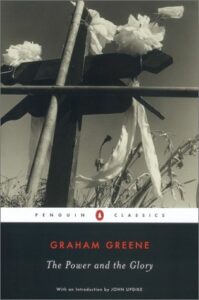
In a poor, remote section of southern Mexico, the paramilitary group, the Red Shirts have taken control. God has been outlawed, and the priests have been systematically hunted down and killed. Now, the last priest is on the run. Too human for heroism, too humble for martyrdom, the nameless little worldly "whiskey priest" is nevertheless impelled toward his squalid Calvary as much by his own compassion for humanity as by the efforts of his pursuers.
In his introduction, John Updike calls The Power and the Glory, "Graham Greene's masterpiece…. The energy and grandeur of his finest novel derive from the will toward compassion, an ideal communism even more Christian than Communist."
Rabbit, Run is the book thatestablished John Updike as one of the major American novelists of his—or any other—generation. Its hero is Harry “Rabbit” Angstrom, a onetime high-school basketball star who on an impulse deserts his wife and son. He is twenty-six years old, a man-child caught in a struggle between instinct and thought, self and society, sexual gratification and family duty—even, in a sense, human hard-heartedness and divine Grace. Though his flight from home traces a zigzag of evasion, he holds to the faith that he is on the right path, an invisible line toward his own salvation as straight as a ruler’s edge.
Welcome Back!
Track your reading progress and sync your library.