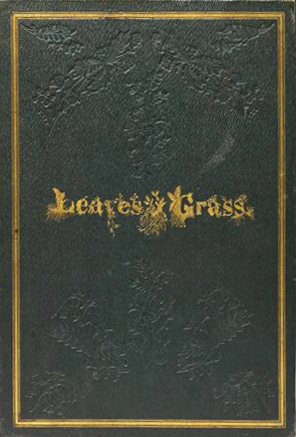
Leaves of Grass
A collection of quintessentially American poems, the seminal work of one of the most influential writers of the nineteenth century.
THE ONLY ONE-VOLUME EDITION CONTAINING ALL 1,775 OF EMILY DICKINSON’S POEMS
Only eleven of Emily Dickinson’s poems were published prior to her death in 1886; the startling originality of her work doomed it to obscurity in her lifetime. Early posthumously published collections-some of them featuring liberally “edited” versions of the poems-did not fully and accurately represent Dickinson’s bold experiments in prosody, her tragic vision, and the range of her intellectual and emotional explorations. Not until the 1955 publication of The Complete Poems of Emily Dickinson, a three-volume critical edition compiled by Thomas H. Johnson, were readers able for the first time to assess, understand, and appreciate the whole of Dickinson’s extraordinary poetic genius.
This book, a distillation of the three-volume Complete Poems, brings together the original texts of all 1,775 poems that Emily Dickinson wrote.
Four Quartets is the culminating achievement of T.S. Eliot's career as a poet. While containing some of the most musical and unforgettable passages in twentieth-century poetry, its four parts, 'Burnt Norton', 'East Coker', 'The Dry Salvages' and 'Little Gidding', present a rigorous meditation on the spiritual, philosophical and personal themes which preoccupied the author. It was the way in which a private voice was heard to speak for the concerns of an entire generation, in the midst of war and doubt, that confirmed it as an enduring masterpiece.
This definitive poetry collection, originally published in 1954 to honor Stevens on his 75th birthday, contains:
- "Harmonium"
- "Ideas of Order"
- "The Man With the Blue Guitar"
- "Parts of the World"
- "Transport Summer"
- "The Auroras of Autumn"
- "The Rock"
Eugene Onegin is the master work of the poet whom Russians regard as the fountainhead of their literature. Set in 1820s Russia, Pushkin's verse novel follows the fates of three men and three women. Engaging, full of suspense, and varied in tone, it also portrays a large cast of other
characters and offers the reader many literary, philosophical, and autobiographical digressions, often in a highly satirical vein. Eugene Onegin was Pushkin's own favourite work, and this new translation conveys the literal sense and the poetic music of the original.
Charles Baudelaire's 1857 masterwork was scandalous in its day for its portrayals of sex, same-sex love, death, the corrupting and oppressive power of the modern city and lost innocence, Les Fleurs du Mal (The Flowers of Evil) remains powerful and relevant for our time.
In Spleen et idéal," Baudelaire dramatizes the erotic cycle of ecstacy and anguish--of sexual and romantic love. Tableaux Parisiens condemns the crushing effects of urban planning on a city's soul and praises the city's anti-heroes including the deranged and derelict. Le Vin centers on the search for oblivion in drink and drugs. The many kinds of love that lie outside traditional morality is the focus of Fleurs du Mal while rebellion is at the heart of Révolte.
A beat movement icon and visionary poet, Allen Ginsberg broke boundaries with his fearless, pyrotechnic verse. The apocalyptic "Howl" became the subject of an obscenity trial when it was first published in 1956 -- its vindication was a watershed moment in twentieth-century history. Dark, ecstatic and rhapsodic, "Howl" shows why Ginsberg was one of the most influential poets of the twentieth century.
Howl and Other Poems is a collection of Ginsberg's finest work, including "Howl," one of the principal works of the Beat Generation as well as "A Supermarket in California," "Transcription of Organ Music," "Sunflower Sutra," "America," "In the Baggage Room at Greyhound," and some of his earlier works.
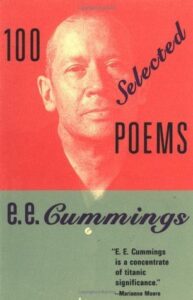
E.E. Cummings is without question one of the major poets of the 20th century, and this volume, first published in 1959, is indispensable for every lover of modern lyrical verse. It contains one hundred of Cummings’s wittiest and most profound poems, harvested from thirty-five of the most radically creative years in contemporary American poetry. These poems exhibit all the extraordinary lyricism, playfulness, technical ingenuity, and compassion for which Cummings is famous. They demonstrate beautifully his extrapolations from traditional poetic structures and his departures from them, as well as the unique synthesis of lavish imagery and acute artistic precision that has won him the adulation and respect of critics and poetry lovers everywhere.