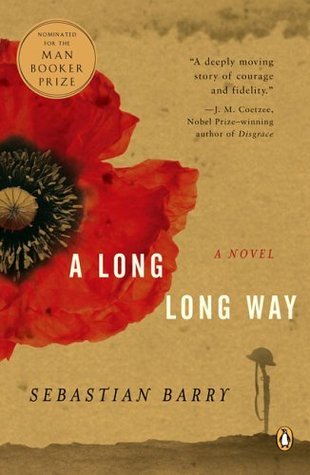
In 1914, Willie Dunne, barely eighteen years old, leaves behind Dublin, his family, and the girl he plans to marry in order to enlist in the Allied forces and face the Germans on the Western Front. Once there, he encounters a horror of violence and gore he could not have imagined and sustains his spirit with only the words on the pages from home and the camaraderie of the mud-covered Irish boys who fight and die by his side. Dimly aware of the political tensions that have grown in Ireland in his absence, Willie returns on leave to find a world split and ravaged by forces closer to home. Despite the comfort he finds with his family, he knows he must rejoin his regiment and fight until the end. With grace and power, Sebastian Barry vividly renders Willie’s personal struggle as well as the overwhelming consequences of war.
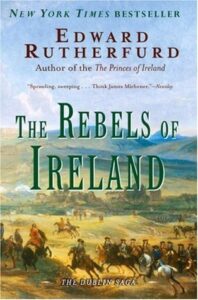
The reigning master of grand historical fiction returns with the stirring conclusion to his bestselling Dublin Saga.
The Princes of Ireland , the first volume of Edward Rutherfurd’s magisterial epic of Irish history, ended with the disastrous Irish revolt of 1534 and the disappearance of the sacred Staff of Saint Patrick. The Rebels of Ireland opens with an Ireland transformed; plantation, the final step in the centuries-long English conquest of Ireland, is the order of the day, and the subjugation of the native Irish Catholic population has begun in earnest.
Edward Rutherfurd brings history to life through the tales of families whose fates rise and fall in each generation: Brothers who must choose between fidelity to their ancient faith or the security of their families; a wife whose passion for a charismatic Irish chieftain threatens her comfortable marriage to a prosperous merchant; a young scholar whose secret rebel sympathies are put to the test; men who risk their lives and their children’s fortunes in the tragic pursuit of freedom, and those determined to root them out forever. Rutherfurd spins the saga of Ireland’s 400-year path to independence in all its drama, tragedy, and glory through the stories of people from all strata of society--Protestant and Catholic, rich and poor, conniving and heroic.
His richly detailed narrative brings to life watershed moments and events, from the time of plantation settlements to the “Flight of the Earls,” when the native aristocracy fled the island, to Cromwell’s suppression of the population and the imposition of the harsh anti-Catholic penal laws. He describes the hardships of ordinary people and the romantic, doomed attempt to overthrow the Protestant oppressors, which ended in defeat at the Battle of the Boyne in 1690, and the departure of the “Wild Geese.” In vivid tones Rutherfurd re-creates Grattan’s Parliament, Wolfe Tone's attempted French invasion of 1798, the tragic rising of Robert Emmet, the Catholic campaign of Daniel O’Connell, the catastrophic famine, the mass migration to America, and the glorious Irish Renaissance of Yeats and Joyce. And through the eyes of his characters, he captures the rise of Charles Stewart Parnell and the great Irish nationalists and the birth of an Ireland free of all ties to England.
A tale of fierce battles, hot-blooded romances, and family and political intrigues, The Rebels of Ireland brings the story begun in The Princes of Ireland to a stunning conclusion.
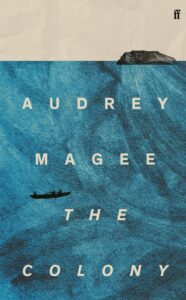
In 1979, as violence erupts all over Ireland, two outsiders travel to a small island off the west coast in search of their own answers, despite what it may cost the islanders.
It is the summer of 1979. An English painter travels to a small island off the west coast of Ireland. Mr. Lloyd takes the last leg by currach, though boats with engines are available and he doesn't much like the sea. He wants the authentic experience, to be changed by this place, to let its quiet and light fill him, give him room to create. He doesn't know that a Frenchman follows close behind. Jean-Pierre Masson has visited the island for many years, studying the language of those who make it their home. He is fiercely protective of their isolation, deems it essential to exploring his theories of language preservation and identity.
But the people who live on this rock--three miles long and half a mile wide--have their own views on what is being recorded, what is being taken, and what ought to be given in return. Over the summer, each of them--from great-grandmother Bean Uí Fhloinn to widowed Mairéad to fifteen-year-old James, who is determined to avoid the life of a fisherman--will wrestle with their values and desires. Meanwhile, all over Ireland, violence is erupting. And there is blame enough to go around.
An expertly woven portrait of character and place, a stirring investigation into yearning to find one's way, and an unflinchingly political critique of the long, seething cost of imperialism, Audrey Magee's The Colony is a novel that transports, that celebrates beauty and connection, and that reckons with the inevitable ruptures of independence.
In the late spring of 1847, from an Ireland torn by injustice and natural disaster, the Star of the Sea sets sail for New York. On board are hundreds of fleeing refugees, some brimming with optimism, many more desperate. Among them are a maidservant with a devastating secret, bankrupt Lord Merridith and his wife and children, an aspiring novelist, a maker of revolutionary ballads, all braving the Atlantic in search of a new life. But a killer is stalking the decks, hungry for the vengeance that will bring absolution. A novel as urgently contemporary in its preoccupations as it is historically revealing, this gripping and compassionate tale from the award-winning author of The Salesman and Inishowen builds with the pace of a thriller to an unforgettable conclusion.
“Colm Tóibín’s beautiful, subtle illumination of Henry James’s inner life” (The New York Times) captures the loneliness and hope of a master of psychological subtlety whose forays into intimacy inevitably fail those he tried to love.
Beautiful and profoundly moving, The Master tells the story of Henry James, a man born into one of America’s first intellectual families who leaves his country in the late nineteenth century to live in Paris, Rome, Venice, and London among privileged artists and writers. With stunningly resonant prose, “The Master is unquestionably the work of a first-rate novelist: artful, moving, and very beautiful” (The New York Times Book Review). The emotional intensity of this portrait is riveting.
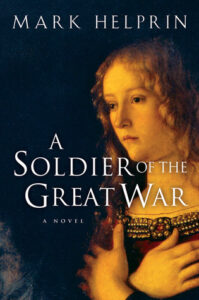
From acclaimed novelist Mark Helprin, a lush, literary epic about love, beauty, and the world at war. Alessandro Giuliani, the young son of a prosperous Roman lawyer, enjoys an idyllic life full of privilege: he races horses across the country to the sea, he climbs mountains in the Alps, and, while a student of painting at the ancient university in Bologna, he falls in love. Then the Great War intervenes. Half a century later, in August of 1964, Alessandro, a white-haired professor, tall and proud, meets an illiterate young factory worker on the road. As they walk toward Monte Prato, a village seventy kilometers away, the old man—a soldier and a hero who became a prisoner and then a deserter, wandering in the hell that claimed Europe—tells him how he tragically lost one family and gained another. The boy, envying the richness and drama of Alessandro's experiences, realizes that this magnificent tale is not merely a story: it's a recapitulation of his life, his reckoning with mortality, and above all, a love song for his family.
Published to international critical and popular acclaim, this intensely romantic yet stunningly realistic novel spans three generations and the unimaginable gulf between the First World War and the present. As the young Englishman Stephen Wraysford passes through a tempestuous love affair with Isabelle Azaire in France and enters the dark, surreal world beneath the trenches of No Man's Land, Sebastian Faulks creates a world of fiction that is as tragic as A Farewell to Arms and as sensuous as The English Patient. Crafted from the ruins of war and the indestructibility of love, Birdsong is a novel that will be read and marveled at for years to come.
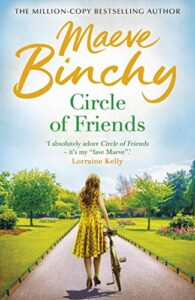
Big, generous-hearted Benny and the elfin Eve Malone have been best friends growing up in sleepy Knockglen. Their one thought is to get to Dublin, to university and to freedom...
On their first day at University College, Dublin, the inseparable pair are thrown together with fellow students Nan Mahon, beautiful but selfish, and handsome Jack Foley. But trouble is brewing for Benny and Eve's new circle of friends, and before long, they find passion, tragedy - and the independence they yearned for.
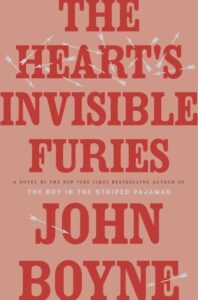
Cyril Avery is not a real Avery or at least that’s what his adoptive parents tell him. And he never will be. But if he isn’t a real Avery, then who is he?
Born out of wedlock to a teenage girl cast out from her rural Irish community and adopted by a well-to-do if eccentric Dublin couple via the intervention of a hunchbacked Redemptorist nun, Cyril is adrift in the world, anchored only tenuously by his heartfelt friendship with the infinitely more glamourous and dangerous Julian Woodbead.
At the mercy of fortune and coincidence, he will spend a lifetime coming to know himself and where he came from – and over his three score years and ten, will struggle to discover an identity, a home, a country and much more.
In this, Boyne's most transcendent work to date, we are shown the story of Ireland from the 1940s to today through the eyes of one ordinary man. The Heart's Invisible Furies is a novel to make you laugh and cry while reminding us all of the redemptive power of the human spirit.
Welcome Back!
Track your reading progress and sync your library.