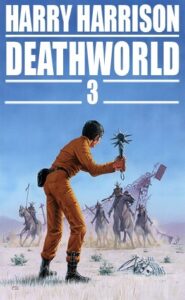
A legendary science fiction story, this trilogy, brought back into print in one single volume, presents hero Jason dinAlt as he discovers three separate planets. dinAlt finds excitement and intrigue as he investigates Pyrrus, a strange place where all the beasts, plants, and natural elements are out to destroy man; the unknown second planet, where every man has to kill other men or live as a slave; and Felicity, where creatures are bred for thousands of years for a single deadly purpose. Well-known to fantasy and science fiction enthusiasts, this tale portrays exciting adventures filled with the elements of classic characters and plot twists.
Chthon was Piers Anthony’s first published novel in 1967, written over the course of seven years. He started it when he was in the US Army, so it has a long prison sequence that is reminiscent of that experience, being dark and grim. It features Aton Five, a space man who commits the crime of falling in love with the dangerous alluring Minionette and is therefore condemned to death in the subterranean prison of Chthon. It uses flashbacks to show how he came to know the Minionette, and flashforwards to show how he dealt with her after his escape from prison. The author regards this as perhaps the most intricately structured novel the science fantasy genre has seen. It was a contender for awards, but not a winner.
In a cosmos of prolific evolutionary diversity and complexity, Mallory Ringess, headstrong novice of the Order of Pilots, sets out to penetrate the Soild State Entity and to track down the secret of immortality
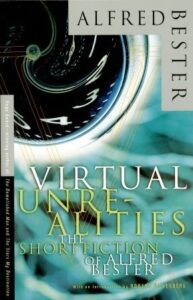
Alfred Bester took science fiction into hyperdrive, endowing it with a wit, speed, and narrative inventiveness that have inspired two generations of writers. And nowhere is Bester funnier, speedier, or more audacious than in these seventeen short stories—two of them previously unpublished—that have now been brought together in a single volume for the first time.
Read about the sweet-natured young man whose phenomenal good luck turns out to be disastrous for the rest of humanity. Find out why tourists are flocking to a hellish little town in a post-nuclear Kansas. Meet a warlock who practices on Park Avenue and whose potions comply with the Pure Food and Drug Act. Make a deal with the Devil—but not without calling your agent. Dazzling, effervescent, sexy, and sardonic, Virtual Unrealities is a historic collection from one of science fiction's true pathbreakers.
CONTENTS: Disappearing Act Oddy and Id Star Light, Star Bright (1953) 5,271,009 (1954) Fondly Fahrenheit (1954) Hobson's Choice (1952) Of Time and Third Avenue (1952) Time is the Traitor (1953) The Men Who Murdered Mohammed (1958) The Pi Man (1959) They Don't Make Life Like They Used To (1963) Will You Wait? (1959) The Flowered Thundermug (1964) Adam and No Eve (1941) And 3 1/2 to Go Galatea Galante (1979) The Devil Without Glasses
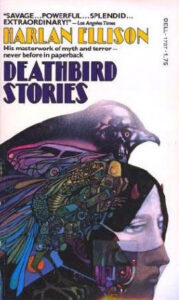
Harlan Ellison's masterwork of myth and terror as he seduces all innocence on a mind-freezing odyssey into the darkest reaches of mortal terror and the most dazzling heights of Olympian hell in his finest collection.
Deathbird Stories is a collection of 19 of Harlan Ellison's best stories, including Edgar and Hugo winners, originally published between 1960 and 1974. The collection contains some of Ellison's best stories from earlier collections and is judged by some to be his most consistently high quality collection of short fiction. The theme of the collection can be loosely defined as God, or Gods. Sometimes they're dead or dying, some of them are as brand-new as today's technology. Unlike some of Ellison's collections, the introductory notes to each story can be as short as a phrase and rarely run more than a sentence or two. One story took a Locus Poll Award, the two final ones both garnered Hugo Awards and Locus Poll awards, and the final one also received a Jupiter Award from the Instructors of Science Fiction in Higher Education (discontinued in 1979). When the collection was published in Britain, it won the 1979 British Science Fiction Award for Short Fiction.
"His stories will rivet you to the floor and change your heartbeat...as unforgettable a chamber of horror, fantasy and reality as you'll ever experience." -Gallery
"Brutally and flamboyantly shocking, frequently brilliant, and always irresistibly mesmerizing." -Richmond Times-Dispatch
Contents:
· Introduction: Oblations at Alien Altars · The Whimper of Whipped Dogs · ss Bad Moon Rising, ed. Thomas M. Disch, Harper&Row, 1973 · Along the Scenic Route [“Dogfight on 101”] · ss Adam Aug’69; Amazing Sep’69 · On the Downhill Side · ss Universe 2, ed. Terry Carr, Ace, 1972 · O Ye of Little Faith · ss Knight Sep’68 · Neon · ss The Haunt of Horror Aug’73 · Basilisk · ss F&SF Aug’72 · Pretty Maggie Moneyeyes · nv Knight May’67 · Corpse · ss F&SF Jan’72 · Shattered Like a Glass Goblin · ss Orbit 4, ed. Damon Knight, G.P. Putnam’s, 1968 · Delusion for a Dragon Slayer · ss Knight Sep’66 · The Face of Helene Bournouw · ss Collage Oct’60 · Bleeding Stones · ss Vertex Apr’73 · At the Mouse Circus · ss New Dimensions I, ed. Robert Silverberg, Doubleday, 1971 · The Place with No Name · ss F&SF Jul’69 · Paingod · ss Fantastic Jun’64 · Ernest and the Machine God · nv Knight Jan’68 · Rock God · ss Coven 13 Nov’69 · Adrift Just Off the Islets of Langerhans: Latitude 38°54’N, Longitude 77°00’13"W · nv F&SF Oct’74 · The Deathbird · nv F&SF Mar’73
The 21st century was drawing to a close, and metapsychic humankind was poised at last to achieve Unity to be admitted into the group mind of the already unified alien races of the Galactic Milieu. But a growing corps of rebels was plotting to keep the people of Earth forever separate in the name of human individuality. And the rebels had a secret supporter: Fury, the insane metapsychic creatrue that would stop at nothing to claim humanity for itself. Fury's greatest enemy was the mutant genius Jack the Bodiless, whose power it craved. But Jack would never be a tool for Fury . . . And so it turned to Dorothea Macdonald, a young woman who had spent a lifetime hiding her towering mindpowers from the best mind readers of the Milieu. But she could not hide them from Fury or from Jack. Time and again she rejected their advances, unwilling to be drawn into the maelstrom of galactic politics or megalomaniacal dreams. And in the end, no one not Jack, not Fury, not even the Galactic Milieu would be a match for the awesome powers of the girl who would come to be called Diamond Mask . . .
Intervention sets the scene for Julian May's new trlogy of the Galactic Milieu. This has been split into two books: The Surveillance (containing Prologue, The Surveillance, and The Disclosure) and The Metaconcert, containing The Intervention and Epilogue.
For 60 000 years the five races of the Galactic Milieu have watched and waited for the time when human mental development on Earth is ready for the Intervention ...
As the twentieth century draws to its end, phenomenal mental powers are displayed by 'operants' all across our planet... They can 'farspeak' one another telepathically. They can build mental shields and they are capable of coercion by power of mind.
One of there is Rogatien Remillard, a dealer in secondhand books, whose memories - written a century on - form the core of this chronicle. They tell of a world where the mind has become a weapon; and of two brothers, each possessed of extraordinary powers - one a peace-bringer, the other an advocate of evil...
Until the arrival of Aiken Drum, the 100,000 humans who had fled backward in time to Pliocene exile on Earth knew little but slavery to the Tanu, the humanoid aliens who came from another galaxy. But King Aiken's rule is precarious, for the Tanu's twisted brethren are secretly maneuvering to bring about his downfall. Worse, Aiken is about to confront a man of incredibly powerful talents who nearly overthrew a galactic rule. He is Marc Remillard. Call him...The Adversary.
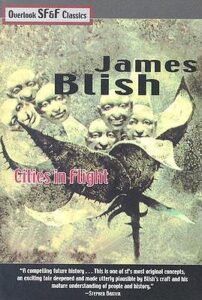
Originally published in four volumes nearly fifty years ago, Cities in Flight brings together the famed "Okie novels" of science fiction master James Blish. Named after the migrant workers of America's Dust Bowl, these novels convey Blish's "history of the future," a brilliant and bleak look at a world where cities roam the Galaxy looking for work and a sustainable way of life.
In the first novel, They Shall Have Stars, man has thoroughly explored the Solar System, yet the dream of going even further seems to have died in all but one man. His battle to realize his dream results in two momentous discoveries anti-gravity and the secret of immortality. In A Life for the Stars, it is centuries later and anti-gravity generations have enabled whole cities to lift off the surface of the earth to become galactic wanderers. In Earthman, Come Home, the nomadic cities revert to barbarism and marauding rogue cities begin to pose a threat to all civilized worlds. In the final novel, The Triumph of Time, history repeats itself as the cities once again journey back in to space making a terrifying discovery which could destroy the entire Universe. A serious and haunting vision of our world and its limits, Cities in Flight marks the return to print of one of science fiction's most inimitable writers.
A Selection of the Science Fiction Book Club
Welcome Back!
Track your reading progress and sync your library.