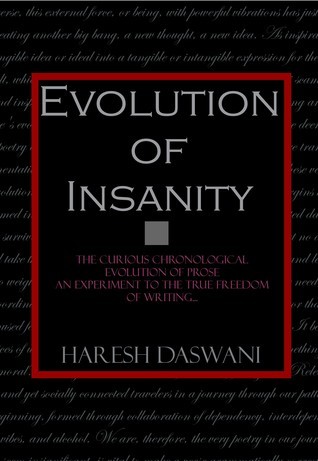
An author having a conversation with his fictional character, or losing control of his character, mind numbing points leading one twists and turns spinning the mind of the reader with hallucinogenic colors, concepts, and eurekas.
The short stories begin simplified, and walks together with the author as he takes a personal journey deep within the universe of his own consciousness, dwelling, prodding, dissecting, and creating…
This book is a play on different writing styles uniquely conjured by the writer from random inspiration and experimentation with poetry as prior experience. This is a chronological anthology spanning the imagination and sanity of the writer.
This book is a collection of humour, satire, and philosophy, with the most unique writing style and twists. This book evolves as one reads, from basic and simple stories of humor, to deeper and more profound satire best savored twice.
The strange and wonderful tale of man’s experiences on Mars, filled with intense images and astonishing visions. Now part of the Voyager Classics collection.
The Martian Chronicles tells the story of humanity’s repeated attempts to colonize the red planet. The first men were few. Most succumbed to a disease they called the Great Loneliness when they saw their home planet dwindle to the size of a fist. They felt they had never been born. Those few that survived found no welcome on Mars. The shape-changing Martians thought they were native lunatics and duly locked them up.
But more rockets arrived from Earth, and more, piercing the hallucinations projected by the Martians. People brought their old prejudices with them – and their desires and fantasies, tainted dreams. These were soon inhabited by the strange native beings, with their caged flowers and birds of flame.
Contents: Rocket Summer Ylla The Summer Night The Earth Men The Taxpayer The Third Expedition -And the Moon Be Still As Bright The Settlers The Green Morning The Locusts Night Meeting The Shore Interim The Musicians Way in the Middle of the Air The Naming of Names Usher II The Old Ones The Martian The Luggage Store The Off Season The Watchers The Silent Towns The Long Years There Will Come Soft Rains The Million Year Picnic
Eleven Classic Novellas by the most honored authors of science fiction:
This volume is the definitive collection of the best science fiction novellas between 1929 to 1964 and contains eleven great classics. There is no better anthology that captures the birth of science fiction as a literary field. Published in 1973 to honor stories that had come before the institution of the Nebula Awards, The Science Fiction Hall of Fame introduced tens of thousands of young readers to the wonders of science fiction and was a favorite of libraries across the country. This volume contains novellas by: Ray Bradbury, James Blish, Algis Budrys, Theodore Cogswell, E. M. Forster, Frederik Pohl, James H. Schmitz, T. L. Sherred, Wilmar H. Shiras, Clifford D. Simak, and Jack Vance.
Contents:
Introduction · Ben Bova · in · Call Me Joe · Poul Anderson · nv Astounding Apr ’57 · Who Goes There? [as by Don A. Stuart] · John W. Campbell, Jr. · na Astounding Aug ’38 · Nerves · Lester del Rey · na Astounding Sep ’42 · Universe [Hugh Hoyland] · Robert A. Heinlein · na Astounding May ’41 · The Marching Morons · C. M. Kornbluth · nv Galaxy Apr ’51 · Vintage Season [as by Lawrence O’Donnell] · Henry Kuttner & C. L. Moore · na Astounding Sep ’46 · ...And Then There Were None · Eric Frank Russell · na Astounding Jun ’51 · The Ballad of Lost C’Mell · Cordwainer Smith · nv Galaxy Oct ’62 · Baby Is Three · Theodore Sturgeon · na Galaxy Oct ’52 · The Time Machine [Time Machine] · H. G. Wells · na The New Review Jan, 1895 (+4) · With Folded Hands... [Humanoids] · Jack Williamson · nv Astounding Jul ’47
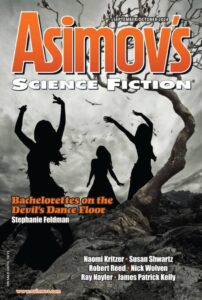
Heartshock by Nick Wolven The Four Sisters Overlooking the Sea by Naomi Kritzer In the Dark by James Patrick Kelly And to Their Shining Palaces Go by Betsy Aoki All the Homes of Terror by Robert Reed
SHORT STORIES
Art Deco Farmhouse, Original Hardwood Floors, Slightly Haunted by Alice Towey Bachelorettes on the Devil's Dance Floor by Stephanie Feldman An Unplanned Hold by Zohar Jacobs Bitter Chai, Sweet Chai by Anita Vijayakumar Lost Recall by Robert R. Chase Eternity Is Moments by R.P. Sand Project Fafnir by Susan Shwartz A Gray Magic by Ray Nayler
POETRY
Like a Haiku by Kendall Evans Futurisms (What Is It Now?) by David Sandner Wanted: by Sai Liuko Eating With the Dead #1 by Mary Soon Lee In a Vial on the Windowsill You'll Find It by Marisca Pichette You Finally Understand Quantum Mechanics by Robert Persons Wanted—Personal Demon by Mary Soon Lee The Kelpie's Back by Jane Yolen Awakening by Greg Schwartz
DEPARTMENTS
Editorial: Magnifique! by Sheila Williams Reflections: The Man Who Saw the Future by Robert Silverberg On the Net: The Music of the Future by James Patrick Kelly Thought Experiment: Nuclear War, Satire, and the Grotesque in Dr. Strangelove by Kelly Lagor On Books by Norman Spinrad
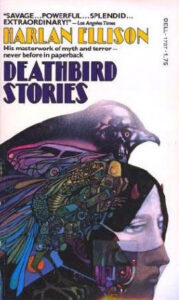
Harlan Ellison's masterwork of myth and terror as he seduces all innocence on a mind-freezing odyssey into the darkest reaches of mortal terror and the most dazzling heights of Olympian hell in his finest collection.
Deathbird Stories is a collection of 19 of Harlan Ellison's best stories, including Edgar and Hugo winners, originally published between 1960 and 1974. The collection contains some of Ellison's best stories from earlier collections and is judged by some to be his most consistently high quality collection of short fiction. The theme of the collection can be loosely defined as God, or Gods. Sometimes they're dead or dying, some of them are as brand-new as today's technology. Unlike some of Ellison's collections, the introductory notes to each story can be as short as a phrase and rarely run more than a sentence or two. One story took a Locus Poll Award, the two final ones both garnered Hugo Awards and Locus Poll awards, and the final one also received a Jupiter Award from the Instructors of Science Fiction in Higher Education (discontinued in 1979). When the collection was published in Britain, it won the 1979 British Science Fiction Award for Short Fiction.
"His stories will rivet you to the floor and change your heartbeat...as unforgettable a chamber of horror, fantasy and reality as you'll ever experience." -Gallery
"Brutally and flamboyantly shocking, frequently brilliant, and always irresistibly mesmerizing." -Richmond Times-Dispatch
Contents:
· Introduction: Oblations at Alien Altars · The Whimper of Whipped Dogs · ss Bad Moon Rising, ed. Thomas M. Disch, Harper&Row, 1973 · Along the Scenic Route [“Dogfight on 101”] · ss Adam Aug’69; Amazing Sep’69 · On the Downhill Side · ss Universe 2, ed. Terry Carr, Ace, 1972 · O Ye of Little Faith · ss Knight Sep’68 · Neon · ss The Haunt of Horror Aug’73 · Basilisk · ss F&SF Aug’72 · Pretty Maggie Moneyeyes · nv Knight May’67 · Corpse · ss F&SF Jan’72 · Shattered Like a Glass Goblin · ss Orbit 4, ed. Damon Knight, G.P. Putnam’s, 1968 · Delusion for a Dragon Slayer · ss Knight Sep’66 · The Face of Helene Bournouw · ss Collage Oct’60 · Bleeding Stones · ss Vertex Apr’73 · At the Mouse Circus · ss New Dimensions I, ed. Robert Silverberg, Doubleday, 1971 · The Place with No Name · ss F&SF Jul’69 · Paingod · ss Fantastic Jun’64 · Ernest and the Machine God · nv Knight Jan’68 · Rock God · ss Coven 13 Nov’69 · Adrift Just Off the Islets of Langerhans: Latitude 38°54’N, Longitude 77°00’13"W · nv F&SF Oct’74 · The Deathbird · nv F&SF Mar’73
Best known for the 1892 title story of this collection, a harrowing tale of a woman's descent into madness, Charlotte Perkins Gilman wrote more than 200 other short stories. Seven of her finest are reprinted here.
Written from a feminist perspective, often focusing on the inferior status accorded to women by society, the tales include "turned," an ironic story with a startling twist, in which a husband seduces and impregnates a naïve servant; "Cottagette," concerning the romance of a young artist and a man who's apparently too good to be true; "Mr. Peebles' Heart," a liberating tale of a fiftyish shopkeeper whose sister-in-law, a doctor, persuades him to take a solo trip to Europe, with revivifying results; "The Yellow Wallpaper"; and three other outstanding stories.
These charming tales are not only highly readable and full of humor and invention, but also offer ample food for thought about the social, economic, and personal relationship of men and women — and how they might be improved.
Collects: —The Yellow Wallpaper —Three Thanksgivings —The Cottagette —Turned —Making a Change —If I Were a Man —Mr. Peebles' Heart
Ijon Tichy travels undercover to a robot world, joining an organization to clean up world history thru time travel.
Things go crazy immediately. His spaceship runs into gravitational vortices at relativistic speeds, resulting in massive time anomalies. It may be a blessing in disguise. The reason he couldn’t get out of the way was that a meteor had shattered the drive regulator & rudder. He could no longer steer his ship. He had a spare rudder, but couldn’t install it. It was a two-man job & he was alone. So when other versions of him start appearing, all he should need do is team up with one of them, fix the rudder & leave the gravitational vortex field.
After that gets straightened out, he goes undercover. A ship’s computer has mutineed & started its own colony, reproducing itself on a previously uninhabited planet. The insurance company paid the shipowner’s claim, & now believes that the ship, it’s computer & all its progeny belong to them. Tichy disguises himself as a robot & goes to investigate.
On another voyage, he heads to a planet where the government irrigation agency has irrigated beyond all need & refused to give up power. People live in water & are jailed in dry cells if they violate the love of water.
After his modern voyages, he comes back from 2166 to recruit himself as a member of THEOHIPPIP, the Teleotelechronistic-Historical Engineering to Optimize the Hyperputerized Implementation of Paleological Programming & Interplanetary Planning. History is in a mess because of all the time travelers. THEOHIPPIP's mission is: “For World History to be regulated, cleaned up, straightened out, adjusted & perfected, all in accordance with the principles of humanitarianism, rationalism & general esthetics. You can understand, surely, that with such a shambles & slaughterhouse in one’s family tree it’s awkward to go calling on important cosmic civilizations!...If need be, alterations will be made even before the rise of man, so that he arises better.”
A classic work of American literature that has not stopped changing minds and lives since it burst onto the literary scene, The Things They Carried is a ground-breaking meditation on war, memory, imagination, and the redemptive power of storytelling.
The Things They Carried depicts the men of Alpha Company: Jimmy Cross, Henry Dobbins, Rat Kiley, Mitchell Sanders, Norman Bowker, Kiowa, and the character Tim O’Brien, who has survived his tour in Vietnam to become a father and writer at the age of forty-three.
Taught everywhere—from high school classrooms to graduate seminars in creative writing—it has become required reading for any American and continues to challenge readers in their perceptions of fact and fiction, war and peace, courage and fear and longing. The Things They Carried won France's prestigious Prix du Meilleur Livre Etranger and the Chicago Tribune Heartland Prize; it was also a finalist for the Pulitzer Prize and the National Book Critics Circle Award.
Welcome Back!
Track your reading progress and sync your library.