From the Earth to the Moon
Een in de 19e eeuw geschreven verhaal over een reis naar de maan, waaruit blijkt dat de schrijver in technisch opzicht zijn tijd ver vooruit was
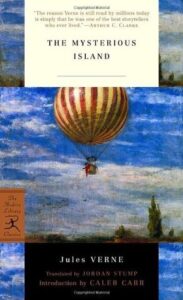
Based on the true story of Alexander Selkirk, who survived alone for almost five years on an uninhabited island off the coast of Chile, The Mysterious Island is considered by many to be Jules Verne’s masterpiece. “Wide-eyed mid-nineteenth-century humanistic optimism in a breezy, blissfully readable translation by Stump” (Kirkus Reviews), here is the enthralling tale of five men and a dog who land in a balloon on a faraway, fantastic island of bewildering goings-on and their struggle to survive as they uncover the island’s secret.
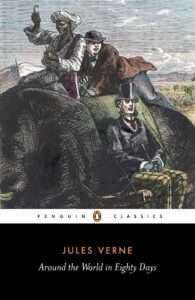
One night in the reform club, Phileas Fogg bets his companions that he can travel across the globe in just eighty days. Breaking the well-established routine of his daily life, he immediately sets off for Dover with his astonished valet Passepartout. Passing through exotic lands and dangerous locations, they seize whatever transportation is at hand—whether train or elephant—overcoming set-backs and always racing against the clock.
An adventurous geology professor chances upon a manuscript in which a 16th-century explorer claims to have found a route to the earth's core. Professor Lidenbrock can't resist the opportunity to investigate, and with his nephew Axel, he sets off across Iceland in the company of Hans Bjelke, a native guide.
The expedition descends into an extinct volcano toward a sunless sea, where they encounter a subterranean world of luminous rocks, antediluvian forests, and fantastic marine life — a living past that holds the secrets to the origins of human existence.
An alternative cover edition for this ISBN can be found here
Thrown in prison for a crime he has not committed, Edmond Dantes is confined to the grim fortress of If. There he learns of a great hoard of treasure hidden on the Isle of Monte Cristo and becomes determined not only to escape but to unearth the treasure and use it to plot the destruction of the three men responsible for his incarceration. A huge popular success when it was first serialized in the 1840s, Dumas was inspired by a real-life case of wrongful imprisonment when writing his epic tale of suffering and retribution.
This is a reproduction of the original artefact. Generally these books are created from careful scans of the original. This allows us to preserve the book accurately and present it in the way the author intended. Since the original versions are generally quite old, there may occasionally be certain imperfections within these reproductions. We're happy to make these classics available again for future generations to enjoy!
Une aventure de Louis Denizart Hippolyte Griffont, mage du Cercle Cyan, sur rendez-vous uniquement. Un roman de Fantasy dans un Paris 1900 qui cohabite avec l’Outre-monde : entre brigades du tigre et licornes, entre mages et Belle Epoque, les débuts d’un couple d’enquêteurs tenant à la fois d’Arsène Lupin de Mata-Hari et de Gandalf le Gris. Une Fantasy “ steampunk ” qui renouvelle formidablement le genre...
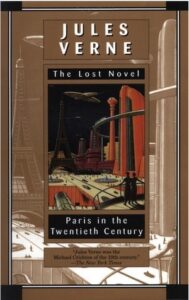
In 1863 Jules Verne, famed author of 20,000 Leagues Under the Sea and Journey to the Center of the Earth, wrote a novel that his literary agent deemed too far fetched to be published. More than one hundred years later, his great-grandson found the handwritten, never-before published manuscript in a safe. That manuscript was Paris in the Twentieth Century, and astonishingly prophetic view into the future by one of the most renowned science fiction writers of our time. . . .
Praise for Paris in the Twentieth Century
“Jules Verne was the Michael Crichton of the 19th century.” — The New York Times
“For anyone interested in the history of speculative fiction . . . this book is an absolute necessity.” —Ray Bradbury
“Verne's Paris is a bustling, overcrowded metropolis teeming with starving homeless and ‘vehicles that passed on paved roads and moved without horses.’ Years before they would be invented, Verne has imagined elevators and faxmachines. It was a vision Verne's editor flatly rejected. Contemporary readers know better.” — People
“An excellent extrapolation, founded on 19th-century technical novelties, of a future culture.” — The Washington Post Book World
“Verne published nearly seventy books, many of them now considered classics. But this little jewel catches him just reaching stride as a writer of science fiction, a genre that he, of course, helped put on the literary map.” — The Denver Post
"I am confiding this manuscript to space, not with the intention of saving myself, but to help, perhaps, to avert the appalling scourge that is menacing the human race. Lord have pity on us!"
With these words, Pierre Boulle hurtles the reader onto the Planet of the Apes. In this simian world, civilization is turned upside down: apes are men and men are apes; apes rule and men run wild; apes think, speak, produce, wear clothes, and men are speechless, naked, exhibited at fairs, used for biological research. On the planet of the apes, man, having reached to apotheosis of his genius, has become inert.
To this planet come a journalist and a scientist. The scientist is put into a zoo, the journalist into a laboratory. Only the journalist retains the spiritual strength and creative intelligence to try to save himself, to fight the appalling scourge, to remain a man.
Out of this situation, Pierre Boulle has woven a tale as harrowing, bizarre, and meaningful as any in the brilliant roster of this master storyteller. With his customary wit, irony, and disciplined intellect and style, the author of The Bridge Over the River Kwai tells a swiftly moving story dealing with man's conflicts, and takes the reader into a suspenseful and strangely fascinating orbit.