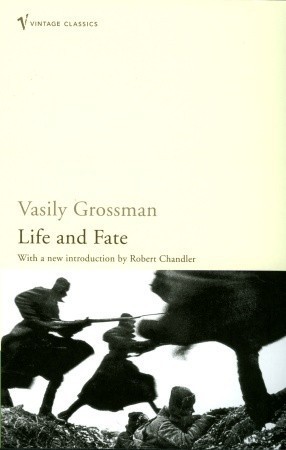
Life and Fate is an epic tale of a country told through the fate of a single family, the Shaposhnikovs. As the battle of Stalingrad looms, Grossman’s characters must work out their destinies in a world torn apart by ideological tyranny and war.
Completed in 1960 and then confiscated by the KGB, this sweeping panorama of Soviet society remained unpublished until it was smuggled into the West in 1980, where it was hailed as a masterpiece.
Librarian’s Note: This is an alternative cover edition of ISBN13: 9780099506164
In Russia's struggle with Napoleon, Tolstoy saw a tragedy that involved all mankind.
War and Peace broadly focuses on Napoleon’s invasion of Russia in 1812 and follows three of the most well-known characters in literature: Pierre Bezukhov, the illegitimate son of a count who is fighting for his inheritance and yearning for spiritual fulfillment; Prince Andrei Bolkonsky, who leaves his family behind to fight in the war against Napoleon; and Natasha Rostov, the beautiful young daughter of a nobleman who intrigues both men.
As Napoleon’s army invades, Tolstoy brilliantly follows characters from diverse backgrounds—peasants and nobility, civilians and soldiers—as they struggle with the problems unique to their era, their history, and their culture. And as the novel progresses, these characters transcend their specificity, becoming some of the most moving—and human—figures in world literature.
Tolstoy gave his personal approval to this translation, published here in a new single volume edition, which includes an introduction by Henry Gifford, and Tolstoy's important essay `Some Words about War and Peace'.
This epic tale about the effects of the Russian Revolution and its aftermath on a bourgeois family was not published in the Soviet Union until 1987. One of the results of its publication in the West was Pasternak's complete rejection by Soviet authorities; when he was awarded the Nobel Prize for Literature in 1958 he was compelled to decline it. The book quickly became an international best-seller.
Dr. Yury Zhivago, Pasternak's alter ego, is a poet, philosopher, and physician whose life is disrupted by the war and by his love for Lara, the wife of a revolutionary. His artistic nature makes him vulnerable to the brutality and harshness of the Bolsheviks. The poems he writes constitute some of the most beautiful writing featured in the novel.
Román vypráví o osudu mukla a věčného vyhnance Olega Kostoglotova, který se v polovině padesátých let přichází léčit na taškentskou onkologickou kliniku. Je to v době, kdy Stalin je již dva roky mrtev, Berija popraven a kdy se začínají objevovat první nesmělé náznaky změn. Na onkologické klinice se setkávají členové strany i vyhnanci, národy, které sem Stalin vysídlil, i původní obyvatelé, lékaři i pacienti. Jejich společným nepřítelem je rakovina: nemoc, smrt, konec života... V blízkosti smrti padají všechny dosavadní jistoty, všechny plány, všechna privilegia. A v tomto světě rozehrává Solženicyn příběhy svých hrdinů, jejich lásek a nadějí. Nádory, sarkomy a metanoblastomy jsou nejen krutou skutečností, s níž se potýkají hrdinové románu i lékaři, ale i metaforou pro rakovinu lži, přetvářky, násilí a útlaku, která metastázuje do všech vrstev ruské společnosti.
Acclaimed by many as the world's greatest novel, Anna Karenina provides a vast panorama of contemporary life in Russia and of humanity in general. In it Tolstoy uses his intense imaginative insight to create some of the most memorable characters in all of literature. Anna is a sophisticated woman who abandons her empty existence as the wife of Karenin and turns to Count Vronsky to fulfil her passionate nature - with tragic consequences. Levin is a reflection of Tolstoy himself, often expressing the author's own views and convictions.
Throughout, Tolstoy points no moral, merely inviting us not to judge but to watch. As Rosemary Edmonds comments, 'He leaves the shifting patterns of the kaleidoscope to bring home the meaning of the brooding words following the title, 'Vengeance is mine, and I will repay.
And Quiet Flows the Don or Quietly Flows the Don (Тихий Дон, lit. "The Quiet Don") is 4-volume epic novel by Russian writer Mikhail Aleksandrovich Sholokhov. The 1st three volumes were written from 1925 to '32 & published in the Soviet magazine October in 1928–32. The 4th volume was finished in 1940. The English translation of the 1st three volumes appeared under this title in 1934. The novel is considered one of the most significant works of Russian literature in the 20th century. It depicts the lives & struggles of Don Cossacks during WWI, the Russian Revolution & Russian Civil War. In 1965, Sholokhov was awarded the Nobel Prize for Literature. The authorship of the novel is contested by some literary critics & historians, who believe it wasn't entirely written by Sholokhov. However, following the discovery of the manuscript, the consensus is that the work is, in fact, Sholokhov’s.
The only English translation authorized by Aleksandr Solzhenitsyn
First published in the Soviet journal Novy Mir in 1962, One Day in the Life of Ivan Denisovich stands as a classic of contemporary literature. The story of labor-camp inmate Ivan Denisovich Shukhov, it graphically describes his struggle to maintain his dignity in the face of communist oppression. An unforgettable portrait of the entire world of Stalin's forced work camps, One Day in the Life of Ivan Denisovich is one of the most extraordinary literary documents to have emerged from the Soviet Union and confirms Solzhenitsyn's stature as "a literary genius whose talent matches that of Dosotevsky, Turgenev, Tolstoy"--Harrison Salisbury
This unexpurgated 1991 translation by H. T. Willetts is the only authorized edition available, and fully captures the power and beauty of the original Russian.
In this magnificent work of fiction, William T. Vollmann turns his trenchant eye to the authoritarian cultures of Germany and the USSR in the twentieth century. Assembling a composite portrait of these two warring leviathans and the terrible age they defined, the narrative intertwines experiences both real and fictional—a young German who joins the SS to expose its crimes, two generals who collaborate with the enemy for different reasons, the Soviet composer Dmitri Shostakovich laboring under Stalinist oppression. Through these and other lives, Vollmann offers a daring and mesmerizing perspective on human actions during wartime.
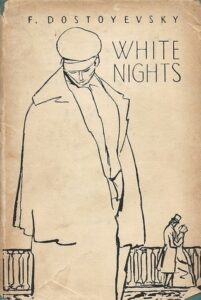
White Nights is a short story by Fyodor Dostoevsky that was published in 1848. Set in St. Petersburg, it is the story of a young man fighting his inner restlessness. A light and tender narrative, it delves into the torment and guilt of unrequited love. Both protagonists suffer from a deep sense of alienation that initially brings them together. A blend of romanticism and realism, the story appeals gently to the senses and feelings.
Welcome Back!
Track your reading progress and sync your library.