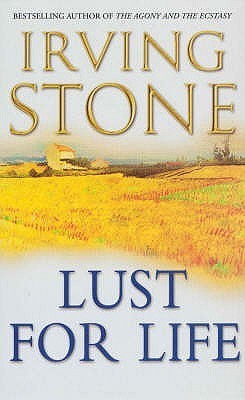
Lust for Life is the classic fictional re-telling of the incredible life of Vincent Van Gogh.
“Vincent is not dead. He will never die. His love, his genius, the great beauty he has created will go on forever, enriching the world… He was a colossus… a great painter… a great philosopher… a martyr to his love of art. “
Walking down the streets of Paris the young Vincent Van Gogh didn’t feel like he belonged. Battling poverty, repeated heartbreak and familial obligation, Van Gogh was a man plagued by his own creative urge but with no outlet to express it. Until the day he picked up a paintbrush.
Written with raw insight and emotion, follow the artist through his tormented life, struggling against critical discouragement and mental turmoil and bare witness to his creative journey from a struggling artist to one of the world’s most celebrated artists.
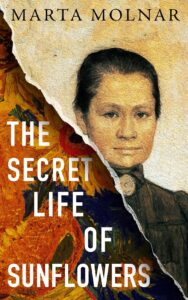
A gripping, inspiring novel based on the true story of Johanna Bonger, Vincent van Gogh's sister-in-law.
When Hollywood auctioneer Emsley Wilson finds her famous grandmother's diary while cleaning out her New York brownstone, the pages are full of surprises. The first surprise is, the diary isn't her grandmother's. It belongs to Johanna Bonger, Vincent van Gogh's sister-in-law.
Johanna inherited Vincent van Gogh's paintings. They were all she had, and they weren't worth anything. She was a 28 year old widow with a baby in the 1800s, without any means of supporting herself, living in Paris where she barely spoke the language. Yet she managed to introduce Vincent's legacy to the world.
The inspiration couldn't come at a better time for Emsley. With her business failing, an unexpected love turning up in her life, and family secrets unraveling, can she find answers in the past?
Would you rather sacrifice your livelihood, your lover, or your life? When the Black Death comes knocking on your door, you'd better decide quickly.
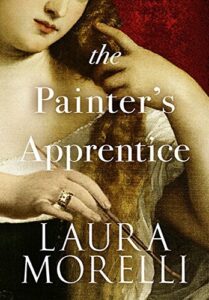
Venice, 1510. Maria Bartolini wants nothing more than to carry on her father’s legacy as a master gilder. Instead, her father has sent her away from the only home she’s ever known to train as an apprentice to Master Trevisan, a renowned painter. Maria arranges to leave the painter’s workshop to return to her family workshop and to a secret lover waiting for her. But the encroaching Black Death foils her plans…
When the painter’s servants uncover the real reason why Maria has been sent away to train with Master Trevisan, they threaten to reveal a secret that could tear down her family and the future of their trade. She is forced to buy the servants’ silence, but as their greed steadily grows, Maria resorts to more desperate measures. She questions whether her heart’s desire is worth risking her family, her trade, and her future, but Maria’s sacrifices may amount to nothing if the plague steals away everything she’s ever loved…
From the author of the award-winning "The Gondola Maker" comes a rich tale of Renaissance Venice, a heroine with a lust for life, and love against all odds.
Buy "The Painter’s Apprentice" today to transport yourself to the vibrant and dangerous world of 16th-century Venice…
Based on the life of Paul Gauguin, The Moon and Sixpence is W. Somerset Maugham's ode to the powerful forces behind creative genius. Charles Strickland is a staid banker, a man of wealth and privilege. He is also a man possessed of an unquenchable desire to create art. As Strickland pursues his artistic vision, he leaves London for Paris and Tahiti, and in his quest makes sacrifices that leave the lives of those closest to him in tatters. Through Maugham's sympathetic eye, Strickland's tortured and cruel soul becomes a symbol of the blessing and the curse of transcendent artistic genius, and the cost in humans' lives it sometimes demands.
In her most accomplished novel, Barbara Kingsolver takes us on an epic journey from the Mexico City of artists Diego Rivera and Frida Kahlo to the America of Pearl Harbor, FDR, and J. Edgar Hoover. The Lacuna is a poignant story of a man pulled between two nations as they invent their modern identities.
Born in the United States, reared in a series of provisional households in Mexico—from a coastal island jungle to 1930s Mexico City—Harrison Shepherd finds precarious shelter but no sense of home on his thrilling odyssey. Life is whatever he learns from housekeepers who put him to work in the kitchen, errands he runs in the streets, and one fateful day, by mixing plaster for famed Mexican muralist Diego Rivera. He discovers a passion for Aztec history and meets the exotic, imperious artist Frida Kahlo, who will become his lifelong friend. When he goes to work for Lev Trotsky, an exiled political leader fighting for his life, Shepherd inadvertently casts his lot with art and revolution, newspaper headlines and howling gossip, and a risk of terrible violence.
Meanwhile, to the north, the United States will soon be caught up in the internationalist goodwill of World War II. There in the land of his birth, Shepherd believes he might remake himself in America's hopeful image and claim a voice of his own. He finds support from an unlikely kindred soul, his stenographer, Mrs. Brown, who will be far more valuable to her employer than he could ever know. Through darkening years, political winds continue to toss him between north and south in a plot that turns many times on the unspeakable breach—the lacuna—between truth and public presumption.
With deeply compelling characters, a vivid sense of place, and a clear grasp of how history and public opinion can shape a life, Barbara Kingsolver has created an unforgettable portrait of the artist—and of art itself. The Lacuna is a rich and daring work of literature, establishing its author as one of the most provocative and important of her time.
Celebrating the 500th anniversary of Michelangelo’s David, New American Library releases a special edition of Irving Stone’s classic biographical novel—in which both the artist and the man are brought to life in full. A masterpiece in its own right, this novel offers a compelling portrait of Michelangelo’s dangerous, impassioned loves, and the God-driven fury from which he wrested the greatest art the world has ever known.
With precisely 35 canvases to his credit, the Dutch painter Johannes Vermeer represents one of the great enigmas of 17th-century art. The meager facts of his biography have been gleaned from a handful of legal documents. Yet Vermeer's extraordinary paintings of domestic life, with their subtle play of light and texture, have come to define the Dutch golden age. His portrait of the anonymous Girl with a Pearl Earring has exerted a particular fascination for centuries—and it is this magnetic painting that lies at the heart of Tracy Chevalier's second novel of the same title.
Girl with a Pearl Earring centers on Vermeer's prosperous Delft household during the 1660s. When Griet, the novel's quietly perceptive heroine, is hired as a servant, turmoil follows. First, the 16-year-old narrator becomes increasingly intimate with her master. Then Vermeer employs her as his assistant—and ultimately has Griet sit for him as a model.
This is a previously-published edition of ISBN 9781400031047.
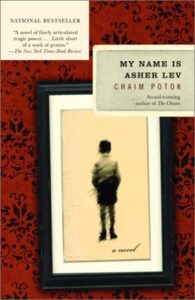
Asher Lev is a Ladover Hasid who keeps kosher, prays three times a day, and believes in the Ribbono Shel Olom, the Master of the Universe. Asher Lev is an artist who is compulsively driven to render the world he sees and feels, even when it leads him to blasphemy. In this stirring and often visionary novel, Chaim Potok traces Asher’s passage between these two identities, the one consecrated to God, the other subject only to the imagination.
Asher Lev grows up in a cloistered Hasidic community in postwar Brooklyn, a world suffused by ritual and revolving around a charismatic Rebbe. But in time, his gift threatens to estrange him from that world and the parents he adores. As it follows his struggle, My Name Is Asher Lev becomes a luminous portrait of the artist, by turns heartbreaking and exultant, a modern classic.
Bit by bit, the ravages of age are eroding Marina's grip on the everyday. And while the elderly Russian woman cannot hold on to fresh memories—the details of her grown children's lives, the approaching wedding of her grandchild—her distant past is preserved: vivid images that rise unbidden of her youth in war-torn Leningrad.
In the fall of 1941, the German army approached the outskirts of Leningrad, signaling the beginning of what would become a long and torturous siege. During the ensuing months, the city's inhabitants would brave starvation and the bitter cold, all while fending off the constant German onslaught. Marina, then a tour guide at the Hermitage Museum, along with other staff members, was instructed to take down the museum's priceless masterpieces for safekeeping, yet leave the frames hanging empty on the walls—a symbol of the artworks' eventual return. To hold on to sanity when the Luftwaffe's bombs began to fall, she burned to memory, brushstroke by brushstroke, these exquisite artworks: the nude figures of women, the angels, the serene Madonnas that had so shortly before gazed down upon her. She used them to furnish a "memory palace," a personal Hermitage in her mind to which she retreated to escape terror, hunger, and encroaching death. A refuge that would stay buried deep within her, until she needed it once more. . . .
Welcome Back!
Track your reading progress and sync your library.