Nine Stories
DeDaumier-Smith’s Blue Period, Teddy, and A Perfect Day for Bananafish are among the nine works in a collection of Salinger’s perceptive and realistic short stories
Here are sixty-one stories that chronicle the lives of what has been called "the greatest generation." From the early wonder and disillusionment of city life in "The Enormous Radio" to the surprising discoveries and common mysteries of suburbia in "The Housebreaker of Shady Hill" and "The Swimmer," Cheever tells us everything we need to know about "the pain and sweetness of life."
Goodbye, my brother --
The common day --
The enormous radio --
O city of broken dreams --
The Hartleys --
The Sutton Place story --
The summer farmer --
Torch song --
The pot of gold --
Clancy in the Tower of Babel --
Christmas is a sad season for the poor --
The season of divorce --
The chaste Clarissa --
The cure --
The superintendent --
The children --
The sorrows of gin --
O youth and beauty! --
The day the pig fell into the well --
The five-forty-eight --
Just one more time --
The housebreaker of Shady Hill --
The bus to St. James's --
The worm in the apple --
The trouble of Marcie Flint --
The bella lingua --
The Wrysons --
The country husband --
The duchess --
The scarlet moving van --
Just tell me who it was --
Brimmer --
The golden age --
The lowboy --
The music teacher --
A woman without a country --
The death of Justina --
Clementina --
Boy in Rome --
A miscellany of characters that will not appear --
The chimera --
The seaside houses --
The angel of the bridge --
The brigadier and the golf widow --
A vision of the world --
Reunion --
An educated American woman --
Metamorphoses --
Mene, mene, tekel, upharsin --
Montraldo --
The ocean --
Marito in città --
The geometry of love --
The swimmer --
The world of apples --
Another story --
Percy --
The fourth alarm --
Artemis, the honest well digger --
Three stories --
The jewels of the Cabots.
Winesburg, Ohio depicts the strange, secret lives of the inhabitants of a small town. In "Hands," Wing Biddlebaum tries to hide the tale of his banishment from a Pennsylvania town, a tale represented by his hands. In "Adventure," lonely Alice Hindman impulsively walks naked into the night rain. Threaded through the stories is the viewpoint of George Willard, the young newspaper reporter who, like his creator, stands witness to the dark and despairing dealings of a community of isolated people.
At the time of his death in 1962, E. E. Cummings was, next to Robert Frost, the most widely read poet in America. Combining Thoreau's controlled belligerence with the brash abandon of an uninhibited bohemian, Cummings, together with Pound, Eliot, and William Carlos Williams, helped bring about the twentieth-century revolution in literary expression. He is recognized on the one hand as the author of some of the most beautiful lyric poems written in the English language, and on the other as one of the most inventive American poets of his time in the worlds of Richard Kostelanetz, "the major American poet of the middle-twentieth-century."
Miss Lonelyhearts
Miss Lonelyhearts was a newspaper reporter, so named because he had been assigned to write the agony column, to answer the letters from Desperate, Sick-of-It-All, Disillusioned. A joke at first; but then he was caught up, terrifyingly, in a vision of suffering, and he sought a way out, turning first here, then there—Art, Sex, Religion. Shrike, the cynical editor, the friend and enemy, compulsively destroyed each of his friend’s gestures toward idealism. Together, in the city’s dim underworld, Shrike and Miss Lonelyhearts turn round and round in a loathsome dance, unresolvable, hating until death…
The Day of the Locust
To Hollywood comes Tod Hackett, hoping for a career in scene designing, but he finds the way hard and falls in with others—extras, technicians, old vaudeville hands—who are also in difficulty. Around him he sees the great mass of inland Americans who have retired to California in expectation of health and ease. But boredom consumes them, their own emptiness maddens them; they search out any abnormality in their lust for excitement—drugs, perversion, crime. In the end only blood will serve; unreasoned, undirected violence. The day of the locust is at hand…
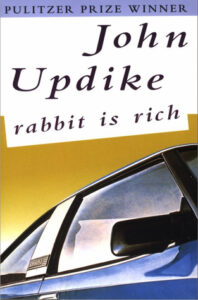
Winner of the 1982 Pulitzer Prize for Fiction.
Ten years after Rabbit Redux, Harry Angstrom has come to enjoy prosperity as the Chief Sales Representative of Springer Motors. The rest of the world may be falling to pieces, but Harry's doing all right. That is, until his son returns from the West, and the image of an old love pays a visit to his lot....
This book contains two separate stories: "Raise High the Roof Beam, Carpenters" is the first, and "Seymour: An Introduction" is the second.
"Raise High the Roof Beam, Carpenters" is a story about the Glass family, narrated by Buddy, the second oldest brother. Buddy is attending his brother Seymour's wedding to a gal named Muriel, but he's on Army leave during active duty in World War II. At the wedding, everyone is stunned when Seymour does not show up.
The action of the story picks up when several characters end up carpooling together following the failed wedding. The others (the Matron of Honor and her husband, and a couple of stragglers) are talking about Seymour and the disappointment of his not showing up, and Buddy never tells them that he is secretly Seymour's brother, so they talk more openly with him than they otherwise would.
They criticize Seymour and speculate about his character flaws and deficiencies, but Buddy finds their assessments quite judgmental and biased. He then decides to tell the car who he really is, shaming them for their loose criticisms.
He finds Seymour's journal, and he discovers a strange message from their sister Boo Boo for Seymour on their bathroom mirror: "Raise high the roof beam, carpenters. Like Ares comes the bridegroom/ taller far than a tall man." This is a fragment from the Greek poet Sappho.
"Seymour: An Introduction" is a kind of elegy for Seymour from Buddy, told in the form of an introduction to the reader. The reader makes Seymour's acquaintance while knowing that Seymour technically isn't alive when the story is published, having killed himself in 1948.
This portion of the story is told in stream of consciousness, and it discusses Eastern religious mysticism.

Alternate-cover edition can be found here
In his second collection, Carver establishes his reputation as one of the most celebrated and beloved short-story writers in American literature—a haunting meditation on love, loss, and companionship, and finding one’s way through the dark.
Jesus' Son, the first collection of stories by Denis Johnson, presents a unique, hallucinatory vision of contemporary American life unmatched in power and immediacy and marks a new level of achievement for this acclaimed writer. In their intensity of perception, their neon-lit evocation of a strange world brought uncomfortably close to our own, the stories in Jesus' Son offer a disturbing yet eerily beautiful portrayal of American loneliness and hope.
Contains:
Car Crash While Hitchhiking
Two Men
Out on Bail
Dundun
Work
Emergency
Dirty Wedding
The Other Man
Happy Hour
Steady Hands at Seattle General
Beverly Home'