An alternative cover edition for this ISBN can be found here.
An acclaimed bestseller and international sensation, Patrick Suskind’s classic novel provokes a terrifying examination of what happens when one man’s indulgence in his greatest passion—his sense of smell—leads to murder.
In the slums of eighteenth-century France, the infant Jean-Baptiste Grenouille is born with one sublime gift—an absolute sense of smell. As a boy, he lives to decipher the odors of Paris, and apprentices himself to a prominent perfumer who teaches him the ancient art of mixing precious oils and herbs. But Grenouille’s genius is such that he is not satisfied to stop there, and he becomes obsessed with capturing the smells of objects such as brass doorknobs and fresh-cut wood. Then one day he catches a hint of a scent that will drive him on an ever-more-terrifying quest to create the “ultimate perfume”—the scent of a beautiful young virgin. Told with dazzling narrative brilliance, Perfume is a hauntingly powerful tale of murder and sensual depravity.
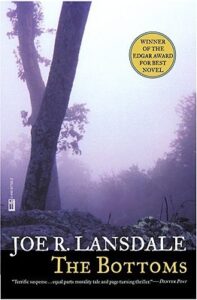
The narrator of The Bottoms is Harry Collins, an old man obsessively reflecting on certain key experiences of his childhood. In 1933, the year that forms the centerpiece of the narrative, Harry is 11 years old and living with his mother, father, and younger sister on a farm outside of Marvel Creek, Texas, near the Sabine River bottoms. Harry's world changes forever when he discovers the corpse of a young black woman tied to a tree in the forest near his home. The woman, who is eventually identified as a local prostitute, has been murdered, molested, and sexually mutilated. She is also, as Harry will soon discover, the first in a series of similar corpses, all of them the victims of a new, unprecedented sort of monster: a traveling serial killer.
From his privileged position as the son of constable (and farmer and part-time barber) Jacob Collins, Harry watches as the distinctly amateur investigation unfolds. As more bodies -- not all of them "colored" -- surface, the mood of the local residents darkens. Racial tensions -- never far from the surface, even in the best of times -- gradually kindle. When circumstantial evidence implicates an ancient, innocent black man named Mose, the Ku Klux Klan mobilizes, initiating a chilling, graphically described lynching that will occupy a permanent place in Harry Collins's memories. With Mose dead and the threat to local white women presumably put to rest, the residents of Marvel Creek resume their normal lives, only to find that the actual killer remains at large and continues to threaten the safety and stability of the town.
Lansdale uses this protracted murder investigation to open up a window on an insular, poverty-stricken, racially divided community. With humor, precision, and great narrative economy, he evokes the society of Marvel Creek in all its alternating tawdriness and nobility, offering us a varied, absolutely convincing portrait of a world that has receded into history. At the same time, he offers us a richly detailed re-creation of the vibrant, dangerous physical landscapes that were part of that world and have since been buried under the concrete and cement of the industrialized juggernaut of the late 20th century. In Lansdale's hands, the gritty realities of Depression-era Texas are as authentic -- and memorable -- as anything in recent American fiction.
The Godfather—the epic tale of crime and betrayal that became a global phenomenon.
Almost fifty years ago, a classic was born. A searing portrayal of the Mafia underworld, The Godfather introduced readers to the first family of American crime fiction, the Corleones, and their powerful legacy of tradition, blood, and honor. The seduction of power, the pitfalls of greed, and the allegiance to family—these are the themes that have resonated with millions of readers around the world and made The Godfather the definitive novel of the violent subculture that, steeped in intrigue and controversy, remains indelibly etched in our collective consciousness.
1937. Tentara Jepang melakukan pembantaian besar-besaran di Nanking saat mereka melakukan invasi ke China. Mereka melakukan pemerkosaan, perampasan, pembakaran, serta eksekusi terhadap tawanan perang dan penduduk sipil. Ini merupakan peristiwa paling tragis yang dialami bangsa China. Karena kekejamannya di Nanking, seorang letnan Jepang bernama Junzo Fuyuki mendapat julukan yanwangye—si Iblis.
1990. Fuyuki menjadi pemimpin sebuah geng Yakuza. Ia dipercaya biasa menyantap daging manusia agar tetap sehat dan panjang umur. Fuyuki selalu didampingi oleh tangan kanannya, Suster Ogawa, yang dijuluki Jahanam Saitama karena kesadisannya. Suster Ogawa telah menjadi mitos di dunia bawah tanah Jepang.
Shi Chongming, profesor di Universitas Todai, beserta Grey, seorang mahasiswa dari London, bekerja sama untuk mengungkap rahasia Fuyuki dan Pembantaian Nanking. Ketika satu per satu fakta terungkap, Grey berada dalam bahaya karena telah membangunkan kembali Iblis yang pernah merajalela dalam tragedi di Nanking dahulu...
Librarian note: an alternate cover for this edition can be found here.
The Jackal. A tall, blond Englishman with opaque, gray eyes. A killer at the top of his profession. A man unknown to any secret service in the world. An assassin with a contract to kill the world's most heavily guarded man.
One man with a rifle who can change the course of history. One man whose mission is so secretive not even his employers know his name. And as the minutes count down to the final act of execution, it seems that there is no power on earth that can stop the Jackal.
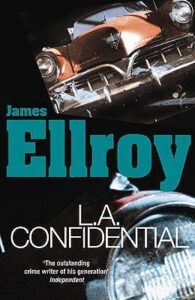
Christmas 1951, Los Angeles: a city where the police are as corrupt as the criminals. Six prisoners are beaten senseless in their cells by cops crazed on alcohol. For the three LAPD detectives involved, it will expose the guilty secrets on which they have built their corrupt and violent careers. The novel takes these cops on a sprawling epic of brutal violence and the murderous seedy side of Hollywood. One of the best crime novels ever written, it is the heart of Ellroy's four-novel masterpiece, the LA Quartet, and an example of crime writing at its most powerful.
December 1941: America teeters on the brink of war, and in Honolulu, Hawaii, police detective Joe McGrady is assigned to investigate a homicide that will change his life forever. Because the trail of murder he uncovers will lead him across the Pacific, far from home and the woman he loves; and though the U.S. doesn’t know it yet, a Japanese fleet is already steaming toward Pearl Harbor.
This extraordinary novel is so much more than just a gripping crime story—it’s a story of survival against all odds, of love and loss and the human cost of war. Spanning the entirety of World War II, Five Decembers is a beautiful, masterful, powerful novel that will live in your memory forever.
The world of Colonial America comes vibrantly to life in this masterful new historical thriller by Robert McCammon. The latest entry in the popular Matthew Corbett series, which began with Speaks the Nightbird and continued in The Queen of Bedlam, Mister Slaughter opens in the emerging metropolis of New York City in 1702, and proceeds to take both Matthew and the reader on an unforgettable journey of horror, violence, and personal discovery. The journey begins when Matthew, now an apprentice "problem solver" for the London-based Herrald Agency, accepts an unusual and hazardous commission. Together with his colleague, Hudson Greathouse, he agrees to escort the notorious mass murderer Tyranthus Slaughter from an asylum outside Philadelphia to the docks of New York. Along the way, Slaughter makes his captors a surprising - and extremely tempting - offer. Mister Slaughter is at once a classic portrait of an archetypal serial killer and an exquisitely detailed account of a fledgling nation still in the process of inventing itself.
MGB officer Leo is a man who never questions the Party Line. He arrests whomever he is told to arrest. He dismisses the horrific death of a young boy because he is told to, because he believes the Party stance that there can be no murder in Communist Russia. Leo is the perfect soldier of the regime. But suddenly his confidence that everything he does serves a great good is shaken. He is forced to watch a man he knows to be innocent be brutally tortured. And then he is told to arrest his own wife. Leo understands how the State works: Trust and check, but check particularly on those we trust. He faces a stark choice: his wife or his life. And still the killings of children continue...
Welcome Back!
Track your reading progress and sync your library.