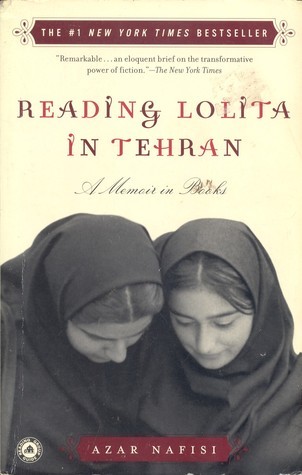
Every Thursday morning for two years in the Islamic Republic of Iran, a bold and inspired teacher named Azar Nafisi secretly gathered seven of her most committed female students to read forbidden Western classics. As Islamic morality squads staged arbitrary raids in Tehran, fundamentalists seized hold of the universities, and a blind censor stifled artistic expression, the girls in Azar Nafisi’s living room risked removing their veils and immersed themselves in the worlds of Jane Austen, F. Scott Fitzgerald, Henry James, and Vladimir Nabokov. In this extraordinary memoir, their stories become intertwined with the ones they are reading. Reading Lolita in Tehran is a remarkable exploration of resilience in the face of tyranny and a celebration of the liberating power of literature.
I come from a country that was created at midnight. When I almost died it was just after midday.
When the Taliban took control of the Swat Valley in Pakistan, one girl spoke out. Malala Yousafzai refused to be silenced and fought for her right to an education.
On Tuesday, October 9, 2012, when she was fifteen, she almost paid the ultimate price. She was shot in the head at point-blank range while riding the bus home from school, and few expected her to survive.
Instead, Malala's miraculous recovery has taken her on an extraordinary journey from a remote valley in northern Pakistan to the halls of the United Nations in New York. At sixteen, she has become a global symbol of peaceful protest and the youngest-ever Nobel Peace Prize laureate.
I Am Malala is the remarkable tale of a family uprooted by global terrorism, of the fight for girls' education, of a father who, himself a school owner, championed and encouraged his daughter to write and attend school, and of brave parents who have a fierce love for their daughter in a society that prizes sons.
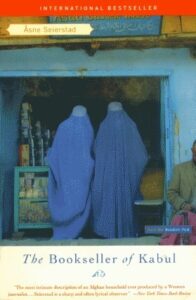
In spring 2002, following the fall of the Taliban, Åsne Seierstad spent four months living with a bookseller and his family in Kabul.
For more than twenty years Sultan Khan defied the authorities—be they communist or Taliban—to supply books to the people of Kabul. He was arrested, interrogated and imprisoned by the communists, and watched illiterate Taliban soldiers burn piles of his books in the street. He even resorted to hiding most of his stock—almost ten thousand books—in attics all over Kabul.
But while Khan is passionate in his love of books and his hatred of censorship, he also has strict views on family life and the role of women. As an outsider, Åsne Seierstad found herself in a unique position, able to move freely between the private, restricted sphere of the women—including Khan’s two wives—and the freer, more public lives of the men.
It is an experience that Seierstad finds both fascinating and frustrating. As she steps back from the page and allows the Khans to speak for themselves, we learn of proposals and marriages, hope and fear, crime and punishment. The result is a genuinely gripping and moving portrait of a family, and a clear-eyed assessment of a country struggling to free itself from history.' to 'This mesmerizing portrait of a proud man who, through three decades and successive repressive regimes, heroically braved persecution to bring books to the people of Kabul has elicited extraordinary praise throughout the world and become a phenomenal international bestseller. The Bookseller of Kabul is startling in its intimacy and its details—a revelation of the plight of Afghan women and a window into the surprising realities of daily life in today’s Afghanistan.'
The astonishing, uplifting story of a real-life Indiana Jones and his humanitarian campaign to use education to combat terrorism in the Taliban’s backyard
Anyone who despairs of the individual’s power to change lives has to read the story of Greg Mortenson, a homeless mountaineer who, following a 1993 climb of Pakistan’s treacherous K2, was inspired by a chance encounter with impoverished mountain villagers and promised to build them a school. Over the next decade he built fifty-five schools—especially for girls—that offer a balanced education in one of the most isolated and dangerous regions on earth. As it chronicles Mortenson’s quest, which has brought him into conflict with both enraged Islamists and uncomprehending Americans, Three Cups of Tea combines adventure with a celebration of the humanitarian spirit.
Pink is my favorite color. I used to say my favorite color was black to be cool, but it is pink—all shades of pink. If I have an accessory, it is probably pink. I read Vogue, and I’m not doing it ironically, though it might seem that way. I once live-tweeted the September issue.
In these funny and insightful essays, Roxane Gay takes us through the journey of her evolution as a woman of color while also taking readers on a ride through culture of the last few years and commenting on the state of feminism today. The portrait that emerges is not only one of an incredibly insightful woman continually growing to understand herself and our society, but also one of our culture.
Bad Feminist is a sharp, funny, and spot-on look at the ways in which the culture we consume becomes who we are, and an inspiring call-to-arms of all the ways we still need to do better.
Feel me, see me, hear me, reach me -- Peculiar benefits -- Typical first year professor -- To scratch, claw or grope clumsily or frantically -- How to be friends with another woman -- Girls, girls, girls -- I once was Miss America -- Garish, glorious spectacles -- Not here to make friends -- How we all lose -- Reaching for catharsis : getting fat right (or wrong) and Diana Spechler's Skinny -- The smooth surfaces of idyll -- The careless language of sexual violence -- What we hunger for -- The illusion of safety/the safety of illusion -- The spectacle of broken men -- A tale of three coming out stories -- Beyond the measure of men -- Some jokes are funnier than others -- Dear young ladies who love Chris Brown -- So much they would let him beat them -- Blurred lines, indeed -- The trouble with Prince Charming, or, He who trespassed against us -- The solace of preparing fried foods and other quaint remembrances from 1960s Mississippi : thoughts on The help -- Surviving Django -- Beyond the struggle narrative -- The morality of Tyler Perry -- The last day of a young black man -- When less is more -- The politics of respectability -- When Twitter does what journalism cannot -- The alienable rights of women -- Holding out for a hero -- A tale of two profiles -- The racism we all carry -- Tragedy, call, compassion, response -- Bad feminist : take one -- Bad feminist : take two
Maya Angelou’s debut memoir is a modern American classic beloved worldwide. Her life story is told in the documentary film And Still I Rise, as seen on PBS’s American Masters.
Here is a book as joyous and painful, as mysterious and memorable, as childhood itself. I Know Why the Caged Bird Sings captures the longing of lonely children, the brute insult of bigotry, and the wonder of words that can make the world right. Maya Angelou’s debut memoir is a modern American classic beloved worldwide.
Sent by their mother to live with their devout, self-sufficient grandmother in a small Southern town, Maya and her brother, Bailey, endure the ache of abandonment and the prejudice of the local “powhitetrash.” At eight years old and back at her mother’s side in St. Louis, Maya is attacked by a man many times her age—and has to live with the consequences for a lifetime. Years later, in San Francisco, Maya learns that love for herself, the kindness of others, her own strong spirit, and the ideas of great authors (“I met and fell in love with William Shakespeare”) will allow her to be free instead of imprisoned.
Poetic and powerful, I Know Why the Caged Bird Sings will touch hearts and change minds for as long as people read.
"In August 2003 a young Iraqi blogger began reporting her experiences as a civilian observer in Baghdad. Calling herself Riverbend, she has offered searing eyewitness accounts of daily life in the war zone and has garnered a worldwide audience hungry for unfiltered news and fresh analysis." "Riverbend's blog, Baghdad Burning, collected here for the first time, responds to events both personal and political - from the impact on her family of the invasion's aftermath to the Abu Ghraib prison abuses. She reveals for us most sharply the fate of Iraqi women, whose rights and freedoms are falling victim to rising fundamentalisms." Describing the reality of regime change in Iraq in a voice at turns outraged, witty, and deeply moving, Riverbend is a witness to the recent events that are shaping the future of her homeland.
Here, in one volume: Marjane Satrapi's best-selling, internationally acclaimed memoir-in-comic-strips.
Persepolis is the story of Satrapi's unforgettable childhood and coming of age within a large and loving family in Tehran during the Islamic Revolution; of the contradictions between private and public life in a country plagued by political upheaval; of her high school years in Vienna facing the trials of adolescence far from her family; of her homecoming—both sweet and terrible; and, finally, of her self-imposed exile from her beloved homeland. It is the chronicle of a girlhood and adolescence at once outrageous and familiar, a young life entwined with the history of her country yet filled with the universal trials and joys of growing up.
Edgy, searingly observant, and candid, often heartbreaking but threaded throughout with raw humor and hard-earned wisdom—Persepolis is a stunning work from one of the most highly regarded, singularly talented graphic artists at work today.
From the New York Times bestselling author of Bad Feminist: a searingly honest memoir of food, weight, self-image, and learning how to feed your hunger while taking care of yourself.
“I ate and ate and ate in the hopes that if I made myself big, my body would be safe. I buried the girl I was because she ran into all kinds of trouble. I tried to erase every memory of her, but she is still there, somewhere. . . . I was trapped in my body, one that I barely recognized or understood, but at least I was safe.”
In her phenomenally popular essays and long-running Tumblr blog, Roxane Gay has written with intimacy and sensitivity about food and body, using her own emotional and psychological struggles as a means of exploring our shared anxieties over pleasure, consumption, appearance, and health. As a woman who describes her own body as “wildly undisciplined,” Roxane understands the tension between desire and denial, between self-comfort and self-care. In Hunger, she explores her past—including the devastating act of violence that acted as a turning point in her young life—and brings readers along on her journey to understand and ultimately save herself.
With the bracing candor, vulnerability, and power that have made her one of the most admired writers of her generation, Roxane explores what it means to learn to take care of yourself: how to feed your hungers for delicious and satisfying food, a smaller and safer body, and a body that can love and be loved—in a time when the bigger you are, the smaller your world becomes.
Welcome Back!
Track your reading progress and sync your library.