The astonishing, uplifting story of a real-life Indiana Jones and his humanitarian campaign to use education to combat terrorism in the Taliban’s backyard
Anyone who despairs of the individual’s power to change lives has to read the story of Greg Mortenson, a homeless mountaineer who, following a 1993 climb of Pakistan’s treacherous K2, was inspired by a chance encounter with impoverished mountain villagers and promised to build them a school. Over the next decade he built fifty-five schools—especially for girls—that offer a balanced education in one of the most isolated and dangerous regions on earth. As it chronicles Mortenson’s quest, which has brought him into conflict with both enraged Islamists and uncomprehending Americans, Three Cups of Tea combines adventure with a celebration of the humanitarian spirit.
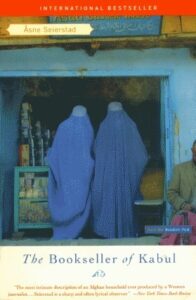
In spring 2002, following the fall of the Taliban, Åsne Seierstad spent four months living with a bookseller and his family in Kabul.
For more than twenty years Sultan Khan defied the authorities—be they communist or Taliban—to supply books to the people of Kabul. He was arrested, interrogated and imprisoned by the communists, and watched illiterate Taliban soldiers burn piles of his books in the street. He even resorted to hiding most of his stock—almost ten thousand books—in attics all over Kabul.
But while Khan is passionate in his love of books and his hatred of censorship, he also has strict views on family life and the role of women. As an outsider, Åsne Seierstad found herself in a unique position, able to move freely between the private, restricted sphere of the women—including Khan’s two wives—and the freer, more public lives of the men.
It is an experience that Seierstad finds both fascinating and frustrating. As she steps back from the page and allows the Khans to speak for themselves, we learn of proposals and marriages, hope and fear, crime and punishment. The result is a genuinely gripping and moving portrait of a family, and a clear-eyed assessment of a country struggling to free itself from history.' to 'This mesmerizing portrait of a proud man who, through three decades and successive repressive regimes, heroically braved persecution to bring books to the people of Kabul has elicited extraordinary praise throughout the world and become a phenomenal international bestseller. The Bookseller of Kabul is startling in its intimacy and its details—a revelation of the plight of Afghan women and a window into the surprising realities of daily life in today’s Afghanistan.'
In January 2002 Rory Stewart walked across Afghanistan—surviving by his wits, his knowledge of Persian dialects and Muslim customs, and the kindness of strangers. By day he passed through mountains covered in nine feet of snow, hamlets burned and emptied by the Taliban, and communities thriving amid the remains of medieval civilizations. By night he slept on villagers' floors, shared their meals, and listened to their stories of the recent and ancient past. Along the way Stewart met heroes and rogues, tribal elders and teenage soldiers, Taliban commanders and foreign-aid workers. He was also adopted by an unexpected companion—a retired fighting mastiff he named Babur in honor of Afghanistan's first Mughal emperor, in whose footsteps the pair was following. Through these encounters—by turns touching, confounding, surprising, and funny—Stewart makes tangible the forces of tradition, ideology, and allegiance that shape life in the map's countless places in between.
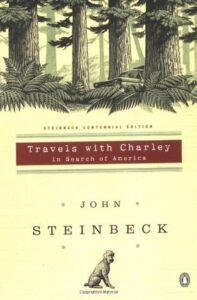
A quest across America, from the northernmost tip of Maine to California’s Monterey Peninsula
To hear the speech of the real America, to smell the grass and the trees, to see the colors and the light—these were John Steinbeck's goals as he set out, at the age of fifty-eight, to rediscover the country he had been writing about for so many years.
With Charley, his French poodle, Steinbeck drives the interstates and the country roads, dines with truckers, encounters bears at Yellowstone and old friends in San Francisco. Along the way he reflects on the American character, racial hostility, the particular form of American loneliness he finds almost everywhere, and the unexpected kindness of strangers.
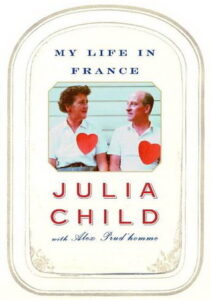
The bestselling story of Julia's years in France--and the basis for Julie & Julia, starring Meryl Streep and Amy Adams--in her own words. Although she would later singlehandedly create a new approach to American cuisine with her cookbook Mastering the Art of French Cooking and her television show The French Chef, Julia Child was not always a master chef. Indeed, when she first arrived in France in 1948 with her husband, Paul, who was to work for the USIS, she spoke no French and knew nothing about the country itself. But as she dove into French culture, buying food at local markets and taking classes at the Cordon Bleu, her life changed forever with her newfound passion for cooking and teaching. Julia's unforgettable story--struggles with the head of the Cordon Bleu, rejections from publishers to whom she sent her now-famous cookbook, a wonderful, nearly fifty-year long marriage that took the Childs across the globe--unfolds with the spirit so key to Julia's success as a chef and a writer, brilliantly capturing one of America's most endearing personalities.
This 1942 memoir (not a complete autobiography) by Beryl Markham chronicles her experiences growing up in Kenya (then British East Africa) in the early 1900s, and her stellar careers as racehorse trainer and bush pilot.
Markham was the first woman in East Africa to be granted a commercial pilot's license, piloting passengers and supplies to remote corners of Africa. She became the first person to fly solo across the Atlantic from east to west.
Considered a classic of outdoor literature and ranked #8 by National Geographic Adventure in 2008 on its list of the 100 best adventure books.
An alternative cover edition for this ISBN can be found here
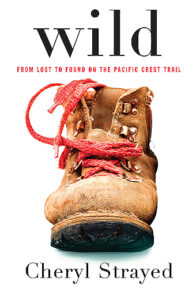
At twenty-two, Cheryl Strayed thought she had lost everything. In the wake of her mother’s death, her family scattered and her own marriage was soon destroyed. Four years later, with nothing more to lose, she made the most impulsive decision of her life. With no experience or training, driven only by blind will, she would hike more than a thousand miles of the Pacific Crest Trail from the Mojave Desert through California and Oregon to Washington State — and she would do it alone.
Told with suspense and style, sparkling with warmth and humor, Wild powerfully captures the terrors and pleasures of one young woman forging ahead against all odds on a journey that maddened, strengthened, and ultimately healed her.
A celebrated writer's irresistible, candid, and eloquent account of her pursuit of worldly pleasure, spiritual devotion, and what she really wanted out of life.
Around the time Elizabeth Gilbert turned thirty, she went through an early-onslaught midlife crisis. She had everything an educated, ambitious American woman was supposed to want—a husband, a house, a successful career. But instead of feeling happy and fulfilled, she was consumed with panic, grief, and confusion. She went through a divorce, a crushing depression, another failed love, and the eradication of everything she ever thought she was supposed to be.
To recover from all this, Gilbert took a radical step. In order to give herself the time and space to find out who she really was and what she really wanted, she got rid of her belongings, quit her job, and undertook a yearlong journey around the world—all alone. Eat, Pray, Love is the absorbing chronicle of that year. Her aim was to visit three places where she could examine one aspect of her own nature set against the backdrop of a culture that has traditionally done that one thing very well. In Rome, she studied the art of pleasure, learning to speak Italian and gaining the twenty-three happiest pounds of her life. India was for the art of devotion, and with the help of a native guru and a surprisingly wise cowboy from Texas, she embarked on four uninterrupted months of spiritual exploration. In Bali, she studied the art of balance between worldly enjoyment and divine transcendence. She became the pupil of an elderly medicine man and also fell in love the best way—unexpectedly.
An intensely articulate and moving memoir of self-discovery, Eat, Pray, Love is about what can happen when you claim responsibility for your own contentment and stop trying to live in imitation of society’s ideals. It is certain to touch anyone who has ever woken up to the unrelenting need for change.
Every Thursday morning for two years in the Islamic Republic of Iran, a bold and inspired teacher named Azar Nafisi secretly gathered seven of her most committed female students to read forbidden Western classics. As Islamic morality squads staged arbitrary raids in Tehran, fundamentalists seized hold of the universities, and a blind censor stifled artistic expression, the girls in Azar Nafisi's living room risked removing their veils and immersed themselves in the worlds of Jane Austen, F. Scott Fitzgerald, Henry James, and Vladimir Nabokov. In this extraordinary memoir, their stories become intertwined with the ones they are reading. Reading Lolita in Tehran is a remarkable exploration of resilience in the face of tyranny and a celebration of the liberating power of literature.
Welcome Back!
Track your reading progress and sync your library.