Slapstick presents an apocalyptic vision as seen through the eyes of the current King of Manhattan (and last President of the United States), a wickedly irreverent look at the all-too-possible results of today’s follies. But even the end of life-as-we-know-it is transformed by Kurt Vonnegut’s pen into hilarious farce—a final slapstick that may be the Almighty’s joke on us all.

Second only to Slaughterhouse-Five of Vonnegut's canon in its prominence and influence, God Bless You, Mr. Rosewater (1965) presents Eliot Rosewater, an itinerant, semi-crazed millionaire wandering the country in search of heritage and philanthropic outcome, introducing the science fiction writer Kilgore Trout to the world and Vonnegut to the collegiate audience which would soon make him a cult writer.
Trout, modeled according to Vonnegut on the science fiction writer Theodore Sturgeon (with whom Vonnegut had an occasional relationship) is a desperate, impoverished but visionary hack writer who functions for Eliot Rosewater as both conscience and horrid example. Rosewater, seeking to put his inheritance to some meaningful use (his father was an entrepreneur), tries to do good within the context of almost illimitable cynicism and corruption.
It is in this novel that Rosewater wanders into a science fiction conference--an actual annual event in Milford, Pennsylvania--and at the motel delivers his famous monologue evoked by science fiction writers and critics for almost half a century: "None of you can write for sour apples... but you're the only people trying to come to terms with the really terrific things which are happening today." Money does not drive Mr. Rosewater (or the corrupt lawyer who tries to shape the Rosewater fortune) so much as outrage at the human condition.
The novel was adapted for a 1979 Alan Menken musical. The novel is told mostly thru a collection of short stories dealing with Eliot's interactions with the citizens of Rosewater County, usually with the last sentence serving as a punch line. The antagonist's tale, Mushari's, is told in a similar short essay fashion. The stories reveal different hypocrisies of humankind in a darkly humorous fashion.
Galápagos takes the reader back one million years, to A.D. 1986. A simple vacation cruise suddenly becomes an evolutionary journey. Thanks to an apocalypse, a small group of survivors stranded on the Galápagos Islands are about to become the progenitors of a brave, new, and totally different human race. In this inimitable novel, America’s master satirist looks at our world and shows us all that is sadly, madly awry—and all that is worth saving.
The Sirens of Titan is an outrageous romp through space, time, and morality. The richest, most depraved man on Earth, Malachi Constant, is offered a chance to take a space journey to distant worlds with a beautiful woman at his side. Of course there's a catch to the invitation—and a prophetic vision about the purpose of human life that only Vonnegut has the courage to tell.
A gargantuan, mind-altering tragi-comedy about the Pursuit of Happiness in America.
Set in an addicts' halfway house and a tennis academy, and featuring the most endearingly screwed-up family to come along in recent fiction, Infinite Jest explores essential questions about what entertainment is and why it has come to so dominate our lives; about how our desire for entertainment affects our need to connect with other people; and about what the pleasures we choose say about who we are.
Equal parts philosophical quest and screwball comedy, Infinite Jest bends every rule of fiction without sacrificing for a moment its own entertainment value. It is an exuberant, uniquely American exploration of the passions that make us human—and one of those rare books that renew the idea of what a novel can do.
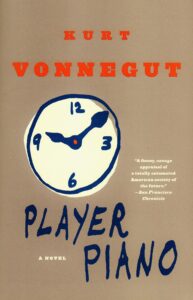
Kurt Vonnegut’s first novel spins the chilling tale of engineer Paul Proteus, who must find a way to live in a world dominated by a supercomputer and run completely by machines. Paul’s rebellion is vintage Vonnegut—wildly funny, deadly serious, and terrifyingly close to reality.
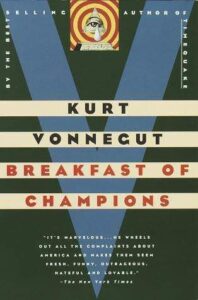
In Breakfast of Champions, one of Kurt Vonnegut’s most beloved characters, the aging writer Kilgore Trout, finds to his horror that a Midwest car dealer is taking his fiction as truth. What follows is murderously funny satire, as Vonnegut looks at war, sex, racism, success, politics, and pollution in America and reminds us how to see the truth.
A vicious fifteen-year-old droog is the central character of this 1963 classic. In Anthony Burgess's nightmare vision of the future, where criminals take over after dark, the story is told by the central character, Alex, who talks in a brutal invented slang that brilliantly renders his and his friends' social pathology. A Clockwork Orange is a frightening fable about good and evil, and the meaning of human freedom. And when the state undertakes to reform Alex to "redeem" him, the novel asks, "At what cost?"
This edition includes the controversial last chapter not published in the first edition and Burgess's introduction "A Clockwork Orange Resucked."
Winner of the 1973 National Book Award, Gravity's Rainbow is a postmodern epic, a work as exhaustively significant to the second half of the 20th century as Joyce's Ulysses was to the first. Its sprawling, encyclopedic narrative, and penetrating analysis of the impact of technology on society make it an intellectual tour de force.
Welcome Back!
Track your reading progress and sync your library.