Gripping, tragic, and densely atmospheric—a masterpiece of suspense San Piedro Island, north of Puget Sound, is a place so isolated that no one who lives there can afford to make enemies. But in 1954 a local fisherman is found suspiciously drowned, and a Japanese American named Kabuo Miyamoto is charged with his murder. In the course of the ensuing trial, it becomes clear that what is at stake is more than a man’s guilt. For on San Pedro, memories of a charmed love affair between a white boy and the Japanese girl who grew up to become Kabuo’s wife; memories of land desired, paid for, and lost. Above all, San Piedro is haunted by the memory of what happened to its Japanese residents during World War II, when an entire community was sent into exile while its neighbors watched.
Librarian's note: See alternate cover edition of ISBN 0571225381 here.
In the summer of 1956, Stevens, a long-serving butler at Darlington Hall, decides to take a motoring trip through the West Country. The six-day excursion becomes a journey into the past of Stevens and England, a past that takes in fascism, two world wars, and an unrealised love between the butler and his housekeeper.
The Poisonwood Bible is a story told by the wife and four daughters of Nathan Price, a fierce, evangelical Baptist who takes his family and mission to the Belgian Congo in 1959. They carry with them everything they believe they will need from home, but soon find that all of it -- from garden seeds to Scripture -- is calamitously transformed on African soil. What follows is a suspenseful epic of one family's tragic undoing and remarkable reconstruction over the course of three decades in postcolonial Africa.
Logan Gonzago Mountstuart, writer, was born in 1906, and died of a heart attack on October 5, 1991, aged 85. William Boyd's novel Any Human Heart is his disjointed autobiography, a massive tome chronicling "my personal rollercoaster"--or rather, "not so much a rollercoaster", but a yo-yo, "a jerking spinning toy in the hands of a maladroit child." From his early childhood in Montevideo, son of an English corned beef executive and his Uraguayan secretary, through his years at a Norfolk public school and Oxford, Mountstuart traces his haphazard development as a writer. Early and easy success is succeeded by a long half-century of mediocrity, disappointments and setbacks, both personal and professional, leading him to multiple failed marriages, internment, alcoholism, and abject poverty.
Mountstuart's sorry tale is also the story of a British way of life in inexorable decline, as his journey takes in the Bloomsbury set, the General Strike, the Spanish Civil War, 1930s Americans in Paris, wartime espionage, New York avant garde art, even the Baader-Meinhof gang--all with a stellar supporting cast. The most sustained and best moment comes mid-book, as Mountstuart gets caught up in one of Britain's murkier wartime secrets, in the company of the here truly despicable Duke and Duchess of Windsor. Elsewhere Boyd occasionally misplaces his tongue too obviously in his cheek--the Wall Street Crash is trailed with truly crashing inelegance--but overall Any Human Heart is a witty, inventive and ultimately moving novel. Boyd succeeds in conjuring not only a compelling 20th century but also, in the hapless Logan Mountstuart, an anti-hero who achieves something approaching passive greatness. --Alan Stewart, Amazon.co.uk
Margaret Atwood takes the art of storytelling to new heights in a dazzling novel that unfolds layer by astonishing layer and concludes in a brilliant and wonderfully satisfying twist. Told in a style that magnificently captures the colloquialisms and clichés of the 1930s and 1940s, The Blind Assassin is a richly layered and uniquely rewarding experience.
It opens with these simple, resonant words: "Ten days after the war ended, my sister drove a car off the bridge." They are spoken by Iris, whose terse account of her sister Laura's death in 1945 is followed by an inquest report proclaiming the death accidental. But just as the reader expects to settle into Laura's story, Atwood introduces a novel-within-a-novel. Entitled The Blind Assassin, it is a science fiction story told by two unnamed lovers who meet in dingy backstreet rooms. When we return to Iris, it is through a 1947 newspaper article announcing the discovery of a sailboat carrying the dead body of her husband, a distinguished industrialist.
For the past twenty-five years, Margaret Atwood has written works of striking originality and imagination. In The Blind Assassin, she stretches the limits of her accomplishments as never before, creating a novel that is entertaining and profoundly serious. The Blind Assassin proves once again that Atwood is one of the most talented, daring, and exciting writers of our time. Like The Handmaid's Tale, it is destined to become a classic.
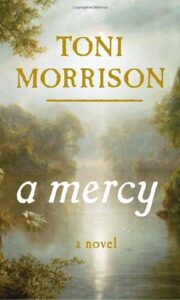
In the 1680s the slave trade in the Americas is still in its infancy. Jacob Vaark is an Anglo-Dutch trader and adventurer, with a small holding in the harsh North. Despite his distaste for dealing in “flesh,” he takes a small slave girl in part payment for a bad debt from a plantation owner in Catholic Maryland. This is Florens, who can read and write and might be useful on his farm. Rejected by her mother, Florens looks for love, first from Lina, an older servant woman at her new master's house, and later from the handsome blacksmith, an African, never enslaved, who comes riding into their lives. A Mercy reveals what lies beneath the surface of slavery. But at its heart, like Beloved, it is the ambivalent, disturbing story of a mother and a daughter - a mother who casts off her daughter in order to save her, and a daughter who may never exorcise that abandonment.
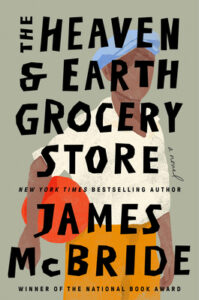
In 1972, when workers in Pottstown, Pennsylvania, were digging the foundations for a new housing development, the last thing they expected to uncover was a human skeleton. Who the skeleton was and how it got buried there were just two of the long-held secrets that had been kept for decades by the residents of Chicken Hill, the dilapidated neighborhood where immigrant Jews and African Americans lived side by side, sharing ambitions and sorrows.
Chicken Hill was where Moshe and Chona Ludlow lived when Chona ran the Heaven & Earth Grocery Store, which served the neighborhood's quirky collection of blacks and European immigrants, helped by her husband, Moshe, a Romanian-born theater owner who integrated the town's first dance hall. When the state came looking for a deaf black child, claiming that the boy needed to be institutionalized, Chicken Hill's residents—roused by Chona's kindess and the courage of a local black worker named Nate Timblin—banded together to keep the boy safe.
As the novel unfolds, it becomes clear how much the people of Chicken Hill have to struggle to survive at the margins of white Christian America and how damaging bigotry, hypocrisy, and deceit can be to a community. When the truth is revealed about the skeleton, the boy, and the part the town’s establishment played in both, McBride shows that it is love and community—heaven and earth—that ultimately sustain us.
It is 1866, and young Walter Moody has come to make his fortune upon the New Zealand goldfields. On the stormy night of his arrival, he stumbles across a tense gathering of twelve local men who have met in secret to discuss a series of unexplained events: A wealthy man has vanished, a prostitute has tried to end her life, and an enormous fortune has been discovered in the home of a luckless drunk. Moody is soon drawn into the mystery: a network of fates and fortunes that is as complex and exquisitely ornate as the night sky. Richly evoking a mid-nineteenth-century world of shipping, banking, and gold rush boom and bust, The Luminaries is a brilliantly constructed, fiendishly clever ghost story and a gripping page-turner.
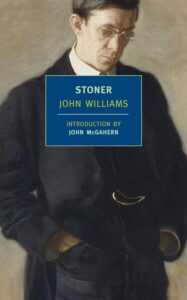
William Stoner is born at the end of the nineteenth century into a dirt-poor Missouri farming family. Sent to the state university to study agronomy, he instead falls in love with English literature and embraces a scholar’s life, so different from the hardscrabble existence he has known. And yet as the years pass, Stoner encounters a succession of disappointments: marriage into a “proper” family estranges him from his parents; his career is stymied; his wife and daughter turn coldly away from him; a transforming experience of new love ends under threat of scandal. Driven ever deeper within himself, Stoner rediscovers the stoic silence of his forebears and confronts an essential solitude.
John Williams’s luminous and deeply moving novel is a work of quiet perfection. William Stoner emerges from it not only as an archetypal American, but as an unlikely existential hero, standing, like a figure in a painting by Edward Hopper, in stark relief against an unforgiving world.
Welcome Back!
Track your reading progress and sync your library.