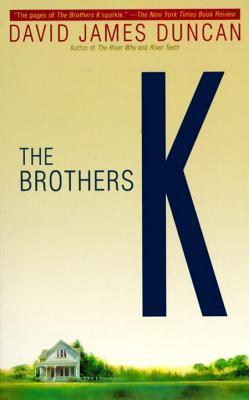
Duncan took almost 10 years to follow up the publication of his much-praised first novel, The River Why, but this massive second effort is well worth the wait. It is a stunning work: a complex tapestry of family tensions, baseball, politics and religion, by turns hilariously funny and agonizingly sad. Highly inventive formally, the novel is mainly narrated by Kincaid Chance, the youngest son in a family of four boys and identical twin girls, the children of Hugh Chance, a discouraged minor-league ballplayer whose once-promising career was curtained by an industrial accident, and his wife Laura, an increasingly fanatical Seventh-Day Adventist. The plot traces the working-out of the family’s fate from the beginning of the Eisenhower years through the traumas of Vietnam.
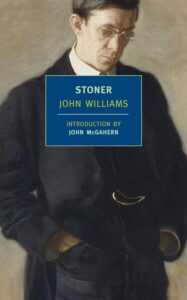
William Stoner is born at the end of the nineteenth century into a dirt-poor Missouri farming family. Sent to the state university to study agronomy, he instead falls in love with English literature and embraces a scholar’s life, so different from the hardscrabble existence he has known. And yet as the years pass, Stoner encounters a succession of disappointments: marriage into a “proper” family estranges him from his parents; his career is stymied; his wife and daughter turn coldly away from him; a transforming experience of new love ends under threat of scandal. Driven ever deeper within himself, Stoner rediscovers the stoic silence of his forebears and confronts an essential solitude.
John Williams’s luminous and deeply moving novel is a work of quiet perfection. William Stoner emerges from it not only as an archetypal American, but as an unlikely existential hero, standing, like a figure in a painting by Edward Hopper, in stark relief against an unforgiving world.
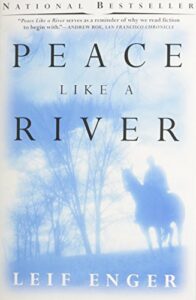
Once in a great while, we encounter a novel in our voluminous reading that begs to be read aloud. Leif Enger's debut, Peace Like a River, is one such work. His richly evocative novel, narrated by an asthmatic 11-year-old named Reuben Land, is the story of Reuben's unusual family and their journey across the frozen Badlands of the Dakotas in search of his fugitive older brother. Charged with the murder of two locals who terrorized their family, Davy has fled, understanding that the scales of justice will not weigh in his favor. But Reuben, his father, Jeremiah—a man of faith so deep he has been known to produce miracles—and Reuben's little sister, Swede, follow closely behind the fleeing Davy.
Affecting and dynamic, Peace Like a River is at once a tragedy, a romance, and an unflagging exploration into the spirituality and magic possible in the everyday world, and in that of the world awaiting us on the other side of life. In Enger's superb debut effort, we witness a wondrous celebration of family, faith, and spirit, the likes of which we haven't seen in a long, long time—and the birth of a classic work of literature.
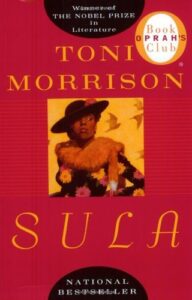
Sula and Nel are born in the Bottom—a small town at the top of a hill. Sula is wild, and daring; she does what she wants, while Nel is well-mannered, a mamma’s girl with a questioning heart. Growing up they forge a bond stronger than anything, stronger even than the dark secret they have to bear. Strong enough, it seems, to last a lifetime—until, decades later, as the girls become women, Sula’s anarchy leads to a betrayal that may be beyond forgiveness.
One of The Atlantic’s Great American Novels of the Past 100 Years
Masterful, richly textured, bittersweet, and vital, Sula is a modern masterpiece about love and kinship, about living in an America birthed from slavery. Nobel Prize laureate Toni Morrison gives life to characters who struggle with what society tells them to be, and the love they long for and crave as Black women. Most of all, they ask: When can we let go? What must we hold back? And just how much can be shared in a friendship?
Crossing to Safety has, since its publication in 1987, established itself as one of the greatest and most cherished American novels of the twentieth century. Tracing the lives, loves, and aspirations of two couples who move between Vermont and Wisconsin, it is a work of quiet majesty, deep compassion, and powerful insight into the alchemy of friendship and marriage.
From the Pulitzer Prize-winning author of The Overstory, an enthralling, wrenching novel about the lives and choices of one family, caught on the cusp of identities.
Jonah, Ruth and Joseph are the children of mixed-race parents determined to raise them beyond time, beyond identity, steeped in song. Yet they cannot be protected from the world forever.
Even as Jonah becomes a successful young tenor, the opera arena remains fixated on his race. Ruth turns her back on classical music and disappears, dedicating herself to activism and a new relationship. As the years pass, Joseph – the middle child, a pianist and our narrator – must battle not just to remain connected to his siblings, but to forge a future of his own.
This is a story of the tragedy of race in America, told through the lives and choices of one family caught on the cusp of identities.
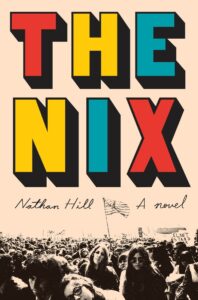
It’s 2011, and Samuel Andresen-Anderson hasn’t seen his mother, Faye, in decades—not since she abandoned the family when he was a boy. Now she’s reappeared, having committed an absurd crime that electrifies the nightly news and inflames a politically divided country. The media paints Faye as a radical hippie with a sordid past, but as far as Samuel knows, his mother was an ordinary girl who married her high-school sweetheart. Which version of his mother is true? Two facts are certain: she’s facing some serious charges, and she needs Samuel’s help.
To save her, Samuel will have to embark on his own journey, uncovering long-buried secrets about the woman he thought he knew, secrets that stretch across generations and have their origin all the way back in Norway, home of the mysterious Nix. As he does so, Samuel will confront not only Faye’s losses but also his own lost love, and will relearn everything he thought he knew about his mother, and himself.
With only a yellowing photograph in hand, a young man -- also named Jonathan Safran Foer -- sets out to find the woman who may or may not have saved his grandfather from the Nazis. Accompanied by an old man haunted by memories of the war; an amorous dog named Sammy Davis, Junior, Junior; and the unforgettable Alex, a young Ukrainian translator who speaks in a sublimely butchered English, Jonathan is led on a quixotic journey over a devastated landscape and into an unexpected past.
In her most accomplished novel, Barbara Kingsolver takes us on an epic journey from the Mexico City of artists Diego Rivera and Frida Kahlo to the America of Pearl Harbor, FDR, and J. Edgar Hoover. The Lacuna is a poignant story of a man pulled between two nations as they invent their modern identities.
Born in the United States, reared in a series of provisional households in Mexico—from a coastal island jungle to 1930s Mexico City—Harrison Shepherd finds precarious shelter but no sense of home on his thrilling odyssey. Life is whatever he learns from housekeepers who put him to work in the kitchen, errands he runs in the streets, and one fateful day, by mixing plaster for famed Mexican muralist Diego Rivera. He discovers a passion for Aztec history and meets the exotic, imperious artist Frida Kahlo, who will become his lifelong friend. When he goes to work for Lev Trotsky, an exiled political leader fighting for his life, Shepherd inadvertently casts his lot with art and revolution, newspaper headlines and howling gossip, and a risk of terrible violence.
Meanwhile, to the north, the United States will soon be caught up in the internationalist goodwill of World War II. There in the land of his birth, Shepherd believes he might remake himself in America's hopeful image and claim a voice of his own. He finds support from an unlikely kindred soul, his stenographer, Mrs. Brown, who will be far more valuable to her employer than he could ever know. Through darkening years, political winds continue to toss him between north and south in a plot that turns many times on the unspeakable breach—the lacuna—between truth and public presumption.
With deeply compelling characters, a vivid sense of place, and a clear grasp of how history and public opinion can shape a life, Barbara Kingsolver has created an unforgettable portrait of the artist—and of art itself. The Lacuna is a rich and daring work of literature, establishing its author as one of the most provocative and important of her time.
Welcome Back!
Track your reading progress and sync your library.