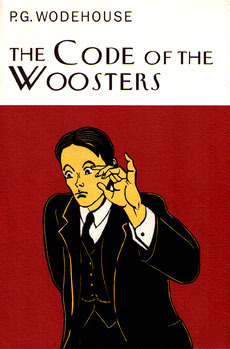
Take Gussie Fink-Nottle, Madeline Bassett, old Pop Bassett, the unscrupulous Stiffy Byng, the Rev., an 18th-century cow-creamer, a small brown leather covered notebook and mix with a dose of the aged aunt Dahlia and one has a dangerous brew which spells toil and trouble for Bertie and Jeeves.
When Bingo Little falls in love at a Camberwell subscription dance and Bertie Wooster drops into the mulligatawny, there is work for a wet-nurse. Who better than Jeeves?
This a previously-published edition of ISBN 9780140621334
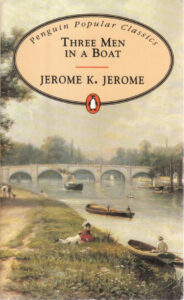
"We agree that we are overworked, and need a rest - A week on the rolling deep? - George suggests the river -"
And with the co-operation of several hampers of food and a covered boat, the three men (not forgetting the dog) set out on a hilarious voyage of mishaps up the Thames. When not falling in the river and getting lost in Hampton Court Maze, Jerome K. Jerome finds time to express his ideas on the world around - many of which have acquired a deeper fascination since the day at the end of the 19th century when this excursion was so lightly undertaken.
An alternative cover edition for this ISBN can be found here
Regarded by many as the finest, and funniest, comic novel of the twentieth century, Lucky Jim remains as trenchant, withering, and eloquently misanthropic as when it first scandalized readers back in 1954. This is the story of Jim Dixon, a hapless lecturer in medieval history at a provincial university who knows better than most that “there was no end to the ways in which nice things are nicer than nasty ones.” Kingsley Amis’s scabrous debut leads the reader through a gallery of emphatically English bores, cranks, frauds, and neurotics with whom Dixon must contend in one way or another in order to hold on to his cushy academic perch and win the girl of his fancy.
More than just a merciless satire of cloistered college life and stuffy postwar manners, Lucky Jim is an attack on the forces of boredom, whatever form they may take, and a work of art that at once distills and extends an entire tradition of English comic writing, from Fielding and Dickens through Wodehouse and Waugh. As Christopher Hitchens has written, “If you can picture Bertie or Jeeves being capable of actual malice, and simultaneously imagine Evelyn Waugh forgetting about original sin, you have the combination of innocence and experience that makes this short romp so imperishable.”
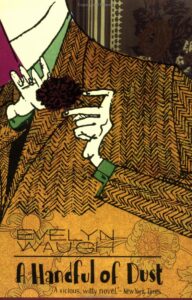
Laced with cynicism and truth, "A Handful of Dust" satirizes a certain stratum of English life where all the characters have wealth, but lack practically every other credential. Murderously urbane, it depicts the breakup of a marriage in the London gentry, where the errant wife suffers from terminal boredom, and becomes enamoured of a social parasite and professional luncheon-goer.
Winner of the 1933 Femina Vie Heureuse Prize, COLD COMFORT FARM is a wickedly funny portrait of British rural life in the 1930s. Flora Poste, a recently orphaned socialite, moves in with her country relatives, the gloomy Starkadders of Cold Comfort Farm, and becomes enmeshed in a web of violent emotions, despair, and scheming, until Flora manages to set things right.
Endlessly digressive, boundlessly imaginative and unmatched in its absurd and timeless wit
Laurence Sterne's great masterpiece of bawdy humour and rich satire defies any attempt to categorize it, with a rich metafictional narrative that might classify it as the first 'postmodern' novel. Part novel, part digression, its gloriously disordered narrative interweaves the birth and life of the unfortunate 'hero' Tristram Shandy, the eccentric philosophy of his father Walter, the amours and military obsessions of Uncle Toby, and a host of other characters, including Dr Slop, Corporal Trim and the parson Yorick. A joyful celebration of the endless possibilities of the art of fiction, Tristram Shandy is also a wry demonstration of its limitations. The text and notes of this volume are based on the acclaimed Florida Edition, with a critical introduction by Melvyn New and Christopher Ricks's introductory essay from the first Penguin Classics edition.
"A story has no beginning or end: arbitrarily one chooses a moment of experience from which to look ahead..."
"This is a record of hate far more than of love," writes Maurice Bendrix in the opening passages of The End of the Affair, and it is a strange hate indeed that compels him to set down the retrospective account of his adulterous affair with Sarah Miles.
Now, a year after Sarah's death, Bendrix seeks to exorcise the persistence of his passion by retracing its course from obsessive love to love-hate. At first, he believes he hates Sarah and her husband, Henry. Yet as he delves deeper into his emotional outlook, Bendrix's hatred shifts to the God he feels has broken his life, but whose existence at last comes to recognize.
With The Mirror & the Light, Hilary Mantel brings to a triumphant close the trilogy she began with her peerless, Booker Prize-winning novels, Wolf Hall and Bring Up the Bodies. She traces the final years of Thomas Cromwell, the boy from nowhere who climbs to the heights of power, offering a defining portrait of predator and prey, of a ferocious contest between present and past, between royal will and a common man’s vision: of a modern nation making itself through conflict, passion and courage.
The story begins in May 1536: Anne Boleyn is dead, decapitated in the space of a heartbeat by a hired French executioner. As her remains are bundled into oblivion, Cromwell breakfasts with the victors. The blacksmith’s son from Putney emerges from the spring’s bloodbath to continue his climb to power and wealth, while his formidable master, Henry VIII, settles to short-lived happiness with his third queen, Jane Seymour.
Cromwell, a man with only his wits to rely on, has no great family to back him, no private army. Despite rebellion at home, traitors plotting abroad and the threat of invasion testing Henry’s regime to the breaking point, Cromwell’s robust imagination sees a new country in the mirror of the future. All of England lies at his feet, ripe for innovation and religious reform. But as fortune’s wheel turns, Cromwell’s enemies are gathering in the shadows. The inevitable question remains: how long can anyone survive under Henry’s cruel and capricious gaze?
Eagerly awaited and eight years in the making, The Mirror & the Light completes Cromwell’s journey from self-made man to one of the most feared, influential figures of his time. Portrayed by Mantel with pathos and terrific energy, Cromwell is as complex as he is unforgettable: a politician and a fixer, a husband and a father, a man who both defied and defined his age.
Welcome Back!
Track your reading progress and sync your library.