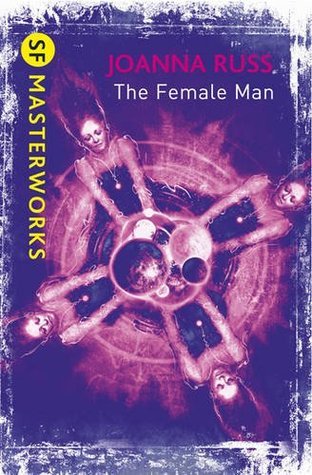
It has influenced William Gibson and been listed as one of the ten essential works of science fiction. Most importantly, Joanna Russ’s The Female Man is a suspenseful, surprising and darkly witty chronicle of what happens when Jeannine, Janet, Joanna, and Jael—four alternative selves from drastically different realities—meet.
Ambassador Mahit Dzmare arrives in the center of the multi-system Teixcalaanli Empire only to discover that her predecessor, the previous ambassador from their small but fiercely independent mining Station, has died. But no one will admit that his death wasn't an accident—or that Mahit might be next to die, during a time of political instability in the highest echelons of the imperial court.
Now, Mahit must discover who is behind the murder, rescue herself, and save her Station from Teixcalaan's unceasing expansion—all while navigating an alien culture that is all too seductive, engaging in intrigues of her own, and hiding a deadly technological secret—one that might spell the end of her Station and her way of life—or rescue it from annihilation.
WINNER OF THE 2022 HUGO AWARD FOR BEST NOVEL Now a USA Today bestseller! Publishers Weekly's Best Books of 2021 Amazon's Best Science Fiction & Fantasy of 2021 Bookpage's Best Science Fiction & Fantasy of 2021 Goodreads Choice Awards Nominee for Best Science Fiction Book of 2021
A Desolation Called Peace is the spectacular space opera sequel to Arkady Martine's genre-reinventing, Hugo Award-winning debut, A Memory Called Empire.
An alien armada lurks on the edges of Teixcalaanli space. No one can communicate with it, no one can destroy it, and Fleet Captain Nine Hibiscus is running out of options.
In a desperate attempt at diplomacy with the mysterious invaders, the fleet captain has sent for a diplomatic envoy. Now Mahit Dzmare and Three Seagrass—still reeling from the recent upheaval in the Empire—face the impossible task of trying to communicate with a hostile entity.
Their failure will guarantee millions of deaths in an endless war. Their success might prevent Teixcalaan’s destruction—and allow the empire to continue its rapacious expansion.
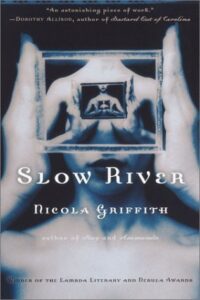
Change or die. These are the only options available on the planet Jeep. Centuries earlier, a deadly virus shattered the original colony, killing the men and forever altering the few surviving women. Now, generations after the colony has lost touch with the rest of humanity, a company arrives to exploit Jeep–and its forces find themselves fighting for their lives. Terrified of spreading the virus, the company abandons its employees, leaving them afraid and isolated from the natives. In the face of this crisis, anthropologist Marghe Taishan arrives to test a new vaccine. As she risks death to uncover the women’s biological secret, she finds that she, too, is changing–and realizes that not only has she found a home on Jeep, but that she alone carries the seeds of its destruction. . . .
Ammonite is an unforgettable novel that questions the very meanings of gender and humanity. As readers share in Marghe’s journey through an alien world, they too embark on a parallel journey of fascinating self-exploration.
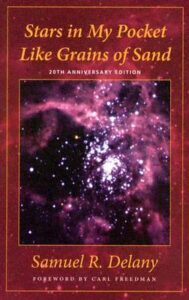
The story of a truly galactic civilization with over 6,000 inhabited worlds.
Stars in My Pocket Like Grains of Sand is a science fiction masterpiece, an essay on the inexplicability of sexual attractiveness, and an examination of interstellar politics among far-flung worlds. First published in 1984, the novel's central issues--technology, globalization, gender, sexuality, and multiculturalism--have only become more pressing with the passage of time.
The novel's topic is information itself: What are the repercussions, once it has been made public, that two individuals have been found to be each other's perfect erotic object out to "point nine-nine-nine and several nines percent more"? What will it do to the individuals involved, to the city they inhabit, to their geosector, to their entire world society, especially when one is an illiterate worker, the sole survivor of a world destroyed by "cultural fugue," and the other is--you!
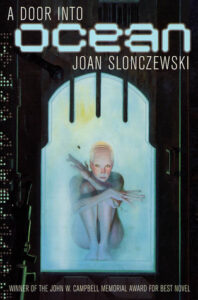
Joan Slonczewski's A Door into Ocean is the novel upon which the author's reputation as an important SF writer principally rests.
A ground-breaking work both of feminist SF and of world-building hard SF, it concerns the Sharers of Shora, a nation of women on a distant moon in the far future who are pacifists, highly advanced in biological sciences, and who reproduce by parthenogenesis--there are no males--and tells of the conflicts that erupt when a neighboring civilization decides to develop their ocean world, and send in an army.
A multi-dimensional explosion hurls the starship's few passengers across the galaxies and onto an uncharted barren tundra. With no technical skills and scant supplies, the survivors face a bleak end in an alien world. One brave woman holds the daring answer, but it is the most desperate one possible.
Elegant and electric, We Who Are About To... brings us face to face with our basic assumptions about our will to live. While most of the stranded tourists decide to defy the odds and insist on colonizing the planet and creating life, the narrator decides to practice the art of dying. When she is threatened with compulsory reproduction, she defends herself with lethal force. Originally published in 1977, this is one of the most subtle, complex, and exciting science fiction novels ever written about the attempt to survive a hostile alien environment. It is characteristic of Russ's genius that such a readable novel is also one of her most intellectually intricate.
Anna Paquin narrates Rita Mae Brown’s pathbreaking novel Rubyfruit Jungle, available for the first time ever in audio. Written by a New York Times bestselling author, this Lambda Literary Pioneer Award winner is “the rare work of fiction that has changed real life” (Gloria Steinem). In the rural South, misfit Molly Bolt forges her own path as she defies the expectations of her closed-minded community. “Truly incredible” (The Boston Globe), with narration from an Academy Award–winning actress.
A landmark coming-of-age novel that launched the career of one of this country’s most distinctive voices, Rubyfruit Jungle remains a transformative work since its original publication almost fifty years ago.
In bawdy, moving prose, Rita Mae Brown tells the story of Molly Bolt, the adoptive daughter of a dirt-poor Southern couple who boldly forges her own path in America. With her startling beauty and crackling wit, Molly finds that women are drawn to her wherever she goes—and she refuses to apologize for loving them back.
This literary milestone continues to resonate with its message about being true to yourself and, against the odds, living happily ever after.
Virginia Woolf's Orlando 'The longest and most charming love letter in literature', playfully constructs the figure of Orlando as the fictional embodiment of Woolf's close friend and lover, Vita Sackville-West. Spanning three centuries, the novel opens as Orlando, a young nobleman in Elizabeth's England, awaits a visit from the Queen and traces his experience with first love as England under James I lies locked in the embrace of the Great Frost. At the midpoint of the novel, Orlando, now an ambassador in Constantinople, awakes to find that he is now a woman, and the novel indulges in farce and irony to consider the roles of women in the 18th and 19th centuries. As the novel ends in 1928, a year consonant with full suffrage for women. Orlando, now a wife and mother, stands poised at the brink of a future that holds new hope and promise for women.
Welcome Back!
Track your reading progress and sync your library.