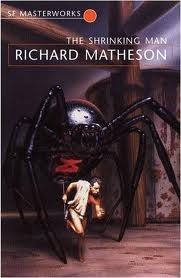
While on holiday, Scott Carey is exposed to a cloud of radioactive spray shortly after he accidentally ingests insecticide. The radioactivity acts as a catalyst for the bug spray, causing his body to shrink at a rate of approximately 1/7 of an inch per day. A few weeks later, Carey can no longer deny the truth: not only is he losing weight, he is also shorter than he was and deduces, to his dismay, that his body will continue to shrink.
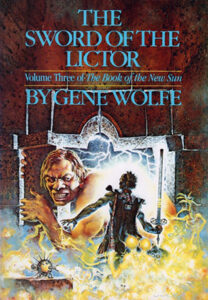
Beneath the dying sun the disgraced torturer, Severian, at last comes to his place of exile - Thrax, the City of Windowless Rooms. But Severian's journeying is not ended, and high in the Earth's ancient mountains he draws closer to his destiny.
A human raised on Mars, Valentine Michael Smith has just arrived on planet Earth. Among his people for the first time, he struggles to understand the social mores and prejudices of human nature that are so alien to him, while his own “psi” powers—including telepathy, clairvoyance, telekenesis, and teleportation—make him a type of messiah figure among humans. "Stranger in a Strange Land" grew from a cult favorite to a bestseller to a classic in a few short years. The story of the man from Mars who taught humankind grokking and water-sharing—and love—it is Robert A. Heinlein’s masterpiece.
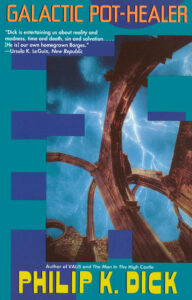
The Glimmung wants Joe Fernwright. Fernwright is a pot-healer — a repairer of ceramics — in a drably utilitarian future where such skills have little value. And the Glimmung? The Glimmung is a being that looks something like a gyroscope, something like a teenaged girl, and something like the contents of an ocean. What's more, it may be divine. And, like certain gods of old Earth, it has a bad temper.
What could an omnipresent and seemingly omnipotent entity want with a humble pot-healer? Or with the dozens of other odd creatures it has lured to Plowman's Planet? And if the Glimmung is a god, are its ends positive or malign? Combining quixotic adventure, spine-chilling horror, and deliriously paranoid theology, Galactic Pot-Healer is a uniquely Dickian voyage to alternate worlds of the imagination.
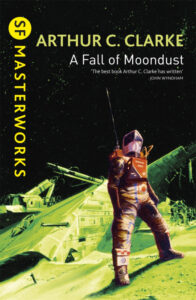
For a million years the bubble had been growing, like a vast abscess, below the root of the mountains. Now the abscess was about to burst. Captain Harris had left the controls on autopilot and was talking to the front row of passengers as the first tremor shook the boat. For a fraction of a second he wondered if a fan blade had hit some submerged obstacle; then, quite literally, the bottom fell out of his world.
It fell slowly, as all things must upon the Moon. The sea was alive and moving . . . Every stage of that nightmare transformation was pitilessly illuminated by the earth light, until the crater was so deep that its firewall was completely lost in shadow, and it seemed as if Selene were racing into a curving crescent of utter blackness – an arc of annihilation.
In darkness and in silence, they were sinking into the Moon. . . .
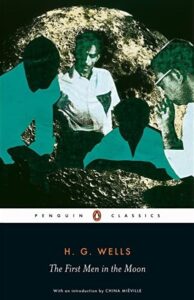
When penniless businessman Mr Bedford retreats to the Kent coast to write a play, he meets by chance the brilliant Dr Cavor, an absent-minded scientist on the brink of developing a material that blocks gravity. Cavor soon succeeds in his experiments, only to tell a stunned Bedford the invention makes possible one of the oldest dreams of humanity: a journey to the moon. With Bedford motivated by money, and Cavor by the desire for knowledge, the two embark on the expedition. But neither are prepared for what they find - a world of freezing nights, boiling days and sinister alien life, on which they may be trapped forever.
The astonishing novel Brave New World, originally published in 1932, presents Aldous Huxley's vision of the future--of a world utterly transformed. Through the most efficient scientific and psychological engineering, people are genetically designed to be passive and therefore consistently useful to the ruling class. This powerful work of speculative fiction sheds a blazing critical light on the present and is considered to be Aldous Huxley's most enduring masterpiece.
The non-fiction work Brave New World Revisited, published in 1958, is a fascinating work in which Huxley uses his tremendous knowledge of human relations to compare the modern-day world with his prophetic fantasy envisioned in Brave New World, including the threats to humanity, such as over-population, propaganda, and chemical persuasion.
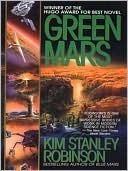
Two eBooks in One! Red In his most ambitious project to date, award-winning author Kim Stanley Robinson utilizes years of research and cutting-edge science in the first of three novels that will chronicle the colonization of Mars. For eons, sandstorms have swept the barren, desolate landscape of the red planet. For centuries, Mars has beckoned to mankind to come and conquer its hostile climate. Now, in the year 2026, a group of one hundred colonists is about to fulfill that destiny. John Boone, Maya Toitovna, Frank Chalmers, and Arkady Bogdanov lead a mission whose ultimate goal is the terraforming of Mars. For some, Mars will become a passion driving them to daring acts of courage and madness; for others it offers an opportunity to strip the planet of its riches. And for the genetic "alchemists," Mars presents a chance to create a biomedical miracle, a breakthrough that could change all we know about life ... and death. The colonists place giant satellite mirrors in Martian orbit to reflect light to the planet's surface. Black dust sprinkled on the polar caps will capture warmth and melt the ice. And massive tunnels, kilometers in depth, will be drilled into the Martian mantle to create stupendous vents of hot gases. Against this backdrop of epic upheaval, rivalries, loves, and friendships will form and fall to pieces--for there are those who will fight to the death to prevent Mars from ever being changed. Brilliantly imagined, breathtaking in scope and ingenuity, Red Mars is an epic scientific saga, chronicling the next step in human evolution and creating a world in its entirety. Red Mars shows us a future, with both glory and tarnish, that awes with complexity and inspires with vision. Green Nearly a generation has passed since the first pioneers landed, but the transformation of Mars to an Earth-like planet has just begun. In Green Mars the colonists will attempt to turn the red planet into a lush garden for humanity. They will bombard the atmosphere with ice meteorites to add moisture. They will seed the red deserts with genetically engineered plants. Then they will tap the boiling planetary core to warm the planet's frozen surface. But their heroic efforts don't go unchallenged. For their plan to transform Mars is opposed by those determined to preserve the hostile and barren beauty of Mars. Led by rebels like Peter Clayborne, these young people are the first generation of children born on Mars, and they will be joined in their violent struggle by original settlers Maya Toitovna, Simon Frasier, and Sax Russell. Against this cosmic backdrop, passions, rivalries, and friendships will explode in a story as big as the planet itself. A novel of breathtaking scope and imagination, of lyric intensity and social resonance, Kim Stanley Robinson employs years of research and state-of-the-art science to create a prophetic vision of where humanity is headed--and of what life will be like on another world. Nebula Award® Winner, Hugo Award Winner
Welcome Back!
Track your reading progress and sync your library.