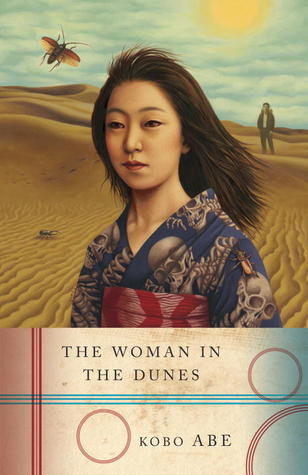
The Woman in the Dunes, by celebrated writer and thinker Kobo Abe, combines the essence of myth, suspense and the existential novel.
After missing the last bus home following a day trip to the seashore, an amateur entomologist is offered lodging for the night at the bottom of a vast sand pit. But when he attempts to leave the next morning, he quickly discovers that the locals have other plans. Held captive with seemingly no chance of escape, he is tasked with shoveling back the ever-advancing sand dunes that threaten to destroy the village. His only companion is an odd young woman, and together their fates become intertwined as they work side by side through this Sisyphean of tasks.
Osamu Dazai's No Longer Human, this leading postwar Japanese writer's second novel, tells the poignant and fascinating story of a young man who is caught between the breakup of the traditions of a northern Japanese aristocratic family and the impact of Western ideas. In consequence, he feels himself "disqualified from being human" (a literal translation of the Japanese title).
Donald Keene, who translated this and Dazai's first novel, The Setting Sun, has said of the author's work: "His world … suggests Chekhov or possibly postwar France, … but there is a Japanese sensibility in the choice and presentation of the material. A Dazai novel is at once immediately intelligible in Western terms and quite unlike any Western book." His writing is in some ways reminiscent of Rimbaud, while he himself has often been called a forerunner of Yukio Mishima.
Cover painting by Noe Nojechowiz, from the collection of John and Barbara Duncan; design by Gertrude Huston
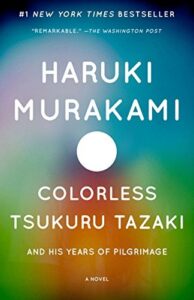
INSTANT #1 NEW YORK TIMES BESTSELLER • One of the most revered voices in literature today gives us a story of love, friendship, and heartbreak for the ages.
Colorless Tsukuru Tazaki and His Years of Pilgrimage is the remarkable story of a young man haunted by a great loss; of dreams and nightmares that have unintended consequences for the world around us; and of a journey into the past that is necessary to mend the present.
ONE OF THE BEST BOOKS OF THE YEAR: The New York Times Book Review, The Washington Post, Financial Times, St. Louis Post-Dispatch, Slate, Mother Jones, The Daily Beast, BookPage
Horacio Oliveira is an Argentinian writer who lives in Paris with his mistress, La Maga, surrounded by a loose-knit circle of bohemian friends who call themselves "the Club." A child's death and La Maga's disappearance put an end to his life of empty pleasures and intellectual acrobatics, and prompt Oliveira to return to Buenos Aires, where he works by turns as a salesman, a keeper of a circus cat which can truly count, and an attendant in an insane asylum. Hopscotch is the dazzling, freewheeling account of Oliveira's astonishing adventures.
The book is highly influenced by Henry Miller’s reckless and relentless search for truth in post-decadent Paris and Daisetz Teitaro Suzuki’s modal teachings on Zen Buddhism.
Cortázar's employment of interior monologue, punning, slang, and his use of different languages is reminiscent of Modernist writers like Joyce, although his main influences were Surrealism and the French New Novel, as well as the "riffing" aesthetic of jazz and New Wave Cinema.
In 1966, Gregory Rabassa won the first National Book Award to recognize the work of a translator, for his English-language edition of Hopscotch. Julio Cortázar was so pleased with Rabassa's translation of Hopscotch that he recommended the translator to Gabriel García Márquez when García Márquez was looking for someone to translate his novel One Hundred Years of Solitude into English. "Rabassa's One Hundred Years of Solitude improved the original," according to García Márquez.
Still Life with Woodpecker is a sort of a love story that takes place inside a pack of Camel cigarettes. It reveals the purpose of the moon, explains the difference between criminals andoutlaws, examines the conflict between social activism and romantic individualism, and paints a portrait of contemporary society that includes powerful Arabs, exiled royalty, and pregnant cheerleaders. It also deals withthe problem of redheads. "From the Trade Paperback edition."
"In my opinion one of the finest novels of our time." - Graham Greene
Shusaku Endo is Japan's foremost novelist, and Silence is generally regarded to be his masterpiece. In a perfect fusion of treatment and theme, this powerful novel tells the story of a seventeenth-century Portuguese priest in Japan at the height of the fearful persecution of the small Christian community.
If on a Winter's Night a Traveler is a marvel of ingenuity, an experimental text that looks longingly back to the great age of narration—"when time no longer seemed stopped and did not yet seem to have exploded." Italo Calvino's novel is in one sense a comedy in which the two protagonists, the Reader and the Other Reader, ultimately end up married, having almost finished If on a Winter's Night a Traveler. In another, it is a tragedy, a reflection on the difficulties of writing and the solitary nature of reading. The Reader buys a fashionable new book, which opens with an exhortation: "Relax. Concentrate. Dispel every other thought. Let the world around you fade." Alas, after 30 or so pages, he discovers that his copy is corrupted, and consists of nothing but the first section, over and over. Returning to the bookshop, he discovers the volume, which he thought was by Calvino, is actually by the Polish writer Bazakbal. Given the choice between the two, he goes for the Pole, as does the Other Reader, Ludmilla. But this copy turns out to be by yet another writer, as does the next, and the next.
The real Calvino intersperses 10 different pastiches—stories of menace, spies, mystery, premonition—with explorations of how and why we choose to read, make meanings, and get our bearings or fail to. Meanwhile the Reader and Ludmilla try to reach, and read, each other. If on a Winter's Night is dazzling, vertiginous, and deeply romantic. "What makes lovemaking and reading resemble each other most is that within both of them times and spaces open, different from measurable time and space."
A classic of Mexican modern literature about a haunted village.
As one enters Juan Rulfo's legendary novel, one follows a dusty road to a town of death. Time shifts from one consciousness to another in a hypnotic flow of dreams, desires, and memories, a world of ghosts dominated by the figure of Pedro Páramo - lover, overlord, murderer.
Rulfo's extraordinary mix of sensory images, violent passions, and unfathomable mysteries has been a profound influence on a whole generation of Latin American writers, including Carlos Fuentes, Mario Vargas Llosa, and Gabriel García Márquez. To read Pedro Páramo today is as overwhelming an experience as when it was first published in Mexico back in 1955.
Often likened to Kafka's The Castle, The Tartar Steppe is both a scathing critique of military life and a meditation on the human thirst for glory. It tells of young Giovanni Drogo, who is posted to a distant fort overlooking the vast Tartar steppe. Although not intending to stay, Giovanni suddenly finds that years have passed, as, almost without his noticing, he has come to share the others' wait for a foreign invasion that never happens. Over time the fort is downgraded and Giovanni's ambitions fade until the day the enemy begins massing on the desolate steppe...
Welcome Back!
Track your reading progress and sync your library.