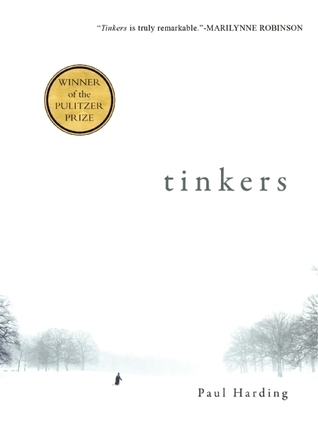
An old man lies dying. Propped up in his living room and surrounded by his children and grandchildren, George Washington Crosby drifts in and out of consciousness, back to the wonder and pain of his impoverished childhood in Maine. As the clock repairer’s time winds down, his memories intertwine with those of his father, an epileptic, itinerant peddler and his grandfather, a Methodist preacher beset by madness.
At once heartbreaking and life affirming, Tinkers is an elegiac meditation on love, loss, illness, faith, and the fierce beauty of nature.
It is 1970, and a down-at-the-heels California commune devoted to peace, free love, and the simple life has decided to relocate to the last frontier—the unforgiving landscape of interior Alaska—in the ultimate expression of going back to the land. Armed with the spirit of adventure and naïve optimism, the inhabitants of “Drop City” arrive in the wilderness of Alaska only to find their utopia already populated by other young homesteaders. When the two communities collide, unexpected friendships and dangerous enmities are born as everyone struggles with the bare essentials of life: love, nourishment, and a roof over one’s head. Rich, allusive, and unsentimental, T.C. Boyle’s ninth novel is a tour de force infused with the lyricism and take-no-prisoners storytelling for which he is justly famous.
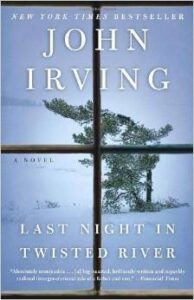
In 1954, in the cookhouse of a logging and sawmill settlement in northern New Hampshire, an anxious twelve-year-old boy mistakes the local constable’s girlfriend for a bear. Both the twelve-year-old and his father become fugitives, forced to run from Coos County–to Boston, to southern Vermont, to Toronto–pursued by the implacable constable. Their lone protector is a fiercely libertarian logger, once a river driver, who befriends them.
In a story spanning five decades, Last Night in Twisted River–John Irving’s twelfth novel–depicts the recent half-century in the United States as “a living replica of Coos County, where lethal hatreds were generally permitted to run their course.” From the novel’s taut opening sentence–“The young Canadian, who could not have been more than fifteen, had hesitated too long”–to its elegiac final chapter, Last Night in Twisted River is written with the historical authenticity and emotional authority of The Cider House Rules and A Prayer for Owen Meany. It is also as violent and disturbing a story as John Irving’s breakthrough bestseller, The World According to Garp.
What further distinguishes Last Night in Twisted River is the author’s unmistakable voice–the inimitable voice of an accomplished storyteller. Near the end of this moving novel, John Irving writes: “We don’t always have a choice how we get to know one another. Sometimes, people fall into our lives cleanly–as if out of the sky, or as if there were a direct flight from Heaven to Earth–the same sudden way we lose people, who once seemed they would always be part of our lives.”
In his journal, Nobel Prize winner John Steinbeck called East of Eden “the first book,” and indeed it has the primordial power and simplicity of myth. Set in the rich farmland of California’s Salinas Valley, this sprawling and often brutal novel follows the intertwined destinies of two families—the Trasks and the Hamiltons—whose generations helplessly reenact the fall of Adam and Eve and the poisonous rivalry of Cain and Abel.
Adam Trask came to California from the East to farm and raise his family on the new rich land. But the birth of his twins, Cal and Aaron, brings his wife to the brink of madness, and Adam is left alone to raise his boys to manhood. One boy thrives nurtured by the love of all those around him; the other grows up in loneliness enveloped by a mysterious darkness.
First published in 1952, East of Eden is the work in which Steinbeck created his most mesmerizing characters and explored his most enduring themes: the mystery of identity, the inexplicability of love, and the murderous consequences of love's absence. A masterpiece of Steinbeck's later years, East of Eden is a powerful and vastly ambitious novel that is at once a family saga and a modern retelling of the Book of Genesis.
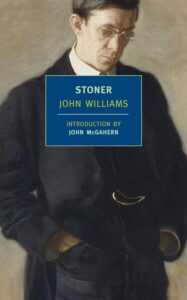
William Stoner is born at the end of the nineteenth century into a dirt-poor Missouri farming family. Sent to the state university to study agronomy, he instead falls in love with English literature and embraces a scholar’s life, so different from the hardscrabble existence he has known. And yet as the years pass, Stoner encounters a succession of disappointments: marriage into a “proper” family estranges him from his parents; his career is stymied; his wife and daughter turn coldly away from him; a transforming experience of new love ends under threat of scandal. Driven ever deeper within himself, Stoner rediscovers the stoic silence of his forebears and confronts an essential solitude.
John Williams’s luminous and deeply moving novel is a work of quiet perfection. William Stoner emerges from it not only as an archetypal American, but as an unlikely existential hero, standing, like a figure in a painting by Edward Hopper, in stark relief against an unforgiving world.
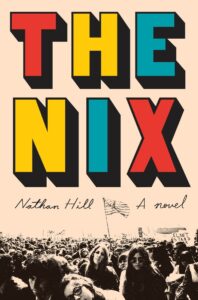
It’s 2011, and Samuel Andresen-Anderson hasn’t seen his mother, Faye, in decades—not since she abandoned the family when he was a boy. Now she’s reappeared, having committed an absurd crime that electrifies the nightly news and inflames a politically divided country. The media paints Faye as a radical hippie with a sordid past, but as far as Samuel knows, his mother was an ordinary girl who married her high-school sweetheart. Which version of his mother is true? Two facts are certain: she’s facing some serious charges, and she needs Samuel’s help.
To save her, Samuel will have to embark on his own journey, uncovering long-buried secrets about the woman he thought he knew, secrets that stretch across generations and have their origin all the way back in Norway, home of the mysterious Nix. As he does so, Samuel will confront not only Faye’s losses but also his own lost love, and will relearn everything he thought he knew about his mother, and himself.
Crossing to Safety has, since its publication in 1987, established itself as one of the greatest and most cherished American novels of the twentieth century. Tracing the lives, loves, and aspirations of two couples who move between Vermont and Wisconsin, it is a work of quiet majesty, deep compassion, and powerful insight into the alchemy of friendship and marriage.
Joe Kavalier, a young Jewish artist who has also been trained in the art of Houdini-esque escape, has just smuggled himself out of Nazi-invaded Prague and landed in New York City. His Brooklyn cousin Sammy Clay is looking for a partner to create heroes, stories, and art for the latest novelty to hit America - the comic book. Drawing on their own fears and dreams, Kavalier and Clay create the Escapist, the Monitor, and Luna Moth, inspired by the beautiful Rosa Saks, who will become linked by powerful ties to both men. With exhilarating style and grace, Michael Chabon tells an unforgettable story about American romance and possibility.
With only a yellowing photograph in hand, a young man -- also named Jonathan Safran Foer -- sets out to find the woman who may or may not have saved his grandfather from the Nazis. Accompanied by an old man haunted by memories of the war; an amorous dog named Sammy Davis, Junior, Junior; and the unforgettable Alex, a young Ukrainian translator who speaks in a sublimely butchered English, Jonathan is led on a quixotic journey over a devastated landscape and into an unexpected past.
Welcome Back!
Track your reading progress and sync your library.