

More by Barbara Kingsolver

Flight Behavior takes on one of the most contentious subjects of our time: climate change. With a deft and versatile empathy Kingsolver dissects the motives that drive denial and belief in a precarious world.
Flight Behavior transfixes from its opening scene, when a young woman's narrow experience of life is thrown wide with the force of a raging fire. In the lyrical language of her native Appalachia, Barbara Kingsolver bares the rich, tarnished humanity of her novel's inhabitants and unearths the modern complexities of rural existence. Characters and reader alike are quickly carried beyond familiar territory here, into the unsettled ground of science, faith, and everyday truces between reason and conviction.
Dellarobia Turnbow is a restless farm wife who gave up her own plans when she accidentally became pregnant at seventeen. Now, after a decade of domestic disharmony on a failing farm, she has settled for permanent disappointment but seeks momentary escape through an obsessive flirtation with a younger man. As she hikes up a mountain road behind her house to a secret tryst, she encounters a shocking sight: a silent, forested valley filled with what looks like a lake of fire. She can only understand it as a cautionary miracle, but it sparks a raft of other explanations from scientists, religious leaders, and the media. The bewildering emergency draws rural farmers into unexpected acquaintance with urbane journalists, opportunists, sightseers, and a striking biologist with his own stake in the outcome. As the community lines up to judge the woman and her miracle, Dellarobia confronts her family, her church, her town, and a larger world, in a flight toward truth that could undo all she has ever believed.
Flight Behavior takes on one of the most contentious subjects of our time: climate change. With a deft and versatile empathy Kingsolver dissects the motives that drive denial and belief in a precarious world.

In her most accomplished novel, Barbara Kingsolver takes us on an epic journey from the Mexico City of artists Diego Rivera and Frida Kahlo to the America of Pearl Harbor, FDR, and J. Edgar Hoover. The Lacuna is a poignant story of a man pulled between two nations as they invent their modern identities.
Born in the United States, reared in a series of provisional households in Mexico—from a coastal island jungle to 1930s Mexico City—Harrison Shepherd finds precarious shelter but no sense of home on his thrilling odyssey. Life is whatever he learns from housekeepers who put him to work in the kitchen, errands he runs in the streets, and one fateful day, by mixing plaster for famed Mexican muralist Diego Rivera. He discovers a passion for Aztec history and meets the exotic, imperious artist Frida Kahlo, who will become his lifelong friend. When he goes to work for Lev Trotsky, an exiled political leader fighting for his life, Shepherd inadvertently casts his lot with art and revolution, newspaper headlines and howling gossip, and a risk of terrible violence.
Meanwhile, to the north, the United States will soon be caught up in the internationalist goodwill of World War II. There in the land of his birth, Shepherd believes he might remake himself in America's hopeful image and claim a voice of his own. He finds support from an unlikely kindred soul, his stenographer, Mrs. Brown, who will be far more valuable to her employer than he could ever know. Through darkening years, political winds continue to toss him between north and south in a plot that turns many times on the unspeakable breach—the lacuna—between truth and public presumption.
With deeply compelling characters, a vivid sense of place, and a clear grasp of how history and public opinion can shape a life, Barbara Kingsolver has created an unforgettable portrait of the artist—and of art itself. The Lacuna is a rich and daring work of literature, establishing its author as one of the most provocative and important of her time.

An edition celebrating the 10th anniversary of Barbara Kingsolver's New York Times bestseller, which describes her family's adventure as they move to a farm in southern Appalachia and realign their lives with the local food chain.
Since its publication in 2007, Animal, Vegetable, Miracle has captivated readers with its blend of memoir and journalistic investigation. Newly updated with original pieces from the entire Kingsolver clan, this commemorative volume explores how the family's original project has been carried forward through the years.
When Barbara Kingsolver and her family moved from suburban Arizona to rural Appalachia, they took on a new to spend a year on a locally-produced diet, paying close attention to the provenance of all they consume. Concerned about the environmental, social, and physical costs of American food culture, they hoped to recover what Barbara considers our nation's lost appreciation for farms and the natural processes of food production. Since 2007, their scheme has evolved enormously. In this new edition, featuring an afterword composed by the entire Kingsolver family, Barbara's husband, Steven, discusses how the project grew into a farm-to-table restaurant and community development project training young farmers in their area to move into sustainable food production. Camille writes about her decision to move back to a rural area after college, and how she and her husband incorporate their food values in their lives as they begin their new family. Lily, Barbara's youngest daughter, writes about how growing up on a farm, in touch with natural processes and food chains, has shaped her life as a future environmental scientist. And Barbara writes about their sheep, and how they grew into her second vocation as a fiber artist, and reports on the enormous response they've received from other home-growers and local-food devotees.
With Americans' ever-growing concern over an agricultural establishment that negatively affects our health and environment, the Kingsolver family's experiences and observations remain just as relevant today as they were ten years ago. Animal, Vegetable, Miracle is a modern classic that will endure for years to come.

"Animals dream about the things they do in the day time just like people do. If you want sweet dreams, you've got to live a sweet life." So says Loyd Peregrina, a handsome Apache trainman and latter-day philosopher. But when Codi Noline returns to her hometown, Loyd's advice is painfully out of her reach. Dreamless and at the end of her rope, Codi comes back to Grace, Arizona to confront her past and face her ailing, distant father. What she finds is a town threatened by a silent environmental catastrophe, some startling clues to her own identity, and a man whose view of the world could change the course of her life. Blending flashbacks, dreams, and Native American legends, Animal Dreams is a suspenseful love story and a moving exploration of life's largest commitments. With this work, the acclaimed author of The Bean Trees and Homeland and Other Stories sustains her familiar voice while giving readers her most remarkable book yet.

Prodigal Summer weaves together three stories of human love within a larger tapestry of lives inhabiting the forested mountains and struggling small farms of southern Appalachia.
From her outpost in an isolated mountain cabin, Deanna Wolfe, a reclusive wildlife biologist, watches a den of coyotes that have recently migrated into the region. She is caught off-guard by a young hunter who invades her most private spaces and confounds her self-assured, solitary life. On a farm several miles down the mountain, Lusa Maluf Landowski, a bookish city girl turned farmer's wife, finds herself unexpectedly marooned in a strange place where she must declare or lose her attachment to the land that has become her own. And a few more miles down the road, a pair of elderly feuding neighbors tend their respective farms and wrangle about God, pesticides, and the possibilities of a future neither of them expected.
Over the course of one humid summer, these characters find their connections to one another and to the flora and fauna with whom they share a place. Prodigal Summer demonstrates a balance of narrative, drama and ideas that is characteristic of Barbara Kingsolver's finest work.

The Poisonwood Bible is a story told by the wife and four daughters of Nathan Price, a fierce, evangelical Baptist who takes his family and mission to the Belgian Congo in 1959. They carry with them everything they believe they will need from home, but soon find that all of it -- from garden seeds to Scripture -- is calamitously transformed on African soil. What follows is a suspenseful epic of one family's tragic undoing and remarkable reconstruction over the course of three decades in postcolonial Africa.
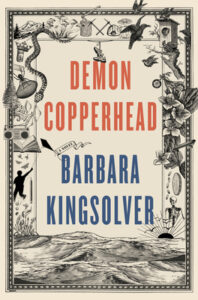
Alternate cover edition of ISBN 9780063251922.
"Anyone will tell you the born of this world are marked from the get-out, win or lose."
Set in the mountains of southern Appalachia, this is the story of a boy born to a teenaged single mother in a single-wide trailer, with no assets beyond his dead father's good looks and copper-colored hair, a caustic wit, and a fierce talent for survival. In a plot that never pauses for breath, relayed in his own unsparing voice, he braves the modern perils of foster care, child labor, derelict schools, athletic success, addiction, disastrous loves, and crushing losses. Through all of it, he reckons with his own invisibility in a popular culture where even the superheroes have abandoned rural people in favor of cities.
Many generations ago, Charles Dickens wrote David Copperfield from his experience as a survivor of institutional poverty and its damages to children in his society. Those problems have yet to be solved in ours. Dickens is not a prerequisite for readers of this novel, but he provided its inspiration. In transposing a Victorian epic novel to the contemporary American South, Barbara Kingsolver enlists Dickens' anger and compassion, and above all, his faith in the transformative powers of a good story. Demon Copperhead speaks for a new generation of lost boys, and all those born into beautiful, cursed places they can't imagine leaving behind.