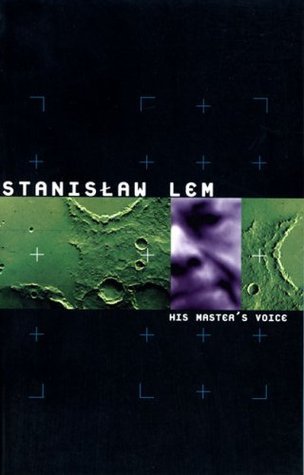
Twenty-five hundred scientists have been herded into an isolated site in the Nevada desert. A neutrino message of extraterrestrial origin has been received and the scientists, under the surveillance of the Pentagon, labor on His Master’s Voice, the secret program set up to decipher the transmission. Among them is Peter Hogarth, an eminent mathematician. When the project reaches a stalemate, Hogarth pursues clandestine research into the classified TX Effect–another secret breakthrough. But when he discovers, to his horror, that the TX Effect could lead to the construction of a fission bomb, Hogarth decides such knowledge must not be allowed to fall into the hands of the military.
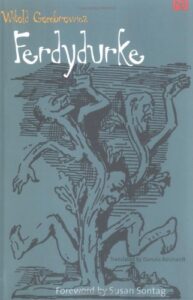
In this bitterly funny novel by the renowned Polish author Witold Gombrowicz. a writer finds himself tossed into a chaotic world of schoolboys by a diabolical professor who wishes to reduce him to childishness. Originally published in Poland in 1937. Ferdydurke became an instant literary sensation and catapulted the young author to fame. Deemed scandalous and subversive by Nazis. Stalinists. and the Polish Communist regime in turn. the novel (as well as all of Gombrowicz's other works) was officially banned in Poland for decades. It has nonetheless remained one of the most influential works of twentieth-century European literature.
Ferdydurke is translated here directly from the Polish for the first time. Danuta Borchardt deftly captures Gombrowicz's playful and idiosyncratic style. and she allows English speakers to experience fully the masterpiece of a writer whom Milan Kundera describes as "one of the great novelists of our century."
Witold Gombrowicz (1904-1969) wrote three other novels. Trans-Atlantyk. Pornografia. and Cosmos. which together with his plays and his three-volume Diary have been translated into more than thirty languages.
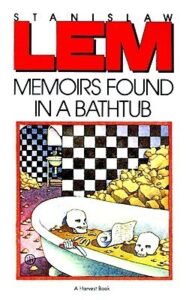
The year is 3149, and a vast paper destroying blight-papyralysis-has obliterated much of the planet's written history. However, these rare memoirs, preserved for centuries in a volcanic rock, record the strange life of a man trapped in a hermetically sealed underground community. Translated by Michael Kandel and Christine Rose.
Siamo nel lembo più estremo dell’universo esplorato dal genere umano. Un astronauta, dalla Terra, approda nella stazione spaziale che gira intorno al pianeta Solaris. Qui trova un’atmosfera di mistero e sospetto: nessuno lo accoglie, i pochi ospiti della astronave sembrano angosciati e sopraffatti, c’è un morto recente a cui si allude con circospezione ma senza sorpresa, gli oggetti subiscono strane deformazioni, si avvertono presenze. Solaris è noto agli umani come il grande pianeta «vivente». Appare in forma di vasto oceano e avrebbe dovuto conflagrare se la sua orbita avesse seguito le leggi della fisica. Ma è come dotato di capacità cosciente di reazione e questa capacità sembra legata alle apparizioni di fantasmi, proiezioni viventi di incubi, sogni e fantasie. L’astronauta è costretto a interrogarsi, mentre lo contagia la stessa angoscia che domina in tutto l’ambiente. Sul mistero della morte del compagno, innanzitutto. Ma questo lo spinge verso maggiori enigmi da svelare: se Solaris ha una propria vita, e che tipo alternativo di forma di vita; se le «apparizioni» hanno una qualche spiegazione accessibile; se tutta questa attività ha un fine, in qualche modo legato ai destini esistenziali degli umani. Se non è tutto addirittura un immane messaggio. Un’avventura avvincente e carica di attesa e mistero. Ma si potrebbe dire anche un’avventura epistemologica, nel senso che presenta alla lente della riflessione un numero enorme di quesiti che abitano i rami della filosofia. Fra essi, il più suggestivo sembra essere il tema dell’Identità, del Soggetto, dell’Io. Non esiste l’Io unico e identico a se stesso. Ognuno è un arcipelago di Io, e ciascuna delle isole di questo arcipelago si muove nei confronti dell’Io che le contiene, come un universo parallelo. Del resto, la mente, i suoi confini, le sue possibilità, i suoi legami con la potente macchina che la sorregge, il cervello, sono i temi attorno ai quali hanno sempre ruotato le storie di fantascienza di questo scrittore di Leopoli, cresciuto a Cracovia, esperto cibernetico, che è annoverato tra gli influenti capostipiti della moderna fiction di realtà virtuali.
The final novel of Hermann Hesse, The Glass Bead Game is a fascinating tale of the complexity of modern life as well as a classic of modern literature.
Set in the twenty-third century, The Glass Bead Game is the story of Joseph Knecht, who has been raised in Castalia, the remote place his society has provided for the intellectual elite to grow and flourish. Since childhood, Knecht has been consumed with mastering the Glass Bead Game, which requires a synthesis of aesthetics and philosophy, which he achieves in adulthood, becoming a Magister Ludi (Master of the Game).
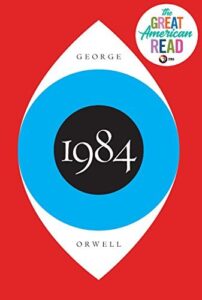
Among the seminal texts of the 20th century, Nineteen Eighty-Four is a rare work that grows more haunting as its futuristic purgatory becomes more real. Published in 1949, the book offers political satirist George Orwell's nightmarish vision of a totalitarian, bureaucratic world and one poor stiff's attempt to find individuality. The brilliance of the novel is Orwell's prescience of modern life—the ubiquity of television, the distortion of the language—and his ability to construct such a thorough version of hell. Required reading for students since it was published, it ranks among the most terrifying novels ever written.
This is the story of a man who said that he would stop the motor of the world and did. Was he a destroyer or the greatest of liberators?
Why did he have to fight his battle, not against his enemies, but against those who needed him most, and his hardest battle against the woman he loved? What is the world’s motor — and the motive power of every man? You will know the answer to these questions when you discover the reason behind the baffling events that play havoc with the lives of the characters in this story.
Tremendous in its scope, this novel presents an astounding panorama of human life — from the productive genius who becomes a worthless playboy — to the great steel industrialist who does not know that he is working for his own destruction — to the philosopher who becomes a pirate — to the composer who gives up his career on the night of his triumph — to the woman who runs a transcontinental railroad — to the lowest track worker in her Terminal tunnels.
You must be prepared, when you read this novel, to check every premise at the root of your convictions.
This is a mystery story, not about the murder — and rebirth — of man’s spirit. It is a philosophical revolution, told in the form of an action thriller of violent events, a ruthlessly brilliant plot structure and an irresistible suspense. Do you say this is impossible? Well, that is the first of your premises to check.
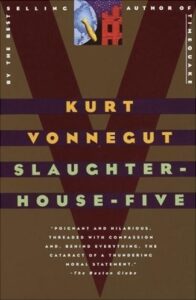
Slaughterhouse-Five, an American classic, is one of the world’s great antiwar books. Centering on the infamous World War II firebombing of Dresden, the novel is the result of what Kurt Vonnegut described as a twenty-three-year struggle to write a book about what he had witnessed as an American prisoner of war. It combines historical fiction, science fiction, autobiography, and satire in an account of the life of Billy Pilgrim, a barber’s son turned draftee turned optometrist turned alien abductee. As Vonnegut had, Billy experiences the destruction of Dresden as a POW. Unlike Vonnegut, he experiences time travel, or coming “unstuck in time.”
An instant bestseller, Slaughterhouse-Five made Kurt Vonnegut a cult hero in American literature, a reputation that only strengthened over time, despite his being banned and censored by some libraries and schools for content and language. But it was precisely those elements of Vonnegut’s writing—the political edginess, the genre-bending inventiveness, the frank violence, the transgressive wit—that have inspired generations of readers not just to look differently at the world around them but to find the confidence to say something about it.
Fifty years after its initial publication at the height of the Vietnam War, Vonnegut's portrayal of political disillusionment, PTSD, and postwar anxiety feels as relevant, darkly humorous, and profoundly affecting as ever, an enduring beacon through our own era’s uncertainties.
Welcome Back!
Track your reading progress and sync your library.