
Winner of the 1933 Femina Vie Heureuse Prize, COLD COMFORT FARM is a wickedly funny portrait of British rural life in the 1930s. Flora Poste, a recently orphaned socialite, moves in with her country relatives, the gloomy Starkadders of Cold Comfort Farm, and becomes enmeshed in a web of violent emotions, despair, and scheming, until Flora manages to set things right.
Take Gussie Fink-Nottle, Madeline Bassett, old Pop Bassett, the unscrupulous Stiffy Byng, the Rev., an 18th-century cow-creamer, a small brown leather covered notebook and mix with a dose of the aged aunt Dahlia and one has a dangerous brew which spells toil and trouble for Bertie and Jeeves.
When Bingo Little falls in love at a Camberwell subscription dance and Bertie Wooster drops into the mulligatawny, there is work for a wet-nurse. Who better than Jeeves?
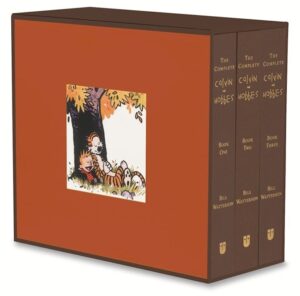
Calvin and Hobbes is unquestionably one of the most popular comic strips of all time. The imaginative world of a boy and his real-only-to-him tiger was first syndicated in 1985 and appeared in more than 2,400 newspapers when Bill Watterson retired on January 1, 1996. The entire body of Calvin and Hobbes cartoons published in a truly noteworthy tribute to this singular cartoon in The Complete Calvin and Hobbes. Composed of three hardcover, four-color volumes in a sturdy slipcase, this New York Times best-selling edition includes all Calvin and Hobbes cartoons that ever appeared in syndication. This is the treasure that all Calvin and Hobbes fans seek.
This a previously-published edition of ISBN 9780140621334
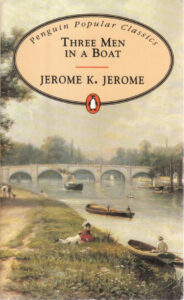
"We agree that we are overworked, and need a rest - A week on the rolling deep? - George suggests the river -"
And with the co-operation of several hampers of food and a covered boat, the three men (not forgetting the dog) set out on a hilarious voyage of mishaps up the Thames. When not falling in the river and getting lost in Hampton Court Maze, Jerome K. Jerome finds time to express his ideas on the world around - many of which have acquired a deeper fascination since the day at the end of the 19th century when this excursion was so lightly undertaken.
An alternative cover edition for this ISBN can be found here
Regarded by many as the finest, and funniest, comic novel of the twentieth century, Lucky Jim remains as trenchant, withering, and eloquently misanthropic as when it first scandalized readers back in 1954. This is the story of Jim Dixon, a hapless lecturer in medieval history at a provincial university who knows better than most that “there was no end to the ways in which nice things are nicer than nasty ones.” Kingsley Amis’s scabrous debut leads the reader through a gallery of emphatically English bores, cranks, frauds, and neurotics with whom Dixon must contend in one way or another in order to hold on to his cushy academic perch and win the girl of his fancy.
More than just a merciless satire of cloistered college life and stuffy postwar manners, Lucky Jim is an attack on the forces of boredom, whatever form they may take, and a work of art that at once distills and extends an entire tradition of English comic writing, from Fielding and Dickens through Wodehouse and Waugh. As Christopher Hitchens has written, “If you can picture Bertie or Jeeves being capable of actual malice, and simultaneously imagine Evelyn Waugh forgetting about original sin, you have the combination of innocence and experience that makes this short romp so imperishable.”
William Stoner is born at the end of the nineteenth century into a dirt-poor Missouri farming family. Sent to the state university to study agronomy, he instead falls in love with English literature and embraces a scholar’s life, so different from the hardscrabble existence he has known. And yet as the years pass, Stoner encounters a succession of disappointments: marriage into a “proper” family estranges him from his parents; his career is stymied; his wife and daughter turn coldly away from him; a transforming experience of new love ends under threat of scandal. Driven ever deeper within himself, Stoner rediscovers the stoic silence of his forebears and confronts an essential solitude.
John Williams’s luminous and deeply moving novel is a work of quiet perfection. William Stoner emerges from it not only as an archetypal American, but as an unlikely existential hero, standing, like a figure in a painting by Edward Hopper, in stark relief against an unforgiving world.
Seconds before the Earth is demolished to make way for a galactic freeway, Arthur Dent is plucked off the planet by his friend Ford Prefect, a researcher for the revised edition of The Hitchhiker's Guide to the Galaxy who, for the last fifteen years, has been posing as an out-of-work actor.
Together this dynamic pair begin a journey through space aided by quotes from The Hitchhiker's Guide ("A towel is about the most massively useful thing an interstellar hitchhiker can have") and a galaxy-full of fellow travelers: Zaphod Beeblebrox--the two-headed, three-armed ex-hippie and totally out-to-lunch president of the galaxy; Trillian, Zaphod's girlfriend (formally Tricia McMillan), whom Arthur tried to pick up at a cocktail party once upon a time zone; Marvin, a paranoid, brilliant, and chronically depressed robot; Veet Voojagig, a former graduate student who is obsessed with the disappearance of all the ballpoint pens he bought over the years.
Where are these pens? Why are we born? Why do we die? Why do we spend so much time between wearing digital watches? For all the answers stick your thumb to the stars. And don't forget to bring a towel!
Cannery Row is a book without much of a plot. Rather, it is an attempt to capture the feeling and people of a place, the cannery district of Monterey, California, which is populated by a mix of those down on their luck and those who choose for other reasons not to live "up the hill" in the more respectable area of town. The flow of the main plot is frequently interrupted by short vignettes that introduce us to various denizens of the Row, most of whom are not directly connected with the central story. These vignettes are often characterized by direct or indirect reference to extreme violence: suicides, corpses, and the cruelty of the natural world.
The "story" of Cannery Row follows the adventures of Mack and the boys, a group of unemployed yet resourceful men who inhabit a converted fish-meal shack on the edge of a vacant lot down on the Row.
Sweet Thursday is the sequel to Cannery Row.
Welcome Back!
Track your reading progress and sync your library.