Heart of a Dog
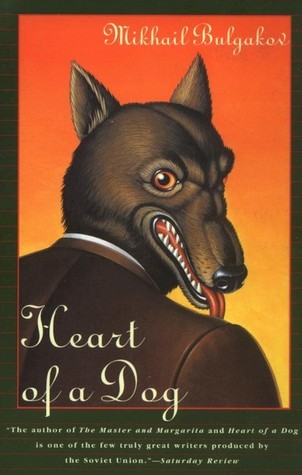
This satirical novel tells the story of the surgical transformation of a dog into a man, and is an obvious criticism of Soviet society, especially the new rich that arose after the Bolshevik revolution.
The novel follows Anton, an undercover operative from the future planet Earth, in his mission on an alien planet, that is populated by human beings, whose society has not advanced beyond the Middle Ages. The novel's core idea is that human progress throughout the centuries is often cruel and bloody, and that religion and blind faith can be an effective tool of oppression, working to destroy the emerging scientific disciplines and enlightenment.
-
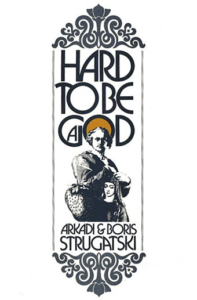
Don Rumata has been sent from Earth to the medieval kingdom of Arkanar with instructions to observe and to save what he can. Masquerading as an arrogant nobleman, a dueler, and a brawler, he is never defeated, but yet he can never kill. With his doubt and compassion, and his deep love for a local girl named Kira, Rumata wants to save the kingdom from the machinations of Don Reba, the first minister to the king. But given his orders, what role can he play? This long overdue translation will reintroduce one of the most profound Soviet-era novels to an eager audience.
Arkady and Boris Strugatsky are widely known as the greatest Russian writers of science fiction, and their 1964 novel Hard to Be a God is considered one of the greatest of their works. Yet until now the only English version (unavailable for over thirty years) was based on a German translation, and was full of errors, infelicities, and misunderstandings. Now, in a new translation by Olena Bormashenko, whose translation of the authors’ Roadside Picnic has received widespread acclaim, here is the definitive edition of this brilliant work.
Red Schuhart is a stalker, one of those young rebels who are compelled, in spite of extreme danger, to venture illegally into the Zone to collect the mysterious artifacts that the alien visitors left scattered around. His life is dominated by the place and the thriving black market in the alien products. But when he and his friend Kirill go into the Zone together to pick up a “full empty,” something goes wrong. And the news he gets from his girlfriend upon his return makes it inevitable that he’ll keep going back to the Zone, again and again, until he finds the answer to all his problems.
First published in 1972, Roadside Picnic is still widely regarded as one of the greatest science fiction novels, despite the fact that it has been out of print in the United States for almost thirty years.
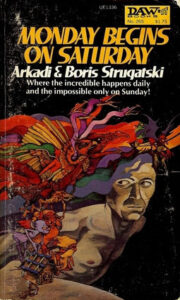
When young programmer Aleksandr Ivanovich Privalov picks up two hitchhikers while driving in Karelia, he is drawn into the mysterious world of the Scientific Research Institute of Sorcery and Wizardry, where research into magic is serious business. Where science, sorcery and socialism meet, can chaos be far behind?
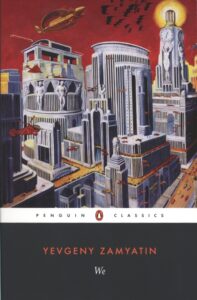
The exhilarating dystopian novel that inspired George Orwell's 1984 and foreshadowed the worst excesses of Soviet Russia
Yevgeny Zamyatin's We is a powerfully inventive vision that has influenced writers from George Orwell to Ayn Rand. In a glass-enclosed city of absolute straight lines, ruled over by the all-powerful 'Benefactor', the citizens of the totalitarian society of OneState live out lives devoid of passion and creativity - until D-503, a mathematician who dreams in numbers, makes a discovery: he has an individual soul. Set in the twenty-sixth century AD, We is the classic dystopian novel and was the forerunner of works such as George Orwell's 1984 and Aldous Huxley's Brave New World. It was suppressed for many years in Russia and remains a resounding cry for individual freedom, yet is also a powerful, exciting and vivid work of science fiction. Clarence Brown's brilliant translation is based on the corrected text of the novel, first published in Russia in 1988 after more than sixty years' suppression.
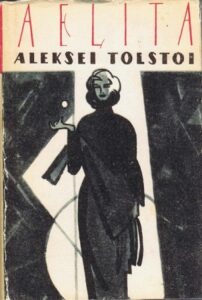
Tolstoi published two science fiction novels, both of which appeared in the experimental 1920s and which were revised during the following decades of Stalinist terror. Aelita (1923) is a science-fiction fantasy in the manner of H.G. Wells, telling the story of a Soviet expedition to Mars with the aim of establishing communism. A Red Army officer forments a rebellion of the native Martians, who are in fact long-ago emigrants from Atlantis. The story was adapted into a screen play in 1924. Its futuristic, expressionistic sets were designed by Isaac Rabinovitch of the Kamerny Theatre. The film influenced the design in Flash Gordon, a space opera, which was created by the artist Alex Raymond in 1934 and led to a popular radio serial and several films. Giperboloid inzhenera Garina (1926, The Death Box) described an attempt of an unscrupulous inventor to use his death ray to conquer the world. He manages to rule a decadently capitalist USA for a short period.
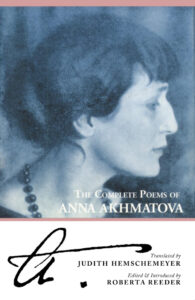
Initially published in 1990, when the New York Times Book Review named it one of fourteen "Best Books of the Year," Judith Hemschemeyer's translation of The Complete Poems of Anna Akhmatova is the definitive edition, and has sold over 13,000 copies, making it one of the most successful poetry titles of recent years.
This reissued and revised printing features a new biographical essay as well as expanded notes to the poems, both by Roberta Reeder, project editor and author of Anna Akhmatova: Poet and Prophet (St. Martin's Press, 1994). Encyclopedic in scope, with more than 800 poems, 100 photographs, a historical chronology, index of first lines, and a bibliography. The Complete Poems will be the definitive English language collection of Akhmatova for many years to come.
Bazarov—a gifted, impatient, and caustic young man—has journeyed from school to the home of his friend Arkady Kirsanov. But soon Bazarov’s outspoken rejection of authority and social conventions touches off quarrels, misunderstandings, and romantic entanglements that will utterly transform the Kirsanov household and reflect the changes taking place across all of nineteenth-century Russia.
Fathers and Sons enraged the old and the young, reactionaries, romantics, and radicals alike when it was first published. At the same time, Turgenev won the acclaim of Flaubert, Maupassant, and Henry James for his craftsmanship as a writer and his psychological insight. Fathers and Sons is now considered one of the greatest novels of the nineteenth century.
A timeless depiction of generational conflict during social upheaval, it vividly portrays the clash between the older Russian aristocracy and the youthful radicalism that foreshadowed the revolution to come—and offers modern-day readers much to reflect upon as they look around at their own tumultuous, ever changing world.
Introduction by Jane Costlow
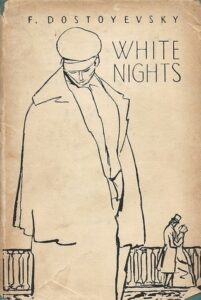
White Nights is a short story by Fyodor Dostoevsky that was published in 1848. Set in St. Petersburg, it is the story of a young man fighting his inner restlessness. A light and tender narrative, it delves into the torment and guilt of unrequited love. Both protagonists suffer from a deep sense of alienation that initially brings them together. A blend of romanticism and realism, the story appeals gently to the senses and feelings.