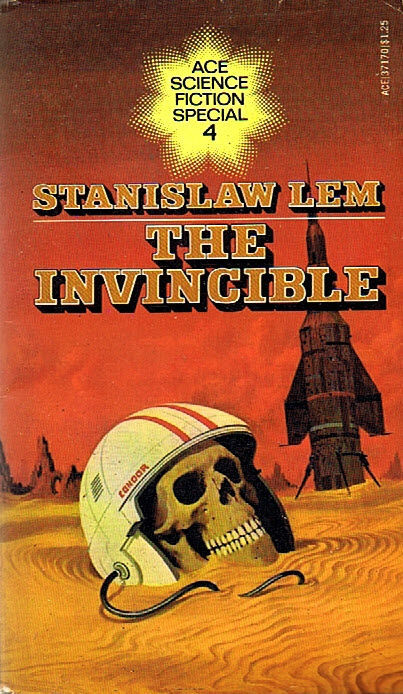
La trama inicia con el arribo de una poderosa nave de guerra, El Invencible, al planeta recientemente descubierto Regis III. La tripulación del Invencible tiene como misión investigar la desaparición de la nave, Cóndor, gemela del Invencible.
Pierwszy tom trylogii Jacka Dukaja. To książka, którą po odwróceniu ostatniej kartki ma się ochotę natychmiast przeczytać jeszcze raz. A potem jeszcze raz. Jest XXIX wiek. Adam Zamoyski, tajemniczy zmartwychwstaniec, tkwi w środku rozgrywki między cywilizacjami, ludźmi, nieludźmi i istotami postludzkimi. Konkurencja stanowi motor ewolucji – konkurują ze sobą rośliny, zwierzęta, ludzie, kultury, gospodarki. Zwycięża, kto lepiej wykorzystuje naturalne środowisko, zasoby planety, ostatecznie – prawa fizyki. Zamoyski nie wie, jakim cudem znalazł się w świecie późniejszym od jego czasów o kilkaset lat, ma problemy z pamięcią i tożsamością – lecz najwyraźniej stanowi klucz do zwycięstwa w owej ewolucji. Kim tak naprawdę jest? Kim są ci, którzy go otaczają? Jaką tajemnicę kryje Narwa, gdzie rozbił się statek Adama? Dukaj jak demiurg powołuje światy do istnienia, nadając im przy tym cywilizacyjną pełnię. Wymyśla edukację, stosunki rodzinne, modę, a nawet język. Przede wszystkim jednak pokazuje skutki genetycznego udoskonalania człowieka – nową hierarchię społeczną i nowe kłopoty z płcią. Z tych względów książkę czyta się świetnie – im dalej, tym lepiej. Kto wie, może będzie to powieść kultowa?
The planet Quinta is pocked by ugly mounds and covered by a spiderweb-like network. It is a kingdom of phantoms and of a beauty afflicted by madness. In stark contrast, the crew of the spaceship Hermes represents a knowledge-seeking Earth. As they approach Quinta, a dark poetry takes over and leads them into a nightmare of misunderstanding. Translated by Michael Kandel.
The novel was published in German translation (translated by H. Schumann) in 1986. The Polish text published in 1987, the English translation (by M. Kandel) the same year.
SETI - Search for Extraterrestrial Intelligence, diese Fahndung nach der Nadel im Heuhaufen, hat diesmal Erfolg: ein Planet im Sternbild Harpyie, die Quinta im dortigen Zetasystem, sendet Signale, und nach jahrhundertelanger Vorbereitung startet die irdische "Hermes" mit einer auserwählten Crew von Spezialisten, unter ihnen der zweite Pilot Marek Tempe, der später die Landung und den ersten Erkundungsgang vornehmen wird. Die Verwirklichung des Projekts bildet den Inhalt dieses Romans.
Als ein Gegenstück zu seinem Jugendroman "Gast im Weltraum", den er in den Jahren 1954/1955 schrieb und der erstmals 1956 bei Volk und Welt in Deutsch erschien (https://www.goodreads.com/book/show/5...), möchte Stanisław Lem seinen neuesten Roman betrachtet wissen, den er im Februar 1985 abschloss.
Keine Negierung von "Gast im Weltraum" soll "Das Fiasko" sein, sondern eher eine Revision eigener, allzu naiver fortschrittsfreudiger Illusionen, die den jungen Lem einst beflügelten und denen er nun den komplizierten, naturwissenschaftlichen, technischen und moralischen Zwängen unterliegenden Prozeß gegenüberstellt, den die Menschen bei ihrem Drang auf der Suche nach außerirdischen Zivilisationen durchlaufen.
Siamo nel lembo più estremo dell’universo esplorato dal genere umano. Un astronauta, dalla Terra, approda nella stazione spaziale che gira intorno al pianeta Solaris. Qui trova un’atmosfera di mistero e sospetto: nessuno lo accoglie, i pochi ospiti della astronave sembrano angosciati e sopraffatti, c’è un morto recente a cui si allude con circospezione ma senza sorpresa, gli oggetti subiscono strane deformazioni, si avvertono presenze. Solaris è noto agli umani come il grande pianeta «vivente». Appare in forma di vasto oceano e avrebbe dovuto conflagrare se la sua orbita avesse seguito le leggi della fisica. Ma è come dotato di capacità cosciente di reazione e questa capacità sembra legata alle apparizioni di fantasmi, proiezioni viventi di incubi, sogni e fantasie. L’astronauta è costretto a interrogarsi, mentre lo contagia la stessa angoscia che domina in tutto l’ambiente. Sul mistero della morte del compagno, innanzitutto. Ma questo lo spinge verso maggiori enigmi da svelare: se Solaris ha una propria vita, e che tipo alternativo di forma di vita; se le «apparizioni» hanno una qualche spiegazione accessibile; se tutta questa attività ha un fine, in qualche modo legato ai destini esistenziali degli umani. Se non è tutto addirittura un immane messaggio. Un’avventura avvincente e carica di attesa e mistero. Ma si potrebbe dire anche un’avventura epistemologica, nel senso che presenta alla lente della riflessione un numero enorme di quesiti che abitano i rami della filosofia. Fra essi, il più suggestivo sembra essere il tema dell’Identità, del Soggetto, dell’Io. Non esiste l’Io unico e identico a se stesso. Ognuno è un arcipelago di Io, e ciascuna delle isole di questo arcipelago si muove nei confronti dell’Io che le contiene, come un universo parallelo. Del resto, la mente, i suoi confini, le sue possibilità, i suoi legami con la potente macchina che la sorregge, il cervello, sono i temi attorno ai quali hanno sempre ruotato le storie di fantascienza di questo scrittore di Leopoli, cresciuto a Cracovia, esperto cibernetico, che è annoverato tra gli influenti capostipiti della moderna fiction di realtà virtuali.
Ijon Tichy travels undercover to a robot world, joining an organization to clean up world history thru time travel.
Things go crazy immediately. His spaceship runs into gravitational vortices at relativistic speeds, resulting in massive time anomalies. It may be a blessing in disguise. The reason he couldn’t get out of the way was that a meteor had shattered the drive regulator & rudder. He could no longer steer his ship. He had a spare rudder, but couldn’t install it. It was a two-man job & he was alone. So when other versions of him start appearing, all he should need do is team up with one of them, fix the rudder & leave the gravitational vortex field.
After that gets straightened out, he goes undercover. A ship’s computer has mutineed & started its own colony, reproducing itself on a previously uninhabited planet. The insurance company paid the shipowner’s claim, & now believes that the ship, it’s computer & all its progeny belong to them. Tichy disguises himself as a robot & goes to investigate.
On another voyage, he heads to a planet where the government irrigation agency has irrigated beyond all need & refused to give up power. People live in water & are jailed in dry cells if they violate the love of water.
After his modern voyages, he comes back from 2166 to recruit himself as a member of THEOHIPPIP, the Teleotelechronistic-Historical Engineering to Optimize the Hyperputerized Implementation of Paleological Programming & Interplanetary Planning. History is in a mess because of all the time travelers. THEOHIPPIP's mission is: “For World History to be regulated, cleaned up, straightened out, adjusted & perfected, all in accordance with the principles of humanitarianism, rationalism & general esthetics. You can understand, surely, that with such a shambles & slaughterhouse in one’s family tree it’s awkward to go calling on important cosmic civilizations!...If need be, alterations will be made even before the rise of man, so that he arises better.”
Severian is in possession of a gem considered to be "The Claw of the Conciliator", a powerful relic of the Master of Power, a legendary figure of mythic proportions. Armed with his sword, Terminus Est, and the Claw, Severian continues his journey to Thrax, the city of his exile. Bizarre apes, strange cannibalistic rituals, and the foreigner named Jonas all lie in his future.
The Earth colony of Landin has been stranded on Werel for ten years. But ten of Werel's years are over 600 terrestrial years.
The lonely and dwindling human settlement is beginning to feel the strain. Every winter—a season that lasts for 15 years—the Earthmen have neighbors: the humanoid hilfs, a nomadic people who only settle down for the cruel cold spell. The hilfs fear the Earthmen, whom they think of as witches and call the farborns.
But hilfs and farborns have common enemies: the hordes of ravaging barbarians called gaals and eerie preying snow ghouls. Will they join forces or be annihilated?
Welcome Back!
Track your reading progress and sync your library.