
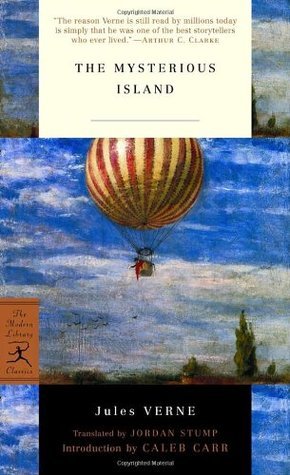
Based on the true story of Alexander Selkirk, who survived alone for almost five years on an uninhabited island off the coast of Chile, The Mysterious Island is considered by many to be Jules Verne’s masterpiece. “Wide-eyed mid-nineteenth-century humanistic optimism in a breezy, blissfully readable translation by Stump” (Kirkus Reviews), here is the enthralling tale of five men and a dog who land in a balloon on a faraway, fantastic island of bewildering goings-on and their struggle to survive as they uncover the island’s secret.
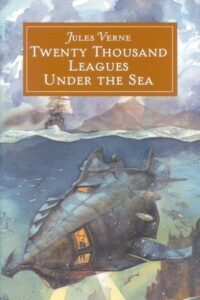
When an unidentified “monster” threatens international shipping, French oceanographer Pierre Aronnax and his unflappable assistant Conseil join an expedition organized by the US Navy to hunt down and destroy the menace. After months of fruitless searching, they finally grapple with their quarry, but Aronnax, Conseil, and the brash Canadian harpooner Ned Land are thrown overboard in the attack, only to find that the “monster” is actually a futuristic submarine, the Nautilus, commanded by a shadowy, mystical, preternaturally imposing man who calls himself Captain Nemo. Thus begins a journey of 20,000 leagues—nearly 50,000 miles—that will take Captain Nemo, his crew, and these three adventurers on a journey of discovery through undersea forests, coral graveyards, miles-deep trenches, and even the sunken ruins of Atlantis. Jules Verne’s novel of undersea exploration has been captivating readers ever since its first publication in 1870, and Frederick Paul Walter’s reader-friendly, scientifically meticulous translation of this visionary science fiction classic is complete and unabridged down to the smallest substantive detail.
An adventurous geology professor chances upon a manuscript in which a 16th-century explorer claims to have found a route to the earth's core. Professor Lidenbrock can't resist the opportunity to investigate, and with his nephew Axel, he sets off across Iceland in the company of Hans Bjelke, a native guide.
The expedition descends into an extinct volcano toward a sunless sea, where they encounter a subterranean world of luminous rocks, antediluvian forests, and fantastic marine life — a living past that holds the secrets to the origins of human existence.
"I am confiding this manuscript to space, not with the intention of saving myself, but to help, perhaps, to avert the appalling scourge that is menacing the human race. Lord have pity on us!"
With these words, Pierre Boulle hurtles the reader onto the Planet of the Apes. In this simian world, civilization is turned upside down: apes are men and men are apes; apes rule and men run wild; apes think, speak, produce, wear clothes, and men are speechless, naked, exhibited at fairs, used for biological research. On the planet of the apes, man, having reached to apotheosis of his genius, has become inert. To this planet come a journalist and a scientist. The scientist is put into a zoo, the journalist into a laboratory. Only the journalist retains the spiritual strength and creative intelligence to try to save himself, to fight the appalling scourge, to remain a man. Out of this situation, Pierre Boulle has woven a tale as harrowing, bizarre, and meaningful as any in the brilliant roster of this master storyteller. With his customary wit, irony, and disciplined intellect and style, the author of The Bridge Over the River Kwai tells a swiftly moving story dealing with man's conflicts, and takes the reader into a suspenseful and strangely fascinating orbit.
An alternative cover edition for this ISBN can be found here
Thrown in prison for a crime he has not committed, Edmond Dantes is confined to the grim fortress of If. There he learns of a great hoard of treasure hidden on the Isle of Monte Cristo and becomes determined not only to escape but to unearth the treasure and use it to plot the destruction of the three men responsible for his incarceration. A huge popular success when it was first serialized in the 1840s, Dumas was inspired by a real-life case of wrongful imprisonment when writing his epic tale of suffering and retribution.
Marcel Proust’s In Search of Lost Time is one of the most entertaining reading experiences in any language and arguably the finest novel of the twentieth century. But since its original prewar translation there has been no completely new version in English. Now, Penguin Classics brings Proust’s masterpiece to new audiences throughout the world, beginning with Lydia Davis’s internationally acclaimed translation of the first volume, Swann’s Way.
This is a reproduction of the original artefact. Generally these books are created from careful scans of the original. This allows us to preserve the book accurately and present it in the way the author intended. Since the original versions are generally quite old, there may occasionally be certain imperfections within these reproductions. We're happy to make these classics available again for future generations to enjoy!
Une aventure de Louis Denizart Hippolyte Griffont, mage du Cercle Cyan, sur rendez-vous uniquement. Un roman de Fantasy dans un Paris 1900 qui cohabite avec l’Outre-monde : entre brigades du tigre et licornes, entre mages et Belle Epoque, les débuts d’un couple d’enquêteurs tenant à la fois d’Arsène Lupin de Mata-Hari et de Gandalf le Gris. Une Fantasy “ steampunk ” qui renouvelle formidablement le genre...